
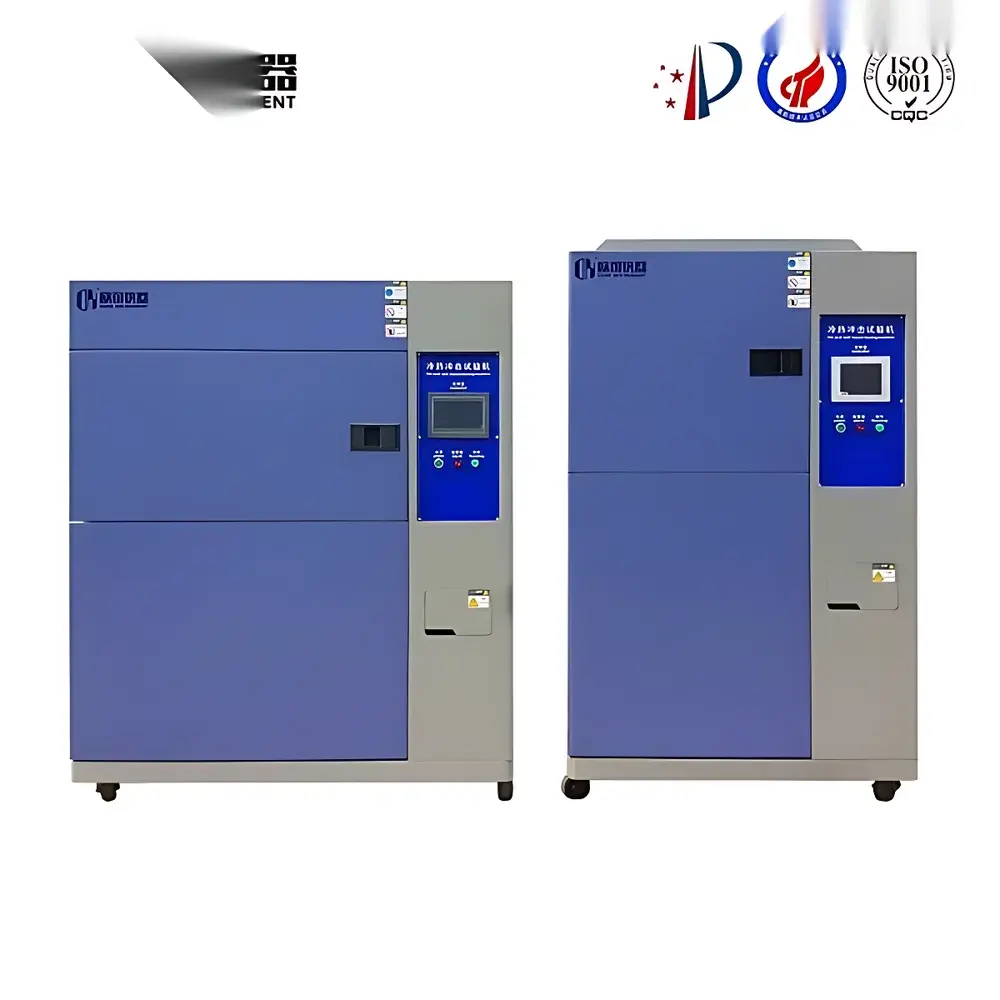
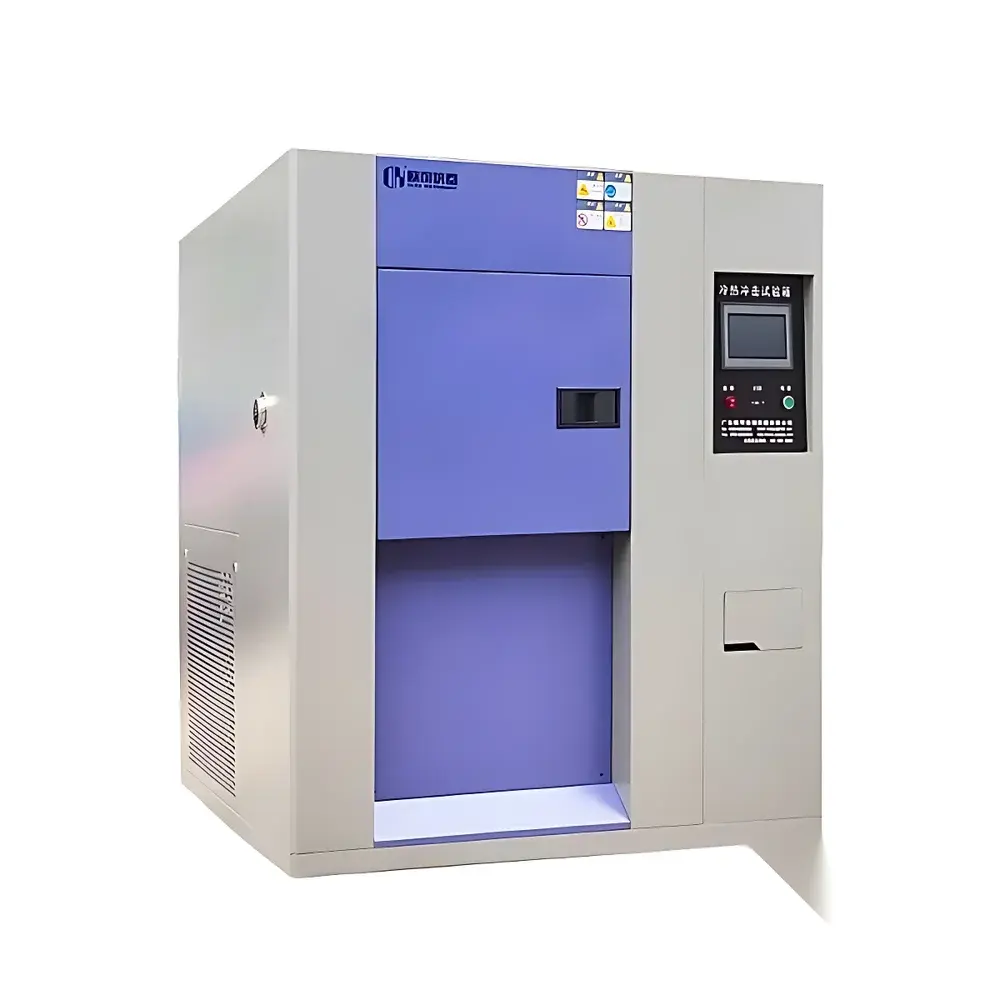
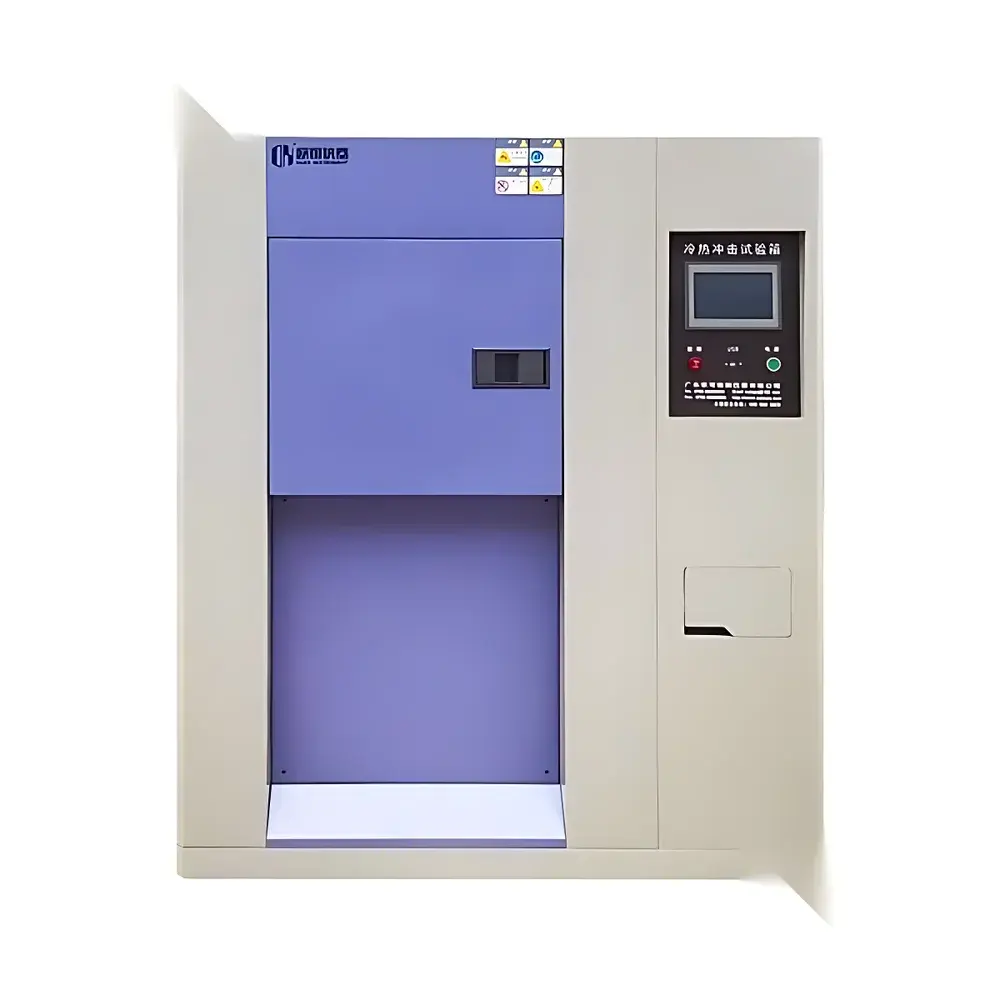
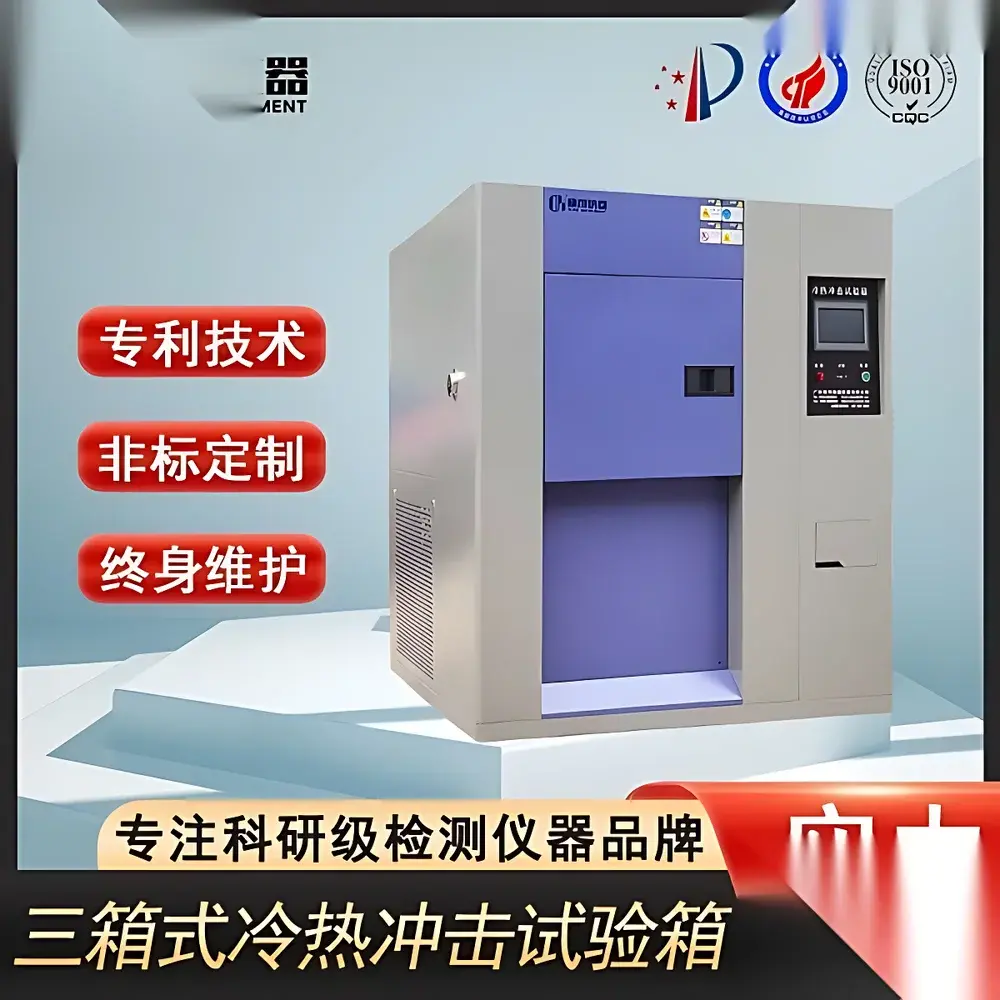
Two-Basket Thermal Shock Test Chamber
| [Brand | Other Brands |
|---|---|
| Origin | Imported |
| Manufacturer Type | General Distributor |
| Price | USD 11,200 (approx. based on ¥80,000 at 1 USD = ¥7.15) |
| Compliance | GB/T 2423.1–2001, GB/T 2423.2–2001, GB/T 2423.22–2002, GJB 150.5–86, IEC 60068-2-14, QC/T 17–92, EIA-364-32 |
| Cooling System | Dual-stage cascade refrigeration with imported German semi-hermetic compressors |
| Cooling Requirement | External 10 m³/h water-cooled cooling tower] |
Overview
The Two-Basket Thermal Shock Test Chamber is an engineered environmental stress screening (ESS) system designed to evaluate material and component resilience under rapid, extreme temperature transitions. Operating on the two-basket (hot/cold chamber separation) principle, it subjects test specimens to abrupt thermal cycling between independently controlled high-temperature and low-temperature zones—typically ranging from –65 °C to +150 °C—with transfer times ≤ 10 seconds. This architecture eliminates thermal inertia associated with single-chamber designs, enabling true step-change thermal shock profiles required for qualification testing in aerospace, automotive electronics, semiconductor packaging, and defense applications. The chamber adheres to fundamental thermodynamic principles of transient heat transfer and thermal expansion mismatch analysis, providing repeatable, traceable data for failure mode identification—including solder joint fatigue, delamination, seal integrity loss, and coefficient-of-thermal-expansion (CTE) induced microcracking.
Key Features
- Dual independent temperature zones: High-temperature chamber (up to +150 °C) and low-temperature chamber (down to –65 °C), each equipped with PID-controlled heating and refrigeration systems
- High-speed horizontal basket transfer mechanism with pneumatic actuation and position feedback sensors, achieving ≤ 10 s transfer time between zones
- Imported German semi-hermetic compressors integrated into a dual-stage cascade refrigeration system, ensuring stable sub-zero operation and rapid cooldown capability
- Water-cooled condensing unit requiring external 10 m³/h cooling tower (user-supplied); optimized for continuous-duty industrial environments
- Energy modulation control logic dynamically adjusts refrigerant flow and compressor loading to maintain setpoint accuracy while minimizing power consumption and mechanical wear
- Stainless steel 304 interior construction with insulated double-wall panels and argon-filled vacuum-gap doors for thermal isolation and condensation suppression
- Real-time monitoring of chamber air temperature uniformity (±1.5 °C) and stability (±0.5 °C) per IEC 60068-3-5
Sample Compatibility & Compliance
This thermal shock chamber accommodates samples up to 500 mm × 500 mm × 500 mm (W×D×H) and supports standardized mounting fixtures for PCBs, connectors, MEMS devices, battery modules, and molded plastic housings. It is validated for compliance with internationally recognized environmental test standards including: GB/T 2423.1–2001 (cold), GB/T 2423.2–2001 (dry heat), GB/T 2423.22–2002 (temperature change), GJB 150.5–86 (military temperature shock), IEC 60068-2-14 (Test N: Change of temperature), and EIA-364-32 (thermal shock for electrical connectors). All test cycles are programmable with dwell time, transition rate, and cycle count parameters traceable to calibration records. The system meets structural and safety requirements per IEC 61000-4-2 (ESD immunity) and UL 61010-1 for laboratory equipment.
Software & Data Management
Equipped with a Windows-based controller interface supporting up to 99 programmable test profiles, each with up to 99 segments (including ramp, dwell, and loop functions). Real-time data logging records chamber temperatures, basket position status, compressor discharge pressure, and alarm events at user-selectable intervals (1–60 s). Export formats include CSV and PDF reports compliant with GLP documentation requirements. Audit trail functionality logs all parameter modifications, operator logins, and calibration actions—supporting FDA 21 CFR Part 11 readiness when deployed in regulated quality systems. Optional Ethernet/IP or Modbus TCP integration enables centralized fleet monitoring via SCADA or MES platforms.
Applications
- Qualification testing of avionics components per DO-160 Section 4 (Temperature Variation)
- Reliability screening of automotive ECUs, ADAS sensors, and powertrain control modules against ISO 16750-4
- Failure analysis of lead-free solder interconnects using JEDEC JESD22-A106B thermal shock protocols
- Material compatibility validation for conformal coatings, potting compounds, and encapsulants
- Accelerated life testing of lithium-ion battery cells under thermal stress conditions
- Process validation for reflow soldering and die-attach manufacturing lines
- Research-grade thermal fatigue studies in university materials science laboratories
FAQ
What is the typical transfer time between hot and cold chambers?
Standard configuration achieves ≤ 10 seconds; optional high-speed transfer kits reduce this to ≤ 5 seconds.
Does the system include built-in data logging and report generation?
Yes—continuous logging with timestamped CSV export and configurable PDF summary reports.
Is external cooling infrastructure mandatory?
Yes; a dedicated 10 m³/h water-cooled tower must be provided by the user for stable long-term operation.
Can the chamber be integrated into an automated test cell?
Yes—RS-485, Ethernet/IP, and dry-contact I/O interfaces support PLC synchronization and robotic sample handling.
What calibration and maintenance support is available?
NIST-traceable temperature sensor calibration certificates are provided annually; preventive maintenance kits and OEM-certified service contracts are available globally.



