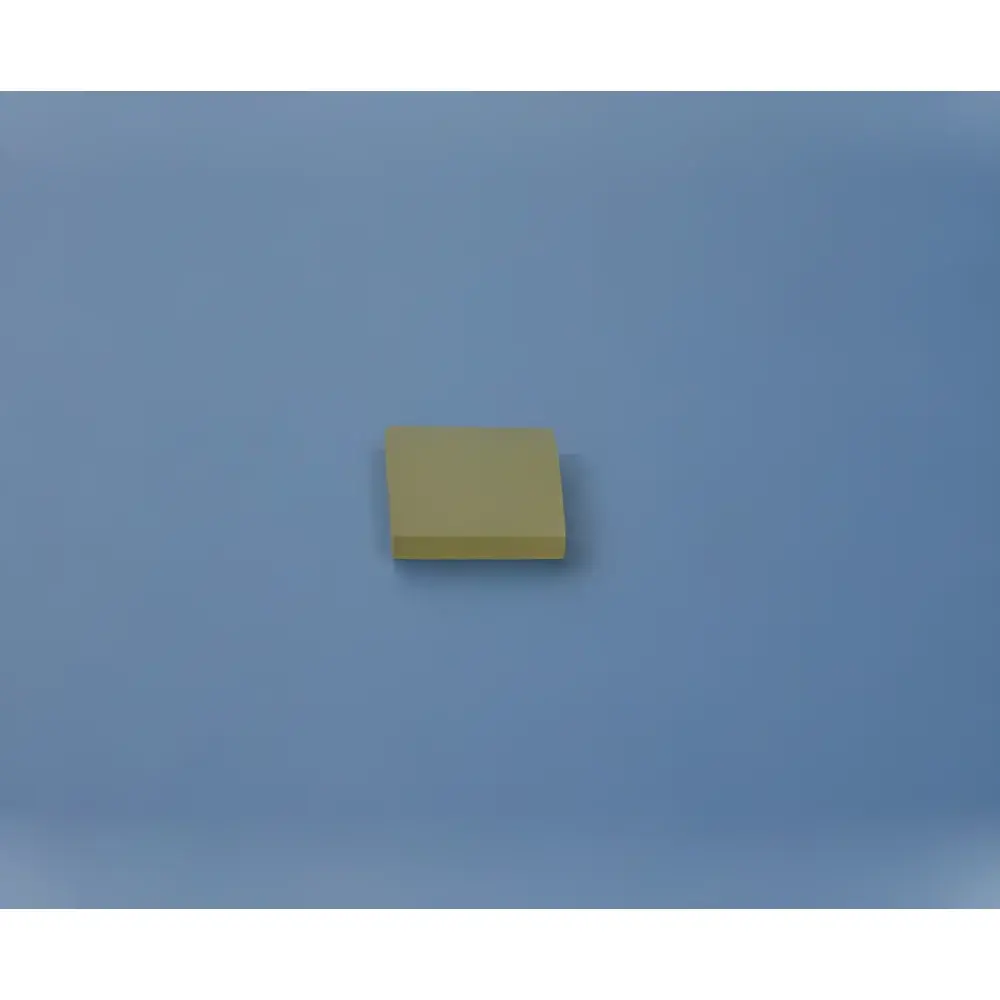
BaTiO3 Single Crystal Substrate
| Brand | Hefei Kejing |
|---|---|
| Origin | Anhui, China |
| Manufacturer Type | Authorized Distributor |
| Origin Category | Domestic |
| Model | BaTiO3 Single Crystal Substrate |
| Pricing | Available Upon Request |
| Crystal Structure | Tetragonal (4mm) |
| Phase Transition Temperatures | 9 °C < T < 130.5 °C |
| Lattice Parameters | a = 3.99 Å, c = 4.04 Å |
| Growth Method | Top-Seeded Solution Growth (TSSG) |
| Melting Point | 1600 °C |
| Density | 6.02 g/cm³ |
| Dielectric Constants (Free) | εₐ = 3700, ε꜀ = 135 |
| Dielectric Constants (Clamped) | εₐ = 2400, ε꜀ = 60 |
| Refractive Indices (no/ne) | 515 nm → no=2.4921, ne=2.4247 |
| Transmission Range | 0.45–6.30 µm |
| Electro-Optic Coefficients | r₁₃ = 11.7 ± 1.9 pm/V, r₃₃ = 112 ± 10 pm/V, r₄₂ = 1920 ± 180 pm/V |
| SPPC Reflectivity (0° cut) | 515 nm → 50–70% (up to 77%), 633 nm → 50–80% (up to 86.8%) |
| Two-Wave Mixing Coupling Coefficient | 10–40 cm⁻¹ |
| Absorption Loss | 515 nm → 3.392 cm⁻¹, 633 nm → 0.268 cm⁻¹, 800 nm → 0.005 cm⁻¹ |
| Standard Orientations | ⟨100⟩, ⟨001⟩ |
| Orientation Tolerance | ±0.5° |
| Typical Dimensions | 10 × 10 × 0.5 mm, 10 × 5 × 0.5 mm |
| Surface Finish | Single- or Double-Polished, Ra < 0.5 nm |
| Packaging | Class 1000 Cleanroom Assembled, Class 100 Clean Bag Sealed |
Overview
BaTiO3 (Barium Titanate) single crystal substrates are high-purity, orientation-controlled ferroelectric materials engineered for advanced research and device fabrication in condensed matter physics, nonlinear optics, piezoelectrics, and electro-optics. As the prototypical perovskite ferroelectric, BaTiO3 exhibits a well-defined tetragonal phase (space group P4mm) between 9 °C and 130.5 °C, with lattice parameters a = 3.99 Å and c = 4.04 Å—enabling precise structural correlation with functional property measurements. Grown via the top-seeded solution growth (TSSG) method, these crystals achieve low defect density, high optical homogeneity, and excellent domain engineering capability—critical for reproducible polarization switching, strain-mediated coupling, and photorefractive response. Their intrinsic lead-free composition aligns with RoHS and REACH regulatory frameworks, supporting sustainable development of next-generation actuators, modulators, and tunable photonic components.
Key Features
- High structural fidelity: Tetragonal symmetry confirmed by XRD rocking curve FWHM < 0.05°, ensuring consistent domain nucleation and switching behavior
- Precision orientation control: Standard ⟨100⟩ and ⟨001⟩ cuts available with angular tolerance ≤ ±0.5°, verified by Laue diffraction and X-ray pole figure mapping
- Ultra-smooth surface finish: Single- or double-polished options with surface roughness < 0.5 nm (Ra), suitable for epitaxial thin-film deposition (e.g., PZT, STO, LSMO) and high-resolution scanning probe characterization
- Controlled clamping state dielectric response: εa = 2400 and εc = 60 under mechanical constraint—essential for accurate modeling of interfacial capacitance in heterostructure devices
- Low optical absorption: α = 0.005 cm−1 at 800 nm enables high-efficiency waveguide and resonator integration in near-infrared photonics
- Validated electro-optic performance: r42 = 1920 ± 180 pm/V supports large-phase-shift modulation in bulk and guided-wave configurations
Sample Compatibility & Compliance
BaTiO3 substrates are compatible with standard semiconductor processing tools—including sputtering, PLD, MBE, and ALD—and withstand thermal cycling up to 600 °C in oxidizing atmospheres. All wafers undergo post-polish inspection per SEMI F20-0201 standards for particle count (< 10 particles ≥ 0.3 µm/cm²) and surface defect density. Packaging adheres to ISO Class 5 (Class 100) cleanroom protocols using static-dissipative, low-outgassing polyethylene bags sealed under nitrogen. Material traceability includes batch-specific certificates of analysis (CoA) reporting lattice parameter deviation, orientation accuracy, and surface roughness metrics. The substrate meets ASTM E1970-22 requirements for ferroelectric reference materials and is routinely employed in GLP-compliant studies of domain dynamics under applied electric fields.
Software & Data Management
While BaTiO3 substrates are passive components, their integration into automated measurement systems benefits from standardized metadata tagging. Each lot is assigned a unique identifier linked to a secure cloud-accessible database containing full XRD patterns, AFM topography maps, spectroscopic ellipsometry data (n/k dispersion across 0.45–6.30 µm), and temperature-dependent dielectric spectroscopy results (10 Hz–1 MHz). This dataset supports traceable calibration of commercial ferroelectric testers (e.g., Radiant Precision Premier II, Keysight B1500A) and enables cross-laboratory validation per IEEE Std 1789-2021 guidelines for piezoelectric coefficient determination. Raw data files are delivered in HDF5 format compliant with FAIR principles (Findable, Accessible, Interoperable, Reusable).
Applications
- Ferroelectric domain engineering for nonvolatile memory and neuromorphic computing elements
- Substrates for epitaxial growth of complex oxide heterostructures (e.g., LaAlO3/SrTiO3, BiFeO3/La0.7Sr0.3MnO3)
- Active elements in electro-optic modulators, Q-switches, and terahertz generation platforms
- High-strain actuators in precision positioning systems (strain > 0.1% under 10 kV/cm)
- Photorefractive media for dynamic holography and real-time interferometry
- Reference standards for calibrating piezoresponse force microscopy (PFM) amplitude and phase sensitivity
FAQ
What is the typical surface preparation protocol prior to thin-film deposition?
Standard procedure includes sequential ultrasonic cleaning in acetone, isopropanol, and deionized water (10 min each), followed by oxygen plasma treatment (100 W, 30 s) to remove organic residues and hydroxylate the surface. A final anneal at 800 °C for 30 min in O2 restores stoichiometry and eliminates subsurface vacancies.
Can custom orientations (e.g., ⟨110⟩ or off-axis cuts) be supplied?
Yes—custom crystallographic orientations are available with lead times of 8–12 weeks. Minimum order quantity applies; orientation verification is performed via triple-axis XRD and reported in the CoA.
Is thermal expansion matching data available for common thin-film materials?
Thermal expansion coefficients (CTE) for BaTiO3 (α ≈ 10.2 × 10⁻⁶ K−1 between 25–200 °C) are provided alongside comparative CTE tables for STO, DSO, YSZ, and SiO2 to support stress modeling in multilayer stacks.
Do you provide mounting fixtures or bonding recommendations for high-field testing?
We supply compatible gold-plated copper sample holders with integrated thermocouple ports and recommend indium-based soldering or conductive silver epoxy (e.g., EPO-TEK H20E) for low-resistance, low-stress electrical contact under DC bias up to ±15 kV.