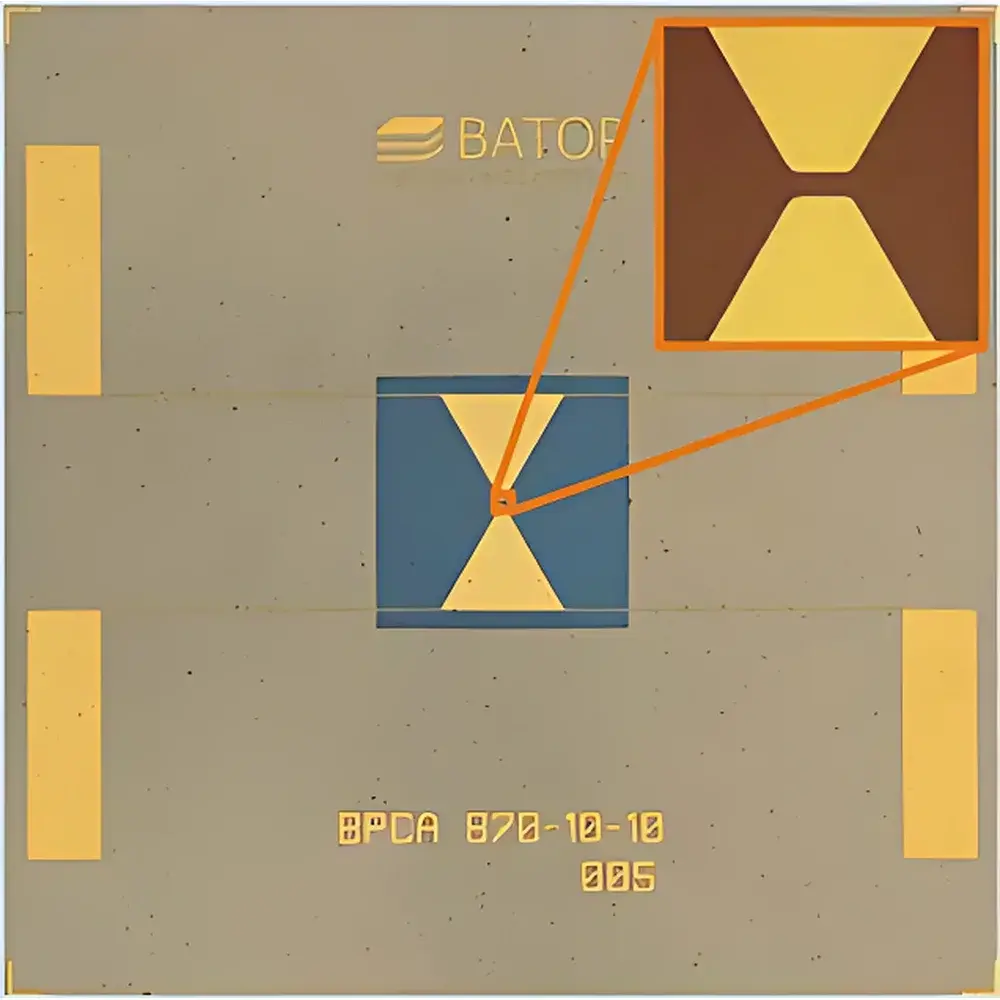
BATOP PCA Series Photoconductive Antennas for Terahertz Generation and Detection
| Brand | BATOP |
|---|---|
| Origin | Germany |
| Model | PCA Series |
| Excitation Wavelengths | 800 nm, 1064 nm, 1550 nm |
| Antenna Types | Bow-tie, Parallel-line, Butterfly, Interdigital Array, Finger-gap, Logarithmic Spiral |
| Lens Options | Aspheric Silicon Lenses (Collimating or Focusing) |
| Compliance | ISO 9001-certified Manufacturing |
| Application Domain | Time-Domain Terahertz Spectroscopy (THz-TDS), Pump-Probe Metrology, Ultrafast Carrier Dynamics |
Overview
The BATOP PCA Series Photoconductive Antennas are precision-engineered components designed for broadband terahertz (THz) pulse generation and coherent electro-optic detection in time-domain spectroscopy (THz-TDS) systems. Based on low-temperature-grown gallium arsenide (LT-GaAs) or radiation-damaged silicon-on-sapphire (RD-SOS) substrates, these antennas operate via ultrafast photoconductive switching: a femtosecond laser pulse excites carriers across the bandgap, and an applied bias field (for emitters) or induced THz field (for detectors) drives transient current flow, radiating or sampling sub-picosecond THz transients. Optimized for excitation wavelengths at 800 nm (Ti:sapphire lasers), 1064 nm (Nd:YAG/Yb-fiber), and 1550 nm (Er-fiber), the PCA series supports flexible integration into both table-top and fiber-coupled THz platforms. Each antenna is monolithically integrated with a high-numerical-aperture aspheric silicon lens—either collimating or focusing—to maximize coupling efficiency between the optical pump/probe beam and the THz near-field, while minimizing spherical aberration in the 0.1–4 THz range.
Key Features
- Substrate options: LT-GaAs (for 800 nm), RD-SOS (for 1064/1550 nm), enabling carrier lifetimes < 0.5 ps and high dark resistivity (>10⁶ Ω·cm)
- Four standardized antenna geometries: bow-tie (broadband, balanced radiation pattern), parallel-line (high low-frequency output), finger-gap (high field strength, compact active area), and logarithmic spiral (circularly polarized THz emission/detection)
- Large-area interdigital array (iPCA) variant for enhanced responsivity and signal-to-noise ratio in low-power detection configurations
- Integrated aspheric silicon lens (NA ≈ 0.5–0.7) with anti-reflection coating optimized for target excitation wavelength and THz transmission (3–5 THz cutoff)
- Laser damage threshold > 100 mJ/cm² (100 fs, 80 MHz, 800 nm), ensuring long-term operational stability under typical THz-TDS operating conditions
- Electrical interface: SMA or K-type RF connectors with 50 Ω impedance matching; bias voltage range up to ±40 V (emitters), optional integrated bias tee
Sample Compatibility & Compliance
The PCA series is compatible with standard THz-TDS architectures using regenerative amplifiers, amplified fiber lasers, or oscillators with pulse durations ≤150 fs. It supports both free-space and quasi-optical waveguide coupling schemes. All devices are manufactured in accordance with ISO 9001:2015 quality management standards in cleanroom environments (Class 1000). While not certified to IEC 61000-4-x electromagnetic compatibility standards as standalone instruments, the antennas comply with material safety requirements per RoHS Directive 2011/65/EU and REACH Regulation (EC) No. 1907/2006. For GLP/GMP-aligned laboratories, full traceable documentation—including substrate batch certificates, lithography process logs, and individual lens transmission spectra—is available upon request.
Software & Data Management
As passive optoelectronic components, BATOP PCAs do not incorporate embedded firmware or require proprietary drivers. Their performance is fully characterized and validated within third-party THz acquisition software environments, including TeraView’s TeraStudio, Menlo Systems’ TERA K15 control suite, and open-source frameworks such as Python-based terapy and MATLAB-based THzToolbox. Raw THz waveforms acquired using these antennas retain full phase and amplitude fidelity, enabling quantitative analysis of complex refractive index (n, κ), absorption coefficient (α), and conductivity spectra without signal distortion. When used in conjunction with lock-in detection or asynchronous optical sampling (ASOPS) hardware, PCA-based systems support automated calibration routines compliant with ASTM E2961–22 (Standard Practice for Calibration of Terahertz Time-Domain Spectrometers).
Applications
- Non-destructive evaluation (NDE) of polymer composites, pharmaceutical tablet coatings, and layered semiconductor heterostructures
- Ultrafast carrier dynamics studies in 2D materials (e.g., graphene, MoS₂), perovskites, and topological insulators
- Gas-phase rotational spectroscopy of polar molecules (H₂O, NH₃, HCl) in atmospheric sensing and industrial process monitoring
- Time-resolved THz magneto-spectroscopy under pulsed magnetic fields up to 30 T (via integration with cryogenic split-coil magnets)
- Development of compact THz imaging systems for security screening and biomedical tissue characterization (ex vivo)
FAQ
What excitation laser parameters are required for optimal PCA operation?
A femtosecond laser with pulse duration ≤150 fs, repetition rate 10–100 MHz, and average power 10–100 mW (at focus) is recommended. Pulse energy should be maintained below 1 nJ to avoid saturation or thermal damage.
Can the same PCA be used interchangeably as emitter and detector?
Yes—except for iPCA and SPCA variants, which are geometry-optimized for specific roles. Standard bow-tie and finger-gap PCAs are bidirectional, though biasing configuration must be adjusted accordingly.
Is vacuum or purged environment necessary for operation?
Not strictly required, but ambient water vapor absorption strongly attenuates THz above 0.5 THz. For broadband spectral fidelity beyond 1 THz, operation in dry nitrogen purge (<10 ppm H₂O) or vacuum (<10⁻² mbar) is advised.
How is alignment performed during system integration?
Each PCA includes mechanical fiducials and a kinematic mount interface (M6 threaded holes). Alignment relies on co-propagating visible alignment beams through the silicon lens, followed by THz beam profiling using a pyroelectric camera or scanning knife-edge method.
Does BATOP provide custom antenna design services?
Yes—custom electrode geometries, substrate doping profiles, lens NA optimization, and hybrid integration (e.g., on-chip Si-lens + PCA) are available under NDA for academic and industrial R&D programs.