
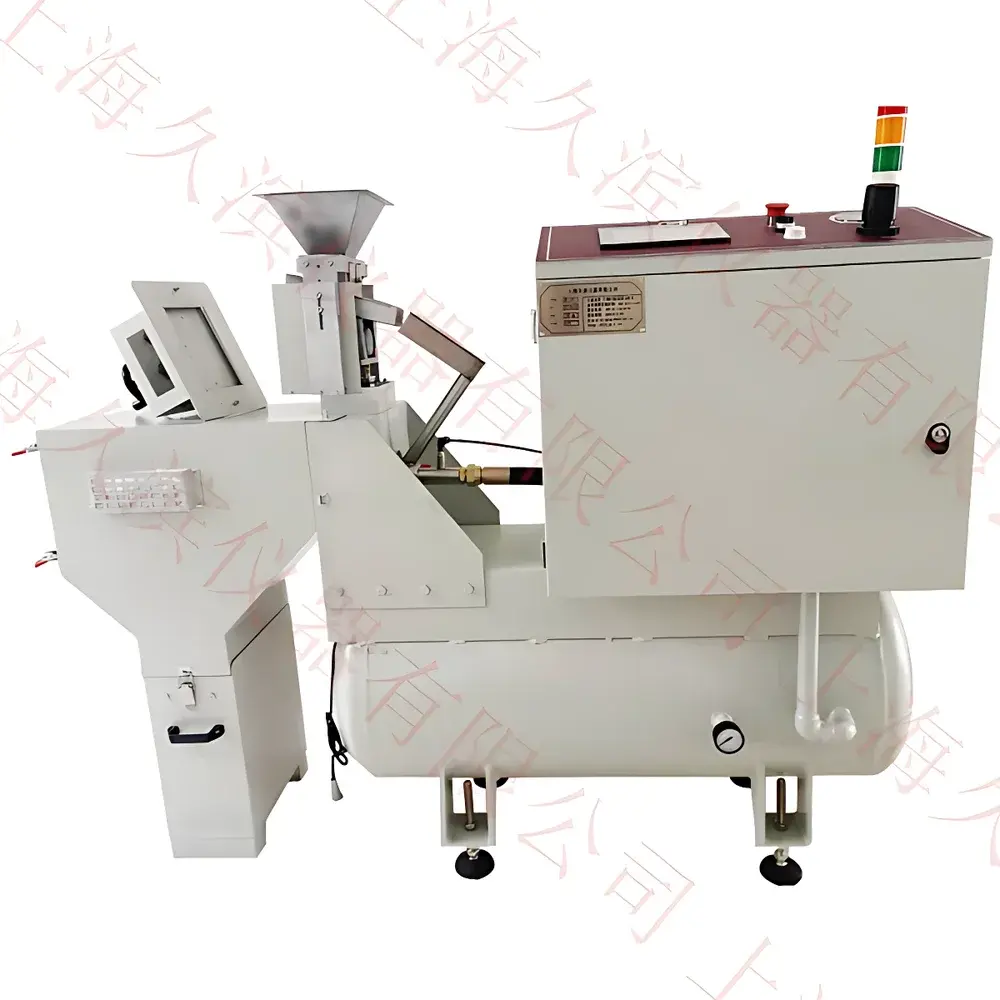
Battery Pack Stone Impact Resistance Tester JB–J M5 by Jiubin Instruments
| Brand | Jiubin Instruments |
|---|---|
| Origin | Shanghai, China |
| Model | JB–J M5 |
| Pressure Range | 0–0.8 MPa (adjustable) |
| Air Reservoir Volume | 136 L |
| Nozzle Inner Diameter | 30 mm / 53 mm |
| Air Hose Inner Diameter | 15 mm / 20 mm |
| Test Angles | 45°, 54°, 90° (flat specimens) |
| Noise Level | ≤120 dB(A) |
| Operating Mode | Continuous duty |
| Test Media | Gravel, crushed stone |
| Feed Rate Control | Electromagnetic vibratory feeder |
| Air Pressure Control | Manual regulating valve |
| Required External Air Supply | 0–0.8 MPa, ≥2 m³/min |
Overview
The JB–J M5 Battery Pack Stone Impact Resistance Tester is an industry-specific impact simulation system engineered for evaluating the mechanical robustness of lithium-ion battery enclosures, protective coatings, and structural components under high-velocity gravel and stone impact conditions. Designed in accordance with functional requirements derived from automotive OEM specifications (e.g., ISO 20474-1, SAE J2527, and GB/T 31467.3), this tester replicates real-world road-debris impact scenarios encountered during vehicle operation. It operates on the principle of pneumatic acceleration: compressed air propels calibrated gravel or crushed stone through a precision-bore nozzle at controlled velocities, inducing localized stress, coating delamination, substrate cracking, or housing deformation. Unlike generic impact testers, the JB–J M5 integrates configurable impact geometry (including 45°, 54°, and 90° incidence angles), a 136 L pressurized air reservoir for stable pulse delivery, and a modular 3D test chamber to accommodate non-planar battery modules and pack-level assemblies—enabling direct assessment of structural integrity across full-scale EV battery systems.
Key Features
- Pneumatically driven impact mechanism with adjustable pressure range (0–0.8 MPa), enabling velocity modulation without mechanical recalibration
- Dual-nozzle configuration (30 mm and 53 mm inner diameter) supporting both localized spot testing and broad-area exposure protocols
- Electromagnetically regulated vibratory feed system ensures consistent, repeatable particle mass flow rate—critical for ASTM D3294-compliant abrasion repeatability
- Modular 3D test chamber accommodates irregularly shaped battery packs, BMS housings, and thermal barrier modules without disassembly
- Integrated acoustic enclosure with noise-dampening design; operational noise ≤120 dB(A) — compliant with OSHA 29 CFR 1910.95 hearing protection thresholds
- Stainless-steel air reservoir (136 L capacity) minimizes pressure decay during sequential impact cycles, ensuring high reproducibility across multi-sample test series
- Manual precision regulating valves for fine-tuned control of airflow dynamics, facilitating method development per internal QC standards or customer-specific test plans
Sample Compatibility & Compliance
The JB–J M5 accepts flat-panel specimens (e.g., coated aluminum busbars, laminated cell casings) as well as three-dimensional battery modules up to 1200 × 800 × 300 mm. Specimen mounting fixtures are compatible with standard DIN 53204 and ISO 20567-1 sample holders. The system supports testing under ambient conditions; optional environmental chambers (–40°C to +85°C) can be integrated for low-temperature impact validation per UN GTR 20 and IEC 62660-2 safety certification workflows. All mechanical and pneumatic subsystems conform to CE machinery directive 2006/42/EC and ISO 12100 risk assessment requirements. Documentation packages include traceable calibration records for pressure transducers and feed-rate verification reports—supporting GLP-compliant lab audits and OEM Tier-1 supplier qualification processes.
Software & Data Management
While the JB–J M5 operates via hardware-based manual control (optimized for deterministic, operator-guided test execution), it supports integration with external data acquisition systems via analog 0–10 V pressure monitoring outputs and TTL-triggered event logging ports. Users may interface with LabVIEW, MATLAB, or custom SCADA platforms to record impact pressure profiles, feed cycle timestamps, and pass/fail visual inspection annotations. Audit trails—including operator ID, test date/time, pressure setpoint, nozzle selection, and angle configuration—are manually logged in accordance with FDA 21 CFR Part 11–aligned documentation practices when paired with validated electronic notebooks.
Applications
- Evaluation of adhesive bond integrity between battery module housing and flame-retardant polymer overmolds
- Quantification of coating spallation thresholds on extruded aluminum battery trays subjected to gravel impact
- Validation of composite lid resistance to stone-induced microcracking prior to thermal cycling
- Comparative assessment of encapsulant materials (e.g., polyurea vs. silicone) under multi-angle impact exposure
- Supporting failure mode analysis (FMEA) for IP67/IP6K9K-rated battery enclosures in harsh-environment EV applications
- Pre-certification testing aligned with GB/T 38031-2020 clause 7.5 (mechanical abuse – impact resistance)
FAQ
Is an air compressor included with the JB–J M5?
No. A dedicated industrial-grade air compressor capable of delivering ≥2 m³/min at 0.8 MPa is required and must be supplied by the end user.
Can the system be used for testing beyond lithium battery components?
Yes. While optimized for EV battery structural validation, the JB–J M5 meets ISO 20567-1 and ASTM D3294 requirements for general coating and substrate impact resistance testing in automotive and aerospace applications.
What particle size distribution is recommended for standardized testing?
For compliance with GB/T 31467.3 Annex F, use graded crushed granite (4–8 mm nominal size, angularity index ≥12) with moisture content <0.5% w/w.
Does the system support automated test sequencing?
Not natively. The JB–J M5 is designed for operator-controlled, method-defined test execution. Automation requires third-party PLC integration via its analog and digital I/O interfaces.
How is test repeatability verified?
Repeatability is ensured through periodic verification using NIST-traceable pressure calibrators and gravimetric feed-rate checks performed per internal SOP-IMP-003, documented in the system’s maintenance logbook.





