BaySpec IntelliGuard OCPM CWDM Embedded Optical Channel Performance Monitor with Integrated Spectrum Analyzer
| Brand | BaySpec |
|---|---|
| Model | IntelliGuard OCPM CWDM |
| Origin | USA |
| Manufacturer | BaySpec, Inc. |
| Type | Embedded Optical Spectrum Analyzer for CWDM Systems |
| Wavelength Range | 1260–1640 nm |
| Resolution | ITU-T G.695-compliant 20 nm channel spacing |
| Detection Technology | Volume Phase Grating (VPG®) + InGaAs linear array detector |
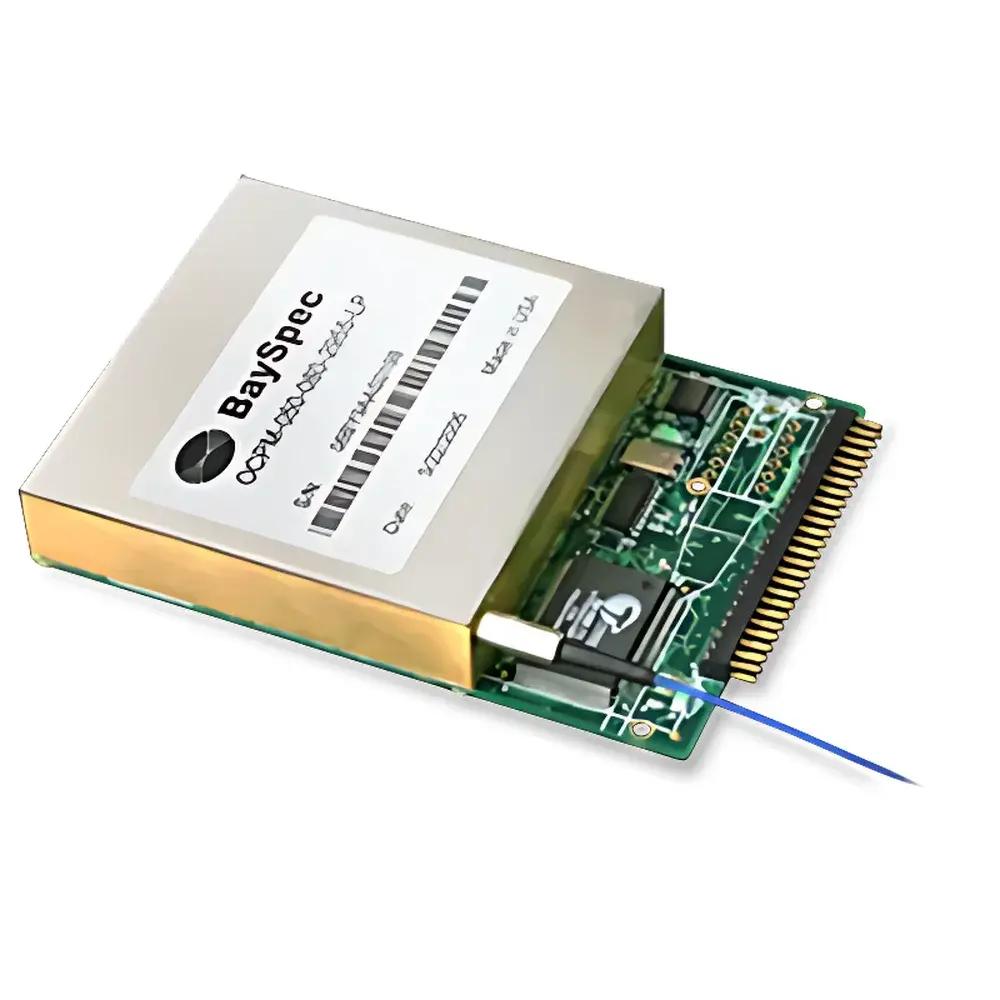
| Form Factor | Card-mountable module (68 × 96 × 15.8 mm³) |
| Reliability Certification | Telcordia GR-63-CORE, GR-1209-CORE, GR-1221-CORE |
| Response Time | <50 ms (full-spectrum acquisition and processing) |
| Interface | Dual-port RAM via ADD/DAT bus or serial (RS-232/USB) |
| Optical Input | Single-mode fiber tap |
| Power | Low-power design compatible with battery-operated handheld platforms |
| Compliance | ITU-T G.695, Telcordia GR-series, RoHS |
Overview
The BaySpec IntelliGuard OCPM CWDM is an embedded optical channel performance monitor engineered for real-time, in-service spectral characterization of coarse wavelength division multiplexing (CWDM) networks. Unlike conventional benchtop spectrum analyzers, this module integrates a volume phase grating (VPG®)-based optical dispersion engine and a thermoelectrically stabilized InGaAs linear photodetector array into a compact, passively aligned optomechanical architecture. It operates on the principle of parallel spectral acquisition—capturing the entire 1260–1640 nm band simultaneously without mechanical scanning—enabling sub-50 ms full-spectrum measurement cycles. Designed specifically for ITU-T G.695-compliant CWDM systems (18-channel grid, 20 nm spacing), the device extracts critical physical-layer parameters—including per-channel optical power, center wavelength, and optical signal-to-noise ratio (OSNR)—directly from a low-coupling-ratio fiber tap. Its solid-state construction eliminates moving parts, ensuring long-term stability under field-deployed thermal and vibrational stress conditions.
Key Features
- Full-band parallel acquisition across 1260–1640 nm with <50 ms latency per spectrum update
- Volume Phase Grating (VPG®) optical disperser offering high diffraction efficiency and polarization-insensitive response
- Thermally stabilized InGaAs linear array detector with calibrated responsivity across the entire CWDM band
- Compact card-mountable form factor (68 × 96 × 15.8 mm³) optimized for integration into handheld test sets and network element line cards
- Dual-interface I/O architecture: high-speed parallel ADD/DAT bus for embedded host control, plus RS-232 and USB for configuration and diagnostics
- GR-63-CORE, GR-1209-CORE, and GR-1221-CORE certified mechanical and environmental robustness—validated for shelf, rack, and outdoor cabinet deployment
- No routine recalibration required; factory-traceable wavelength and power calibration maintained over temperature (–5 °C to +70 °C operating range)
Sample Compatibility & Compliance
The IntelliGuard OCPM CWDM is designed exclusively for passive in-line monitoring of single-mode fiber (SMF-28 compliant) CWDM links. It accepts optical input via a standardized 1×2 fused-fiber tap (typical coupling ratio: 99:1), enabling non-intrusive signal sampling without disrupting live traffic. The instrument complies with ITU-T Recommendation G.695 for CWDM channel definitions and spectral mask requirements. Its hardware and firmware meet Telcordia GR-63-CORE (physical protection), GR-1209-CORE (electrical safety), and GR-1221-CORE (reliability prediction) standards—making it suitable for carrier-grade deployment in central offices and outside plant environments. All optical components are RoHS-compliant and rated for extended operational lifetime (>100,000 hours MTBF). No laser safety classification applies, as the device functions solely as a passive receiver.
Software & Data Management
The module provides raw spectral data (16-bit digital counts per pixel) and processed parameters (power per channel, wavelength deviation, OSNR estimate) through its dual-port RAM interface. Host systems access calibrated measurement results using BaySpec’s open-command protocol (ASCII-based, documented in the OEM Integration Guide). Firmware supports configurable averaging modes (1x to 64x), dynamic range optimization, and alarm thresholds per channel. For traceability in regulated environments, the device logs timestamped measurement metadata—including internal temperature, detector bias voltage, and calibration epoch—supporting GLP/GMP-aligned audit trails when integrated with host software that implements 21 CFR Part 11-compliant electronic signatures and audit logging.
Applications
- OEM integration into portable field test instruments for Tier-1 and Tier-2 service providers performing CWDM turn-up, troubleshooting, and maintenance
- Embedded physical-layer monitoring in optical line terminals (OLTs), remote node aggregators, and reconfigurable optical add-drop multiplexers (ROADMs)
- Real-time fault detection and isolation in metro and access networks—identifying channel loss, wavelength drift, or interference events within milliseconds
- R&D validation of CWDM transceivers, filters, multiplexers/demultiplexers, and passive splitters under varying thermal and aging conditions
- Automated commissioning workflows where channel power uniformity, spectral flatness, and OSNR margin verification are required pre-service activation
FAQ
Does the IntelliGuard OCPM CWDM require external calibration during field operation?
No. Its solid-state optical path and factory-traceable calibration eliminate the need for periodic recalibration. Stability is maintained across the specified operating temperature range through thermal compensation algorithms embedded in the firmware.
Can this module measure OSNR in the presence of amplified spontaneous emission (ASE)?
Yes. The VPG®-based architecture enables high-fidelity spectral resolution sufficient to resolve individual CWDM channels and adjacent ASE noise floors. OSNR is calculated using the industry-standard two-point method per ITU-T G.695 Annex A.
Is the device compatible with third-party network management systems (NMS)?
Yes—via its ASCII command interface and structured output format. Integration with SNMP-based NMS platforms is supported through middleware translation layers provided by BaySpec’s OEM partner program.
What is the maximum optical input power the device can handle without saturation?
The detector is linear up to –10 dBm per channel. With typical 99:1 tap ratios, the module safely accommodates upstream link powers up to +17 dBm without front-end attenuation.
How is firmware updated in deployed units?
Firmware updates are performed in-field via USB or serial interface using signed binary images and CRC-verified flash programming—ensuring integrity and rollback capability per Telcordia GR-1221 reliability guidelines.