
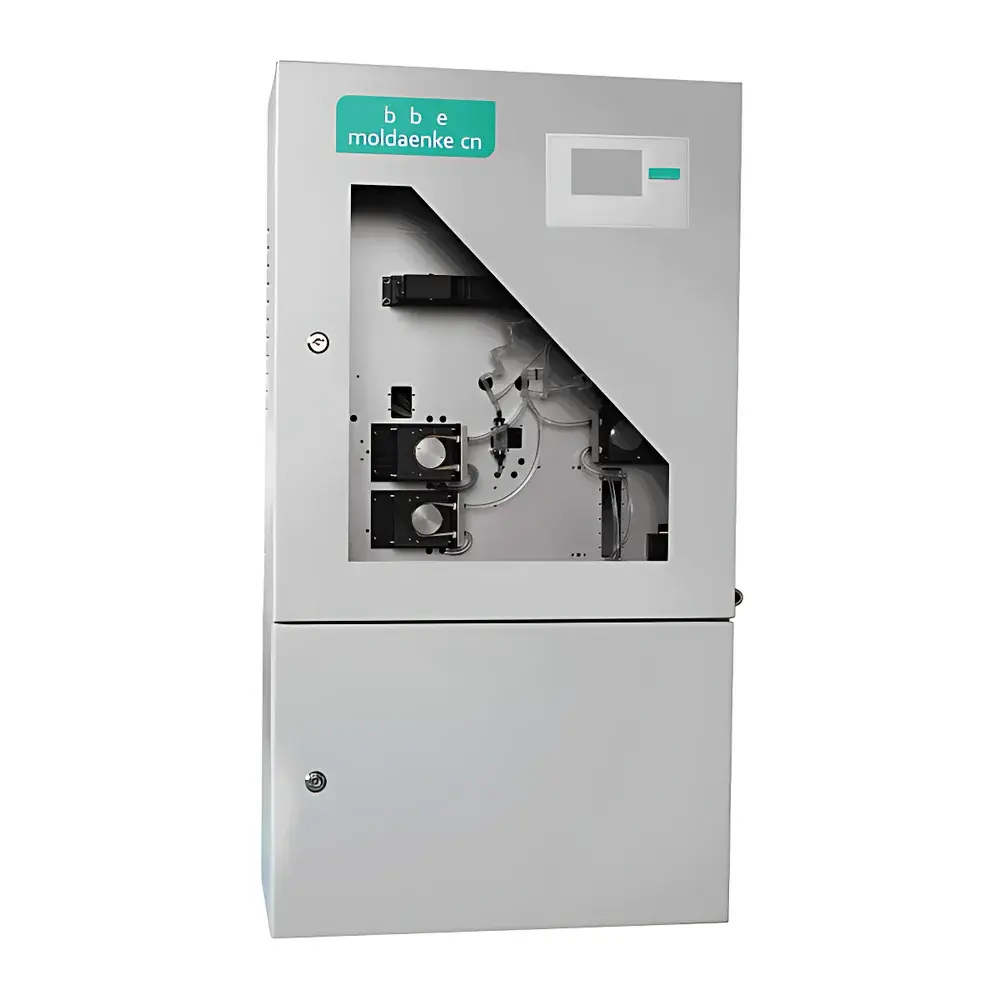
bbe Phenol—PWR II Online Volatile Phenol Water Quality Analyzer
| Brand | BBE / bbe Moldaenke |
|---|---|
| Origin | Shanghai, China |
| Manufacturer Type | Direct Manufacturer |
| Product Origin | Domestic (China) |
| Model | bbe Phenol—PWR II |
| Instrument Type | Online Water Quality Analyzer |
| Analyte | Volatile Phenol |
| Measurement Range | 0–0.1 / 2 / 20 mg/L (selectable) |
| Detection Limit | 0.001 mg/L (at lowest range) |
| Accuracy | ≤ ±3% FS or 0.0008 mg/L (whichever is greater) |
| Repeatability | ≤3% |
| Zero Drift | ≤2% FS/24h |
| Span Drift | ≤2% FS/24h |
| Measurement Cycle Time | 39 minutes |
| Resolution | 0.0001 mg/L (at lowest range) |
| Dimensions (H×L×W) | 1100 × 600 × 310 mm |
| Weight | ~45 kg |
| Sample Requirements | Oil-free and particle-free |
| Temperature | 2–40 °C |
| Pressure | 0.0–0.1 bar |
| Flow Rate | 1.5–3.0 L/min |
| Output Interfaces | 4–20 mA, RS232/RS485 |
| Communication Protocols | MODBUS RTU/TCP (optional), TCP/IP (optional) |
| Calibration | Automatic & manual |
| Cleaning | Fully automated |
| Compliance Features | Built-in QC verification, remote operational status monitoring (optional) |
Overview
The bbe Phenol—PWR II Online Volatile Phenol Water Quality Analyzer is an industrial-grade, fully automated instrumentation system engineered for continuous, unattended monitoring of volatile phenol concentrations in surface water, drinking water, municipal wastewater, and industrial effluents. It implements the standardized distillation–4-aminoantipyrine (4-AAP) spectrophotometric method (aligned with ISO 6439, HJ 502-2009, and EPA Method 420.1), ensuring regulatory traceability and analytical consistency across diverse water matrices. The analyzer integrates a dedicated on-board steam distillation module featuring patented bubble-interruption technology — a critical innovation that prevents carryover of non-volatile interferences and guarantees quantitative recovery of volatile phenolic compounds prior to colorimetric detection at 510 nm. Its robust architecture supports long-term deployment in harsh environmental monitoring stations or process-critical water treatment facilities, delivering stable performance under variable ambient conditions and fluctuating sample loads.
Key Features
- Integrated online steam distillation unit with bubble-interruption separation — eliminates matrix interference and ensures complete volatilization of phenolic compounds
- High-precision peristaltic fluid handling system with calibrated pump tubing, enabling sub-microgram-level repeatability (≤3% RSD)
- Automated multi-point calibration and system cleaning cycles, programmable at user-defined intervals (e.g., hourly, daily, or per measurement)
- Modular hardware design facilitates field maintenance, sensor replacement, and future range extension without system downtime
- TFT touchscreen HMI with intuitive navigation, real-time trend visualization, and embedded diagnostic logs
- Comprehensive fault detection: reagent depletion alerts, flow interruption warnings, temperature deviation notifications, and power-loss recovery with auto-resume functionality
- Configurable analog (4–20 mA) and digital (RS232/RS485) outputs for seamless integration into SCADA, DCS, or PLC-based control infrastructures
Sample Compatibility & Compliance
The bbe Phenol—PWR II accepts raw water samples meeting defined physical preconditions: oil-free, suspended solids <5 mg/L, temperature between 2–40 °C, and inlet pressure within 0.0–0.1 bar. It is compatible with standard 1/4" PTFE or PVDF sample tubing and supports continuous flow rates of 1.5–3.0 L/min. All wetted components are chemically inert (e.g., borosilicate glass, PTFE, EPDM), minimizing adsorption or catalytic degradation of phenolic analytes. The instrument adheres to GLP-aligned operational protocols — including audit-trail-enabled calibration logging, QC spike recovery tracking, and timestamped event history — supporting compliance with ISO/IEC 17025, US EPA 40 CFR Part 136, and China’s HJ 502-2009 standard methods. Optional remote status monitoring enables centralized oversight in multi-site water quality networks.
Software & Data Management
The embedded firmware provides local data storage for ≥30 days of high-resolution measurement records (including absorbance values, calibration coefficients, and diagnostic flags). Data export is supported via USB or serial interface in CSV format. For enterprise-scale deployment, optional TCP/IP and MODBUS TCP modules allow secure integration with centralized LIMS or cloud-based water intelligence platforms. All communication channels support configurable data polling intervals and alarm-triggered push notifications. Audit trails meet requirements for regulated environments: each calibration, cleaning, or parameter change is time-stamped, user-identified, and immutable unless exported externally. Firmware updates are performed via authenticated USB key to ensure version control and cybersecurity integrity.
Applications
- Real-time surveillance of phenol discharge compliance at petrochemical, pharmaceutical, and resin manufacturing plants
- Early-warning detection in drinking water intake protection zones downstream of industrial clusters
- Performance validation of activated carbon or advanced oxidation process (AOP) units treating phenol-contaminated streams
- Long-term trend analysis in national surface water monitoring networks (e.g., river basins, reservoirs)
- Supporting ISO 24510-based asset management by correlating phenol spikes with infrastructure failure events (e.g., pipeline breaches, tank overflows)
FAQ
What regulatory standards does the bbe Phenol—PWR II comply with?
It implements the distillation–4-AAP method per ISO 6439 and HJ 502-2009, and its performance specifications align with US EPA Method 420.1 for volatile phenol quantification.
Can the instrument operate without external PC supervision?
Yes — all core functions (sampling, distillation, reaction, detection, calibration, cleaning) are autonomously managed by the onboard controller; no external computer is required for routine operation.
Is remote diagnostics and software update capability available?
Remote status monitoring and firmware updates via secure TCP/IP connection are available as optional configurations, subject to network security policy alignment.
How often must reagents be replenished?
Reagent consumption depends on measurement frequency; typical refill intervals range from 30 to 90 days for standard 2-L reagent bottles operating at one measurement per hour.
Does the system support automatic QC verification?
Yes — built-in spiked recovery tests and blank verification cycles can be scheduled independently of routine measurements to validate analytical integrity per GLP principles.
Related Products







