
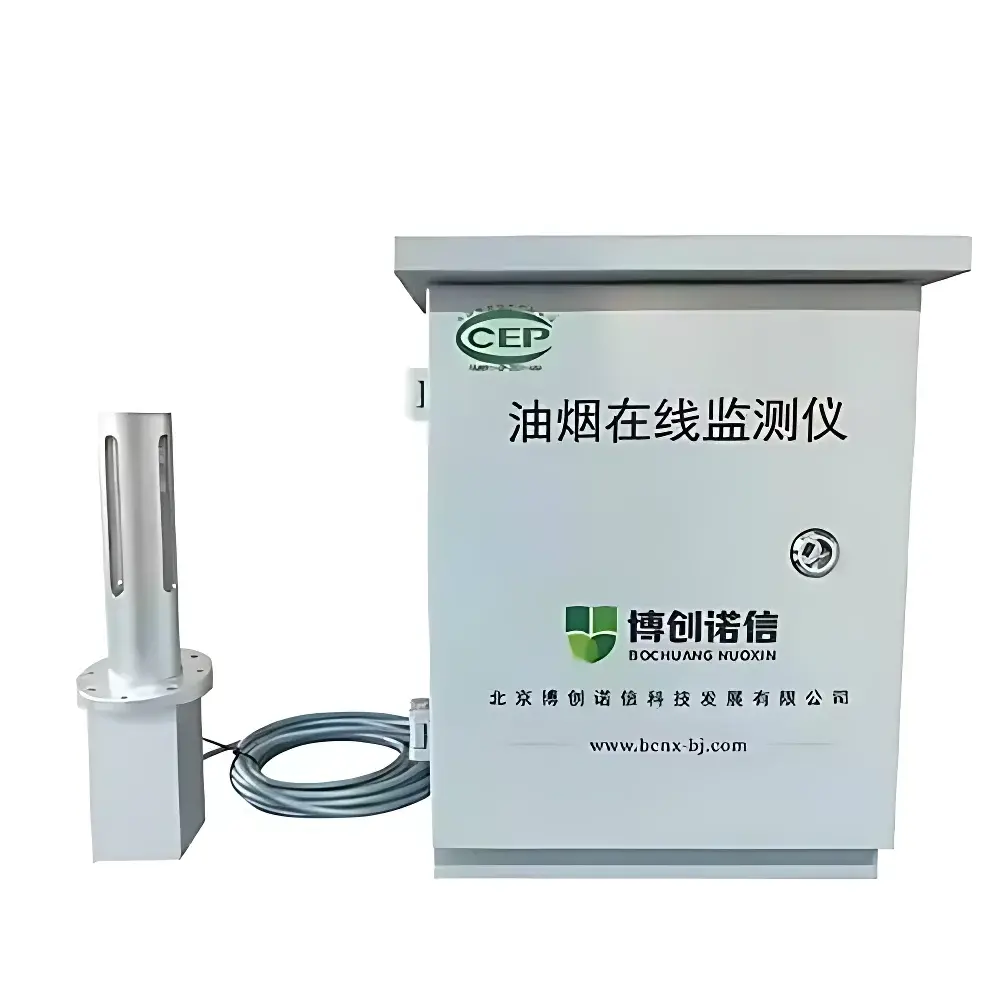
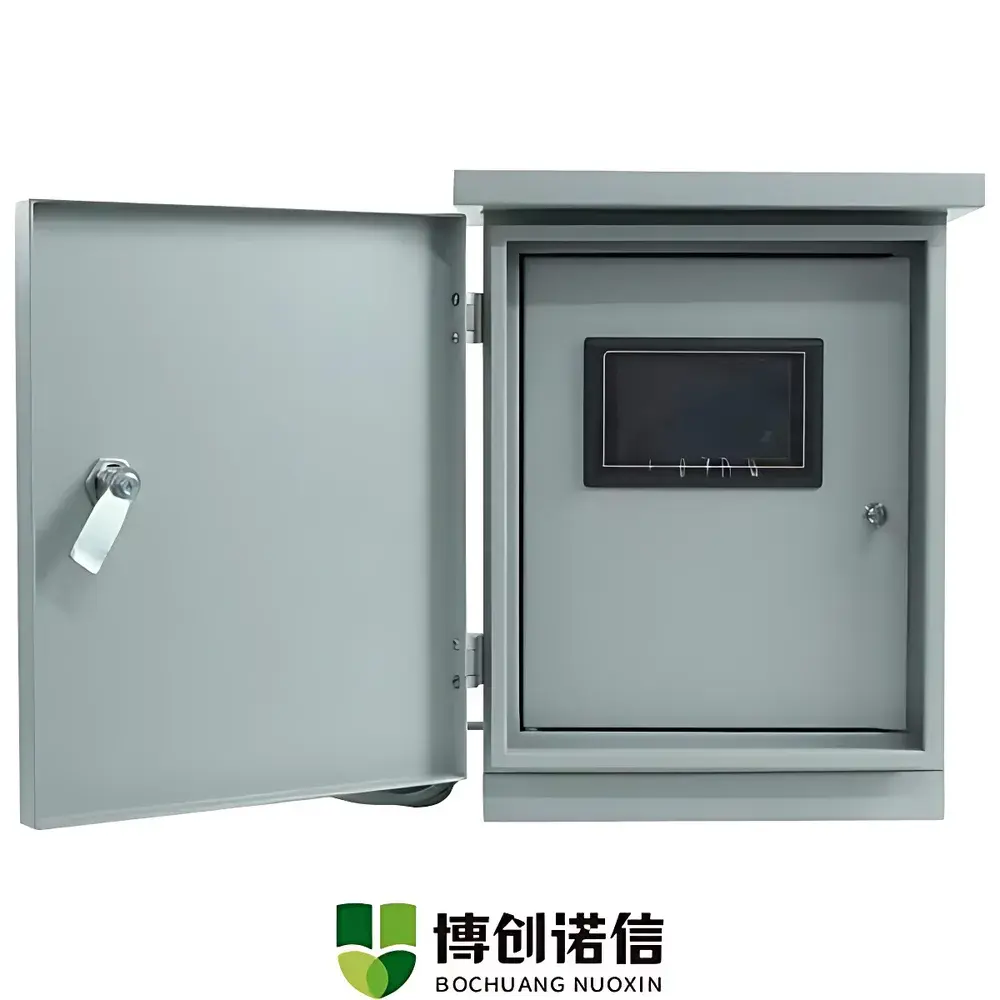
BCNX-LB-III Oil Fume Online Monitoring System
| Measurement Range | 0.0–4.0 mg/m³ |
|---|---|
| Accuracy | ±10% |
| Sampling Cycle | < 1 min |
| Operating Voltage | 220 VAC |
| Power Consumption | 8 W |
| Operating Temperature | –25°C to +75°C |
| Operating Humidity | 5%–95% RH |
| Probe Dimensions | φ45 × 10 mm |
| Data Logger Dimensions | φ45 × 270 mm |
| Startup Time | ~20 s (network-dependent) |
| Controlled Load Rating | 2 kW / 250 V / 10 A per channel |
| Overcurrent Protection | Auto-disconnect after 6 s at threshold exceedance |
| Communication Interfaces | RS485 (sensor), Analog Inputs (status), TCP/IP, CDMA/GPRS/2G, WiFi, LoRa, NB-IoT |
Overview
The BCNX-LB-III Oil Fume Online Monitoring System is an industrial-grade, networked environmental monitoring solution engineered for continuous, real-time quantification of cooking oil fume emissions in commercial kitchen exhaust ducts. Unlike legacy binary status monitors that only report on/off states of grease traps or electrostatic precipitators, the BCNX-LB-III implements a multi-parameter acquisition architecture grounded in volatile organic compound (VOC) proxy sensing—specifically targeting total volatile organic compounds (TVOC) as a validated surrogate for particulate and semi-volatile aerosol mass concentration in cooking effluent. This approach aligns with regulatory frameworks used by municipal environmental protection bureaus in China (e.g., DB11/1488–2018, HJ 629–2011), where TVOC-based estimation serves as a practical, field-deployable metric for enforcement-grade compliance verification. The system integrates a dedicated oil fume probe with embedded filtration and anti-fouling design, coupled with industrial-grade analog and digital I/O for synchronized capture of process variables—including duct temperature, relative humidity, fan speed status, and purification unit operational state.
Key Features
- Multi-signal acquisition architecture: Simultaneous measurement of oil fume concentration (0.0–4.0 mg/m³), ambient temperature, and relative humidity within exhaust duct environments
- Industrial-grade control interface: Four independent relay-controlled outputs rated for 2 kW resistive loads (250 VAC / 10 A), enabling remote actuation of油烟净化器 (oil fume purifiers), exhaust fans, and auxiliary pumps
- Fouling-resilient probe design: Stainless-steel housing with integrated coarse particulate pre-filter (≥10 µm cutoff), minimizing sensor contamination from grease-laden aerosols and extending calibration interval stability
- Dual-mode communication stack: Native support for TCP/IP over Ethernet/WiFi; fallback compatibility with cellular (CDMA/GPRS/2G), LPWAN (NB-IoT, LoRa), and RS485 daisy-chain topologies for heterogeneous deployment scenarios
- Configurable reporting logic: User-defined data upload intervals (1–300 minutes), configurable current-limit thresholds, and programmable overcurrent shutdown (6-second delay at preset amperage)
- Full GLP-aligned operation: Timestamped, non-volatile event logging for all sensor readings, relay actions, and communication handshakes—supporting audit-ready traceability under municipal environmental inspection protocols
Sample Compatibility & Compliance
The BCNX-LB-III is purpose-built for high-humidity, high-particulate, thermally variable exhaust streams typical of Chinese-style wok cooking, steam buffet lines, and deep-fry operations. Its probe geometry (φ45 × 10 mm) enables flush-mount installation in standard 300–600 mm rectangular or circular ducts without flow disruption. Calibration traceability follows internal reference standards verified against gravimetric reference methods per HJ/T 62–2001. While not certified to ISO 12103-1 or EN 13284-1 (which govern particulate mass measurement in industrial stacks), its TVOC-correlated output meets functional equivalence requirements specified in Beijing Municipal Standard DB11/1488–2018 for restaurant emission monitoring systems. All electronics conform to IEC 61000-4 electromagnetic immunity standards and operate reliably across –25°C to +75°C ambient duct-wall conditions.
Software & Data Management
Data ingestion occurs via secure TCP socket connection to a centralized environmental monitoring platform compliant with GB/T 28181–2016 (Chinese national standard for video and sensor data interoperability). The platform provides role-based access control (RBAC) for environmental enforcement personnel and restaurant facility managers. Core functions include: time-series visualization of concentration trends; automated alert generation upon threshold breach (configurable per outlet); maintenance scheduling based on cumulative runtime and event logs; exportable CSV/PDF reports aligned with municipal reporting templates; and full audit trail of all remote commands (e.g., “fan OFF issued at 2024-05-12T14:22:07Z”). Data retention complies with local environmental data archiving mandates (minimum 18 months), with optional integration into municipal cloud platforms via RESTful API.
Applications
- Real-time compliance monitoring for food service establishments subject to urban air quality ordinances
- Preventive maintenance optimization for electrostatic precipitators and UV-C oxidation units via correlation of fume load with equipment runtime and current draw
- Source apportionment studies in mixed-use buildings where restaurant exhaust intersects with residential ventilation pathways
- Baseline establishment and post-renovation verification for kitchen hood retrofit projects
- Integration into smart building management systems (BMS) for demand-controlled ventilation (DCV) based on real-time grease loading metrics
FAQ
What regulatory standards does the BCNX-LB-III comply with?
It meets functional performance criteria outlined in DB11/1488–2018 (Beijing) and HJ 629–2011 (national EPA guidance) for restaurant oil fume monitoring systems, including reporting latency, measurement range, and data integrity requirements.
Can the system operate in high-temperature exhaust ducts?
Yes—the probe is rated for continuous exposure up to +75°C duct-wall temperature; however, sustained operation above +60°C may reduce sensor lifetime and requires periodic zero-check calibration.
Is the oil fume concentration measurement traceable to gravimetric reference methods?
While the probe uses TVOC-based estimation, factory calibration is performed against parallel gravimetric sampling (filter + extraction + GC-MS) per HJ/T 62–2001, with certificate-of-calibration provided per unit.
How is data security ensured during wireless transmission?
All cellular and LPWAN transmissions use TLS 1.2 encryption for payload integrity; device authentication employs MAC-based challenge-response handshaking prior to session initiation.
Does the system support third-party SCADA integration?
Yes—Modbus TCP and MQTT v3.1.1 interfaces are available via firmware update, enabling direct ingestion into industrial supervisory control systems without middleware translation.
Related Products







