
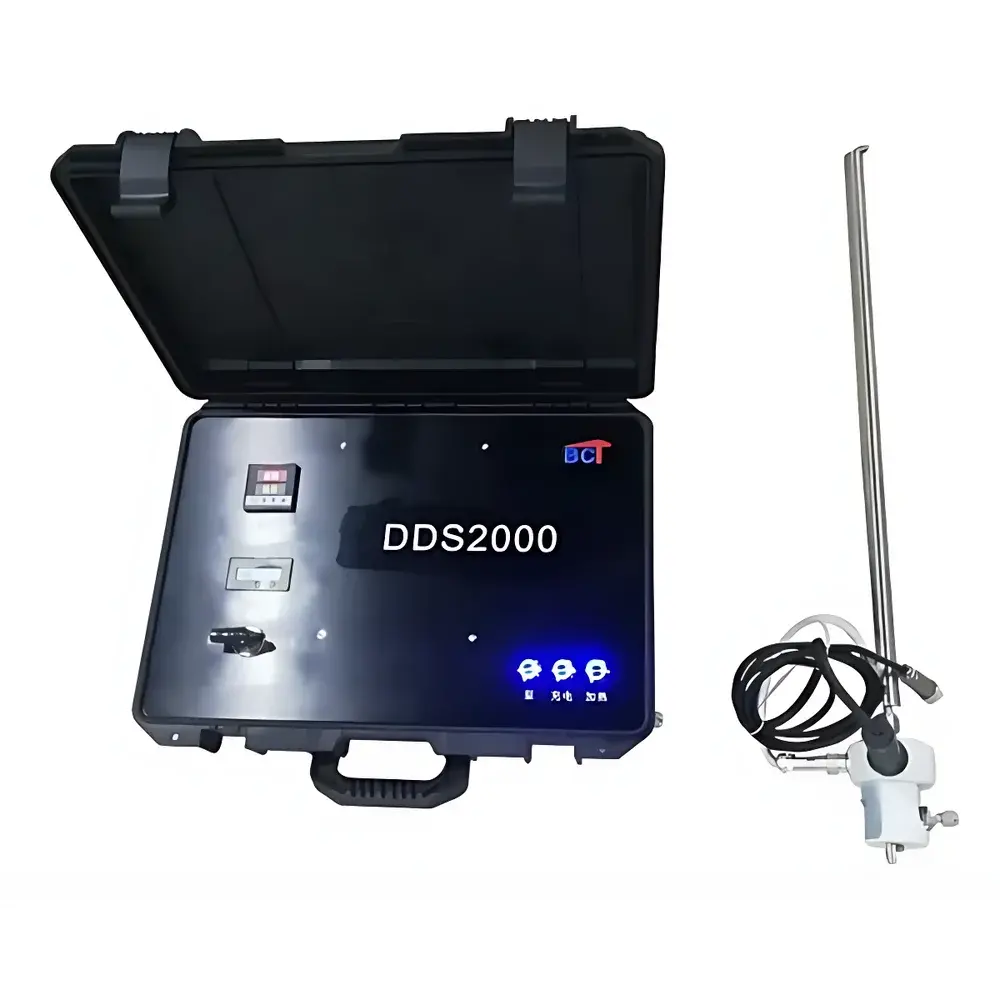
BCT DDS2000 Dilution Sampling System for Stationary Source Emissions
| Brand | BCT |
|---|---|
| Origin | Beijing, China |
| Manufacturer Type | Original Equipment Manufacturer (OEM) |
| Product Origin | Domestic (China) |
| Model | BCT DDS2000 |
| Pricing | Upon Request |
Overview
The BCT DDS2000 Dilution Sampling System is an engineered solution designed specifically for the quantitative collection and controlled dilution of hot, humid, and particulate-laden exhaust streams from stationary emission sources—such as industrial stacks, incinerators, and combustion test benches. It operates on the principle of isokinetic dilution sampling, where a representative portion of the main flue gas stream is extracted under isokinetic conditions and mixed with purified, temperature-controlled dilution air in a precisely metered ratio. This process lowers the sample dew point, suppresses condensation, minimizes wall losses of semi-volatile organic compounds (SVOCs), and enables compatibility with downstream analytical instrumentation—including gas chromatography–mass spectrometry (GC–MS), Fourier-transform infrared spectroscopy (FTIR), and online particle sizers. The system meets fundamental design requirements outlined in EPA Method 205, ISO 16911-1:2013 (Stationary source emissions — Manual and automated determination of velocity and volume flow rate — Part 1: Manual reference method), and aligns with QA/QC expectations for Method 25A and TO-17 applications.
Key Features
- Unattended operation via multiple triggering modes: programmable timer, remote control (RS485/Modbus RTU), centralized SCADA integration, or external event-triggered start/stop
- Wide dynamic dilution range (1:5 to 1:200), adjustable in discrete steps via precision mass flow controllers (MFCs) for both sample and dilution air streams
- Fused-silica-coated stainless-steel sampling probe and transport lines—chemically inert, low-adsorption, and resistant to acidic condensates and heavy metal deposition
- Full-path active heating (up to 180 °C) with independent PID-controlled zones to prevent condensation and maintain gaseous-phase integrity throughout the sampling train
- Integrated purge subsystem using ultra-high-purity nitrogen or zero air, enabling automated pre- and post-sampling line cleaning to eliminate carryover and ensure inter-sample reproducibility
- Modular architecture with standardized 1/4″ VCR fittings and NIST-traceable flow calibration certificates for all MFCs
Sample Compatibility & Compliance
The DDS2000 accommodates complex matrices typical of coal-fired boilers, waste-to-energy plants, chemical reactors, and cement kilns—including high-moisture (>20% v/v), high-temperature (up to 250 °C stack exit), and high-particulate (>100 mg/m³) streams. Its fused-silica surface finish significantly reduces adsorption of polar VOCs (e.g., formaldehyde, acetaldehyde) and SVOCs (e.g., PAHs, phthalates), supporting data integrity per EPA Compendium Method TO-11A and ISO 16000-6. All electronic modules comply with IEC 61326-1 (EMC for laboratory equipment) and IEC 61010-1 (safety requirements). Optional audit-trail logging and user-access controls support GLP and 21 CFR Part 11 readiness when integrated with validated LIMS environments.
Software & Data Management
The system includes embedded firmware with real-time monitoring of critical parameters—including sample/dilution flow rates, line temperatures, pressure differentials, and valve actuation status—accessible via Ethernet or USB-C interface. A Windows-based configuration and diagnostics suite provides intuitive setup of sampling protocols, calibration schedules, and alarm thresholds (e.g., low-flow, over-temperature, valve timeout). Raw operational logs are timestamped, digitally signed, and exportable in CSV/JSON formats. For enterprise deployment, OPC UA server support enables seamless integration into plant-wide DCS or environmental data management systems (EDMS), satisfying traceability requirements for ISO 14064-3 and EU MRV reporting frameworks.
Applications
- Regulatory compliance monitoring for VOC, SVOC, and odorant emissions under national emission standards (e.g., China’s GB 16297, US EPA NSPS Subpart JJJJ)
- Source apportionment studies requiring representative dilution to simulate atmospheric aging and partitioning behavior
- Method validation and interlaboratory comparison exercises for dilution-based sampling protocols
- Performance testing of abatement technologies (e.g., RTOs, scrubbers, ESPs) under realistic load conditions
- Calibration gas generation for field-portable analyzers via gravimetric or dynamic dilution approaches
FAQ
What is the maximum allowable stack gas temperature for continuous operation?
The probe and primary sampling line are rated for continuous exposure up to 250 °C; optional high-temp probes extend this to 400 °C.
Can the DDS2000 be used for PM2.5-bound compound sampling?
Yes—when coupled with a thermophoretic or cascade impactor upstream, it maintains particle-phase integrity through controlled dilution cooling and minimizes volatilization artifacts.
Is third-party calibration certification available?
BCT provides factory calibration with NIST-traceable documentation; ISO/IEC 17025-accredited calibration services are available through authorized partners.
Does the system support automatic leak checking?
Yes—the firmware includes an integrated pressure-decay test routine that verifies seal integrity across all heated zones prior to each sampling sequence.
How is data security handled during remote operation?
All network communications use TLS 1.2 encryption; local storage employs AES-256 full-disk encryption, and user roles are enforced via password+certificate authentication.



