
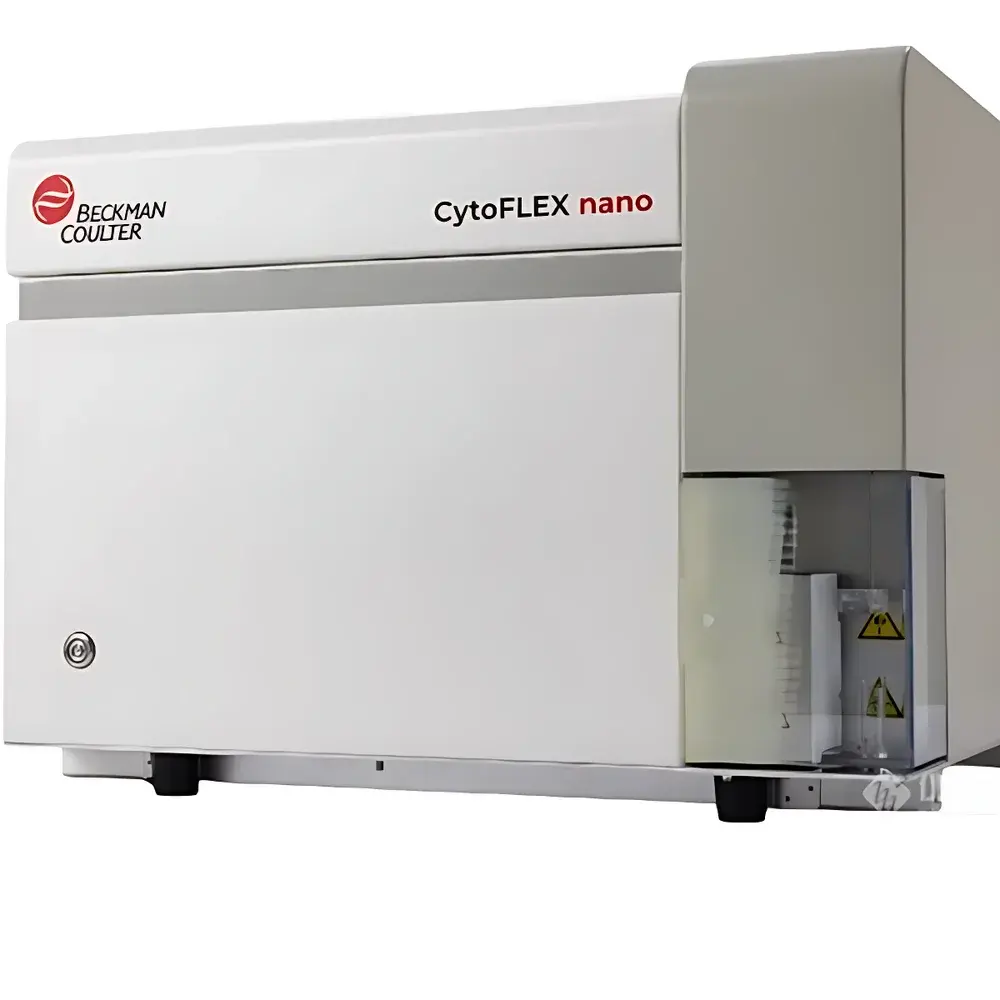
Beckman Coulter CytoFLEX o Nano-Flow Cytometer
| Brand | Beckman Coulter |
|---|---|
| Origin | Shanghai, China |
| Manufacturer Type | Authorized Distributor |
| Regional Classification | Domestic (China-manufactured) |
| Model | CytoFLEX o |
| Technology Platform | Nanoscale Flow Cytometry |
| Instrument Type | Flow Cytometer |
| Primary Use Case | Research |
| Lasers | 405 nm, 488 nm, 561 nm, 638 nm |
| Fluorescence Detection Channels | 6 |
| Side Scatter (SSC) Detection Channels | 5 |
| Particle Size Detection Range | 40 nm – 1 µm |
| Automated Sample Loading | Yes |
| Compensation Method | Fully Automated |
| Sorting Capability | Optional |
| Sorting Output Ports | 6-way |
| Voltage Adjustment Required | No |
Overview
The Beckman Coulter CytoFLEX o Nano-Flow Cytometer is an engineered platform for high-sensitivity detection and multiparametric characterization of submicron biological particles—particularly extracellular vesicles (EVs), exosomes, virus-like particles, and synthetic nanocarriers. Unlike conventional flow cytometers optimized for cells ≥500 nm, the CytoFLEX o implements a purpose-built optical architecture, low-noise fluidics, and enhanced signal-to-noise electronics to resolve particles as small as 40 nm with high reproducibility. Its measurement principle relies on light scattering (forward and side scatter) combined with multi-laser excitation and spectrally resolved fluorescence detection, enabling single-particle analysis in suspension at physiological or near-physiological concentrations. Designed explicitly for life science research laboratories, the system bridges a critical gap between bulk biochemical assays and electron microscopy—providing statistically robust, quantitative, and scalable data on EV heterogeneity, surface marker expression, and size distribution without requiring ultracentrifugation-based enrichment or labeling artifacts.
Key Features
- Four solid-state lasers (405 nm, 488 nm, 561 nm, 638 nm) enable broad spectral coverage for multicolor immunophenotyping of EV surface antigens and cargo markers.
- Six independent fluorescence detection channels with high quantum-efficiency photomultiplier tubes (PMTs) support simultaneous acquisition of multiple biomarkers—including CD9, CD63, CD81, Annexin V, and tissue-specific tetraspanins.
- Five side scatter (SSC) detection channels provide orthogonal granularity and refractive index sensitivity, improving resolution across the 40 nm–1 µm range and enabling discrimination between lipid bilayer vesicles, protein aggregates, and lipoprotein contaminants.
- Fully automated compensation eliminates manual matrix adjustment, reducing operator dependency and ensuring consistent spectral unmixing across experiments and users.
- Integrated automated quality control (QC) workflow monitors background noise, laser stability, fluidic pressure, and detector baseline drift before each run—supporting GLP-compliant instrument qualification.
- Carryover mitigation protocol achieves <1% inter-sample contamination through sequential high-stringency wash cycles and real-time conductivity monitoring of sheath fluid.
Sample Compatibility & Compliance
The CytoFLEX o accepts native, minimally processed samples—including cell culture supernatants, plasma, serum, urine, cerebrospinal fluid (CSF), and purified EV fractions from differential ultracentrifugation, size-exclusion chromatography (SEC), or immunoaffinity capture. It complies with ISO 21528-1:2021 (extracellular vesicle characterization guidelines) and supports adherence to MISEV2018 reporting standards. While not FDA-cleared for clinical diagnostics, its hardware and software architecture align with principles outlined in FDA Guidance for Industry: Bioanalytical Method Validation (2018) and ICH S6(R1) for preclinical biologics assessment. Data integrity safeguards include audit-trail-enabled user authentication, timestamped event logging, and secure export protocols compatible with laboratory information management systems (LIMS).
Software & Data Management
Acquisition and analysis are performed using Beckman Coulter’s CytExpert™ Software v3.0+, which provides real-time visualization, gating hierarchies, and batch processing for high-throughput EV studies. The software supports FCS 3.1 file format, enables Boolean logic-based population identification, and integrates with third-party tools such as FlowJo, R/Bioconductor (flowCore, cytolib), and Python-based cytometry pipelines. All instrument settings, QC reports, and raw event lists are archived with cryptographic hash verification to ensure traceability. For regulated environments, optional CytExpert™ Enterprise Edition includes 21 CFR Part 11 compliance modules—electronic signatures, role-based access control, and immutable audit trails.
Applications
- Quantitative profiling of EV subpopulations by size, scatter intensity, and surface epitope expression in cancer, neurodegeneration, and infectious disease models.
- Monitoring EV release kinetics during cellular stress, differentiation, or drug treatment via time-resolved acquisition.
- Validation of EV isolation methods (e.g., SEC vs. ultracentrifugation) using particle concentration, purity ratio (EV:protein), and marker co-expression metrics.
- Characterization of engineered EVs and synthetic nanoparticles for therapeutic delivery—assessing loading efficiency, surface functionalization density, and batch-to-batch consistency.
- High-content screening of EV-mediated intercellular communication using dual-labeling strategies (e.g., donor-cell membrane dyes + recipient-cell uptake probes).
FAQ
What is the smallest particle size reliably detectable on the CytoFLEX o?
The system achieves consistent detection of polystyrene nanoparticles down to 40 nm under standardized calibration conditions using reference beads and optimized trigger thresholds.
Can the CytoFLEX o be used for absolute quantification of EV concentration?
Yes—when calibrated with NIST-traceable reference standards (e.g., ApogeeMix or Thermo Scientific NanoFCM standards), it delivers particle concentration within ±15% CV across replicates.
Is the sorting module integrated or external?
Sorting is an optional add-on module; when installed, it provides 6-way electrostatic sorting with post-sort viability preservation confirmed in >85% of sorted EV preparations.
Does the instrument require daily alignment or optical recalibration?
No—automated daily QC routines verify optical alignment, laser power, and PMT gain stability; manual intervention is only required following major maintenance events.
How does the system handle sample carryover between runs?
A programmable wash sequence—including air-gap introduction, high-flow detergent flush, and conductivity-monitored final rinse—ensures residual particle carryover remains below 1% as verified per ISO 20387 Annex B protocols.




