
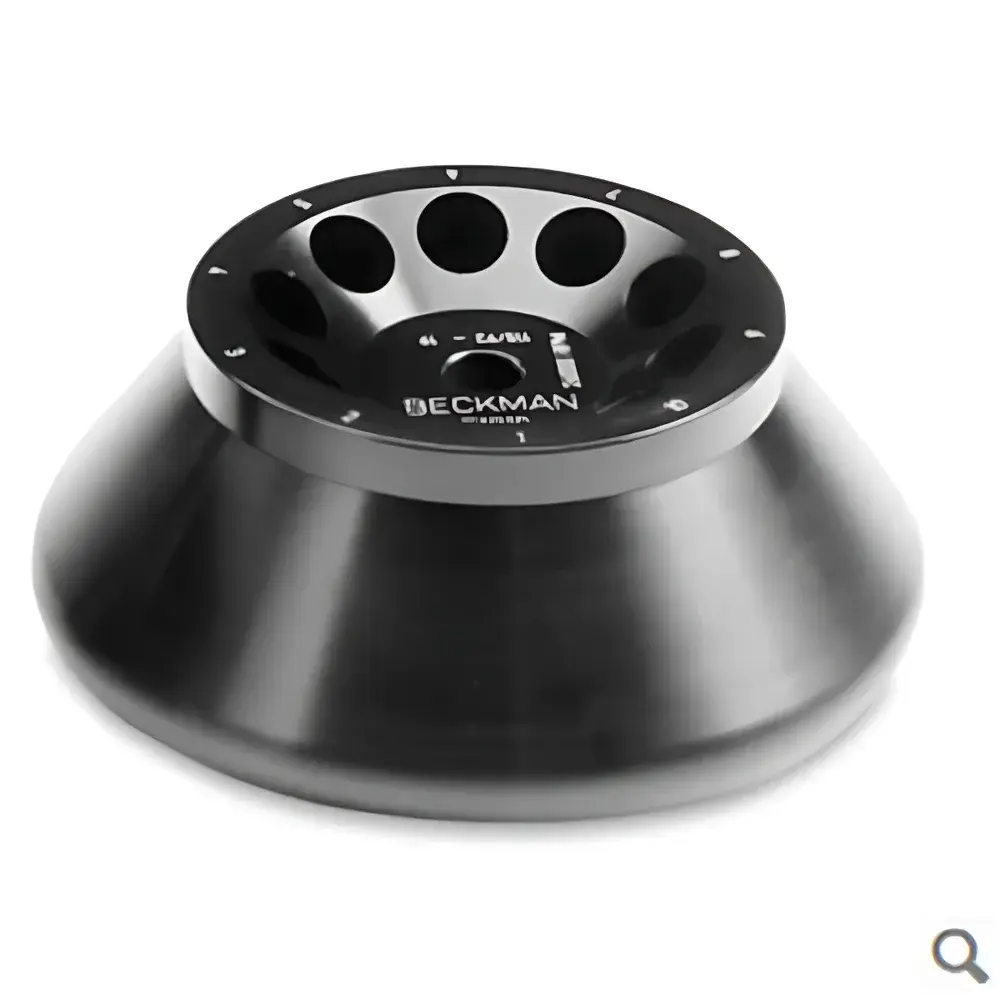
Beckman Coulter F1010 Fixed-Angle Rotor for Benchtop Centrifuges
| Brand | Beckman Coulter |
|---|---|
| Origin | USA |
| Model | F1010 |
| Instrument Type | Benchtop Centrifuge Rotor |
| Rotor Type | Fixed-Angle |
| Max Capacity | 10 × 10 mL |
| Max Speed | 26,000 rpm |
| Max RCF | 57,440 × g |
| k-Factor | 500 |
| Compatible Systems | Allegra 64R and Allegra X-30 Series Centrifuges |
| BioC Certification | Not Applicable |
Overview
The Beckman Coulter F1010 fixed-angle rotor is a precision-engineered centrifugation component designed exclusively for integration with the Allegra 64R and Allegra X-30 series benchtop centrifuges. Engineered to deliver high-performance sedimentation under controlled gravitational forces, this rotor operates on the principle of fixed-angle centrifugation—where sample tubes are held at a constant angle (typically 35°–45°) relative to the axis of rotation. This geometry promotes rapid pelleting of particles by maximizing the effective path length of sedimentation while minimizing resuspension during deceleration. With a maximum rated speed of 26,000 rpm and an RCF ceiling of 57,440 × g, the F1010 enables efficient separation of subcellular organelles, macromolecular complexes, and precipitated nucleic acids in routine laboratory workflows. Its k-factor of 500 reflects moderate run-time efficiency—optimized for balance between throughput and resolution in applications requiring reproducible, mid-range centrifugal force delivery.
Key Features
- Fixed-angle configuration with precisely machined aluminum alloy construction for thermal stability and mechanical rigidity under high-speed operation.
- Rated for 10 × 10 mL conical or round-bottom polypropylene or polycarbonate tubes—compatible with standard microcentrifuge tube formats used in molecular biology and clinical diagnostics.
- Designed for seamless installation and automatic rotor recognition on Allegra 64R and X-30 platforms, ensuring firmware-enforced safety interlocks and speed/RCF validation.
- Autoclavable (121°C, 15 psi, 20 min) for sterility assurance in cell culture and vaccine development environments—validated per ISO 13485-compliant cleaning protocols.
- No BioC certification required; intended for non-GMP research use where full traceability per FDA 21 CFR Part 11 is not mandated—but fully compatible with instrument audit trail logging when paired with Allegra system software.
Sample Compatibility & Compliance
The F1010 rotor accommodates common 10 mL centrifuge tubes—including Beckman Coulter Polyallomer™, Ultra-Clear™, and certified DNase/RNase-free disposable variants. It supports both aqueous and low-viscosity organic solvent-based samples (e.g., ethanol precipitations, phenol-chloroform extractions), provided density differentials exceed 0.05 g/mL. While not designated as BioC-certified, its material composition (6061-T6 aluminum) complies with USP Class VI biocompatibility standards for indirect contact with biological materials. The rotor meets IEC 61010-2-020 safety requirements for laboratory centrifuges and is CE-marked for use within the European Economic Area. Routine calibration verification follows ASTM E2920 guidelines for rotor performance validation.
Software & Data Management
When installed on Allegra 64R or X-30 systems running Centriware™ v5.3 or later, the F1010 rotor is automatically identified and configured via embedded RFID tags. All run parameters—including speed, time, acceleration/deceleration profiles, and real-time RCF calculation—are logged with timestamped metadata. Audit trails support GLP-compliant documentation, including operator ID, rotor serial number, and cycle history—exportable in CSV or PDF format for internal quality review. No proprietary drivers or third-party middleware are required; native USB and Ethernet interfaces enable integration into centralized LIMS environments via HL7 or ASTM E1384 messaging frameworks.
Applications
- Isolation of mitochondria, lysosomes, and microsomal fractions from mammalian tissue homogenates.
- Clarification of bacterial lysates prior to protein purification (e.g., His-tagged recombinant expression).
- Concentration of viral vectors (AAV, lentivirus) and exosomes from conditioned media.
- Routine DNA/RNA pellet recovery following alcohol precipitation steps in NGS library preparation.
- Phase separation in immunoaffinity capture workflows involving magnetic bead–antibody complexes.
FAQ
Is the F1010 rotor compatible with Beckman Coulter Avanti or Optima ultracentrifuges?
No. The F1010 is mechanically and electronically certified only for Allegra 64R and Allegra X-30 benchtop systems. It lacks the rotor hub interface and balancing specifications required for floor-model ultracentrifuges.
Can this rotor be used with sealed aerosol-tight caps?
Yes—provided caps meet ASME BPE-2021 sealing integrity standards and do not exceed 10 mL nominal volume. Over-torquing may compromise rotor balance; torque specification is 12–15 N·m.
What is the recommended maintenance interval for rotor inspection?
Visual and dimensional inspection every 500 runs or annually—whichever occurs first—per Beckman Coulter Technical Bulletin TB-102. Record all inspections in the facility’s equipment logbook.
Does the F1010 support refrigerated operation?
Yes. When installed in refrigerated Allegra models (e.g., Allegra 64R), it maintains temperature setpoints from –10°C to +40°C across the full speed range without condensation-induced imbalance.
Is rotor lifetime finite? How is end-of-service determined?
Yes. Lifetime is defined by cumulative operational hours and exposure to corrosive agents. Beckman Coulter specifies a service life of 10,000 hours or 15 years—whichever comes first—under documented operating conditions per TB-101.



