
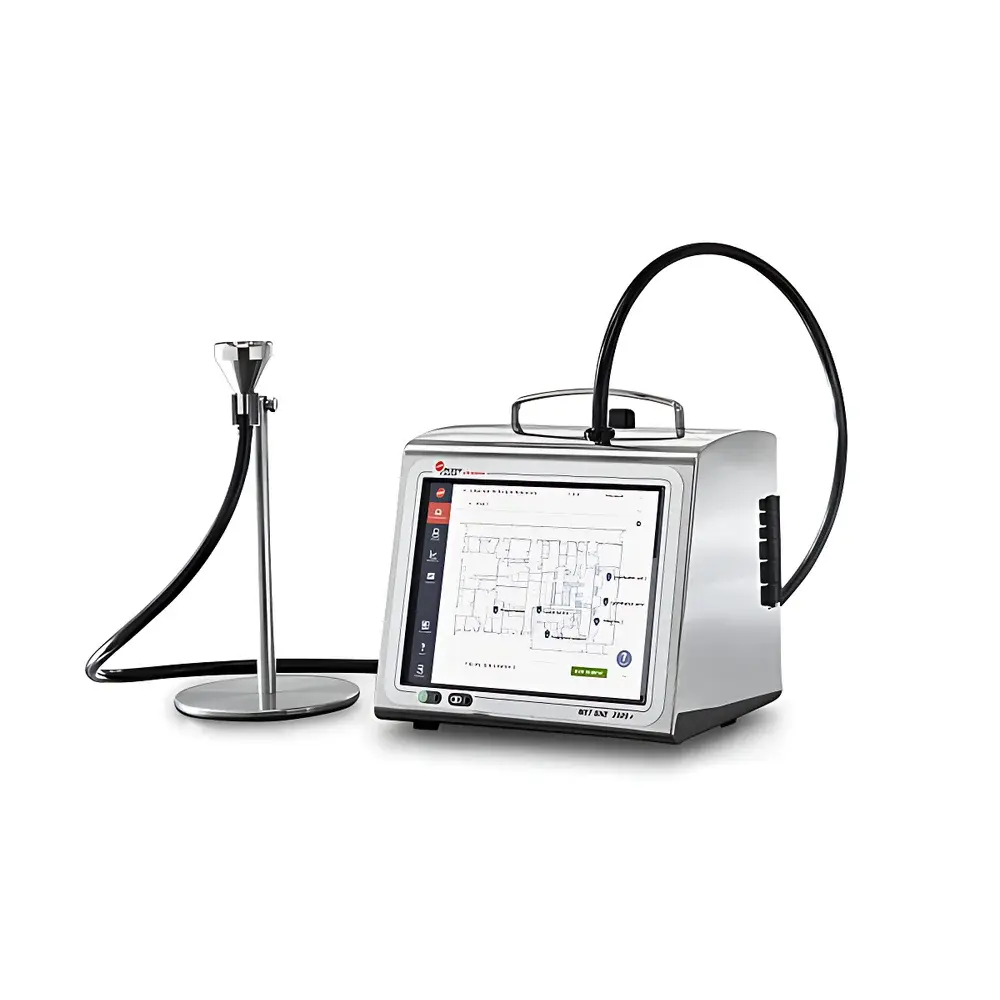
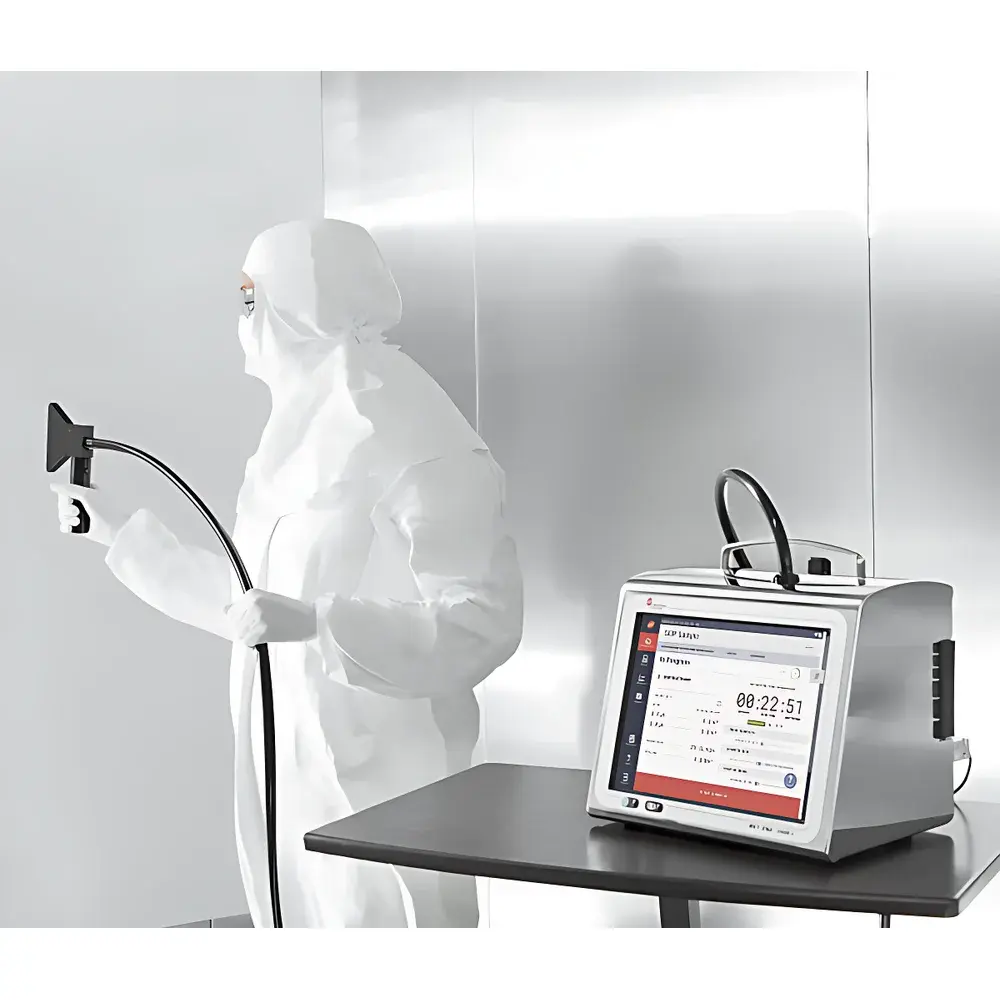
Beckman Coulter MET ONE 3400+ Portable Optical Particle Counter
| Brand | Beckman Coulter |
|---|---|
| Origin | USA |
| Manufacturer Type | Manufacturer |
| Origin Category | Imported |
| Model | MET ONE 3400+ |
| Instrument Type | Optical Particle Counter |
| Flow Rates | 28.3 L/min, 50 L/min, 100 L/min |
| Standard Sizing Channels | 0.3, 0.5, 1.0, 3.0, 5.0, 10.0 µm (model-dependent) |
| Laser Source | Long-life laser diode (MTBF ≥ 10 years) |
| Power | AC input 80–264 VAC |
| Dimensions | 26.7 × 26 × 21 cm (10.5" × 10.25" × 8.25") |
| Weight | 5.6 kg (no battery), 6.9 kg (with 2 cells) |
| Enclosure | 316 stainless steel |
| Operating Environment | 0–40°C, 10–90% RH (non-condensing) |
| Compliance | FDA 21 CFR Part 11 ready, ISO 21501-4, ISO 14644-1, EU GMP Annex 1 compatible |
Overview
The Beckman Coulter MET ONE 3400+ is a high-performance, portable optical particle counter engineered for real-time, regulatory-compliant environmental monitoring in controlled environments—including cleanrooms, isolators, aseptic processing suites, and pharmaceutical manufacturing facilities. It operates on the principle of light scattering: airborne particles drawn through a precisely controlled laminar flow path intersect a collimated laser beam; scattered photons are detected by a photodiode array calibrated to quantify particle concentration across multiple size thresholds. Unlike fixed-installation counters, the MET ONE 3400+ integrates mobility with enterprise-grade data integrity—enabling rapid, repeatable, and auditable spatial mapping of airborne particulate contamination without compromising measurement fidelity or operational traceability.
Key Features
- Touchscreen & web-based SOP authoring: Define sampling sequences, assign location-specific parameters, and load georeferenced floor plans directly via the 10-inch capacitive LCD or remote browser interface—supporting glove-compatible operation.
- Visual sampling map execution: Preloaded point maps display real-time status—green icons confirm completed sampling points—providing immediate visual feedback during routine monitoring campaigns.
- Barcode-assisted sampling: Optional integrated barcode reader enables one-touch annotation of sample IDs, locations, operators, and timestamps—eliminating manual entry errors and reinforcing ALCOA+ data principles (Attributable, Legible, Contemporaneous, Original, Accurate).
- Centralized SOP lifecycle management: Administrators revise, digitally sign, and deploy updated SOPs across instrument groups via HTTPS-secured web portal—changes propagate automatically, ensuring version control and procedural consistency.
- Regulatory-ready electronic records: All final reports include embedded electronic signatures, audit trails, and immutable metadata—exportable in secure PDF/A or CSV formats compliant with FDA 21 CFR Part 11 and EU Annex 11 requirements.
- Network-transparent architecture: Native Ethernet (10/100BASE-TX) and IEEE 802.11 b/g WiFi enable zero-software-deployment remote access, real-time data streaming, and centralized fleet monitoring—minimizing IT overhead.
Sample Compatibility & Compliance
The MET ONE 3400+ is validated for continuous monitoring of ISO Class 5–8 environments per ISO 14644-1 and EU GMP Annex 1. Its optical design meets ISO 21501-4 for calibration traceability to NIST standards, with documented counting efficiency (50% at 0.3 µm or 0.5 µm depending on model variant) and sizing resolution verified under controlled aerosol challenge conditions. Integrated temperature and relative humidity sensors (DIN-port compatible) allow concurrent environmental parameter logging—critical for trending and root-cause analysis. The stainless-steel 316 enclosure, IP54-rated ingress protection, and sealed internal optics support cleaning with common disinfectants (e.g., 70% IPA, hydrogen peroxide vapor), satisfying pharmaceutical facility hygiene protocols.
Software & Data Management
No proprietary client software is required. Configuration, calibration verification, report generation, and user permission management occur entirely through a standards-based web interface supporting TLS 1.2 encryption. The system maintains a full audit trail—including user login/logout events, SOP edits, alarm acknowledgments, and report approvals—with timestamped entries linked to authenticated identities. Electronic signatures comply with digital signature validation workflows defined in 21 CFR Part 11 Subpart B, including role-based access control, biometric or two-factor authentication options, and non-repudiation safeguards. Data export supports both structured (CSV) and archival (PDF/A-2u) formats, each retaining cryptographic hash integrity for long-term retention and regulatory inspection readiness.
Applications
- ISO-certified cleanroom qualification and routine surveillance per ISO 14644-2
- Aseptic process simulation (media fill) environmental monitoring
- Facility commissioning, requalification, and change control impact assessment
- Investigation of excursions and non-conformance events using spatiotemporal particle trajectory analysis
- Supplier qualification and incoming air quality verification for HVAC pre-filters and ULPA systems
- Supporting Quality Risk Management (QRM) frameworks under ICH Q9 and PIC/S PI 007-6
FAQ
Does the MET ONE 3400+ require annual recalibration?
Calibration verification is recommended before each critical monitoring campaign using NIST-traceable PSL standards; full recalibration is performed annually or after instrument service—per ISO 21501-4 and internal SOPs.
Can multiple users access the same instrument simultaneously?
Yes—role-based concurrent web sessions are supported, with granular permissions for operators, supervisors, and administrators defined in the user management module.
Is offline operation supported when network connectivity is unavailable?
Yes—SOPs, maps, and sampling configurations are stored locally; all data is cached and synchronized to the central server upon network restoration, preserving chronological integrity and audit trail continuity.
What environmental probes are natively supported?
Integrated temperature and relative humidity sensing is standard; optional DIN-port expansion supports external CO₂, differential pressure, or viable particle probes (e.g., microbial impactors) via third-party certified interfaces.
How is battery health monitored and maintained?
Smart Li-ion batteries report state-of-charge, cycle count, and thermal history in real time; firmware enforces optimal charge/discharge profiles to maximize service life—consistent with IEC 62133 safety compliance.



