
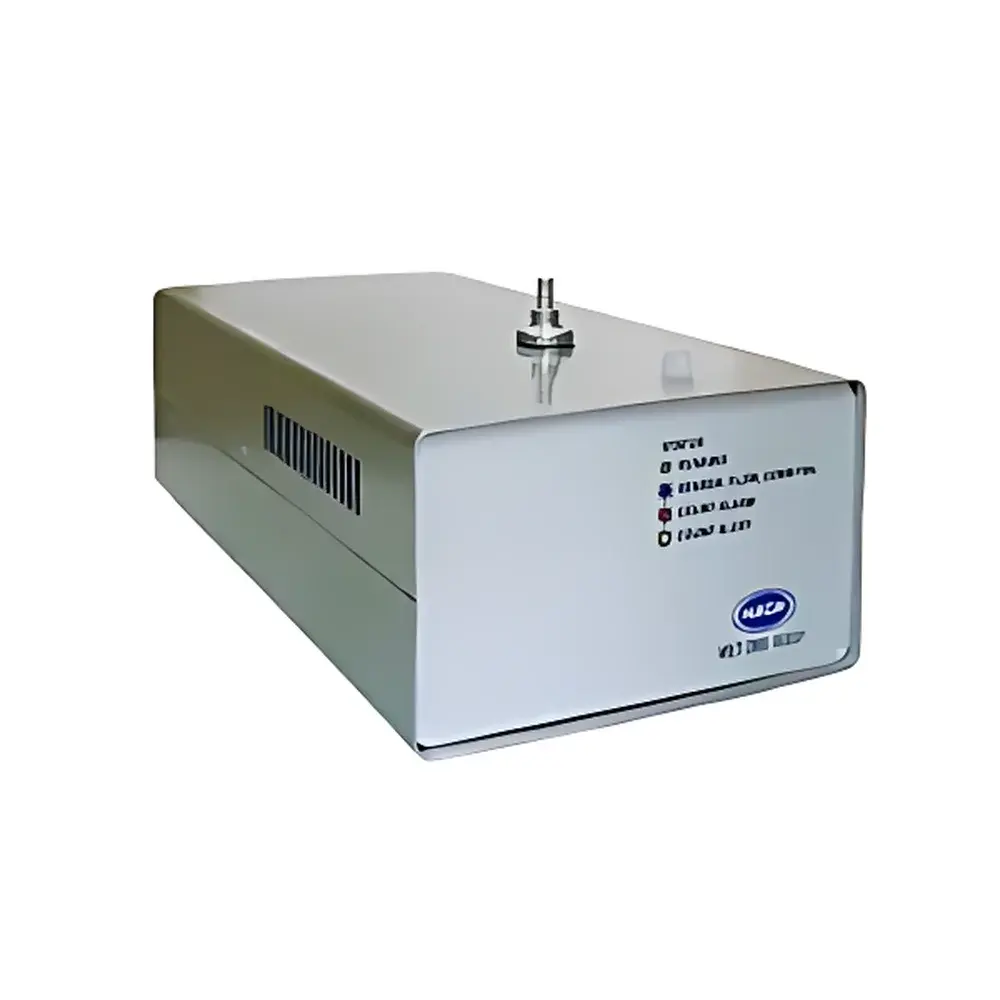
Beckman Coulter MET ONE 6000P Remote Airborne Particle Counter
| Brand | Beckman Coulter |
|---|---|
| Origin | USA |
| Manufacturer Type | Original Equipment Manufacturer (OEM) |
| Origin Category | Imported |
| Model | MET ONE 6000P |
| Instrument Type | Optical Airborne Particle Counter |
| Flow Rate Options | 0.1 cfm or 1.0 cfm |
| Sizing Thresholds | 0.3 µm and 0.5 µm |
| Channel Configurations | Standard 2-channel or optional 4-channel |
| Light Source | Long-life laser diode |
| Housing Material | Stainless steel |
| Dimensions | 17.15 × 11.43 × 31.75 cm (W × D × H) |
| Weight | 4.62 kg (10.2 lb) |
| Power Supply | 24 VDC ±10% or 100–230 VAC, 50/60 Hz |
| Max. Power Consumption | 50 W (DC), 7.9 W (AC) |
| Operating Temperature | 10–32 °C |
| Operating Humidity | 5–95% RH, non-condensing |
| Storage Temperature | −40–70 °C |
| Storage Humidity | 5–98% RH, non-condensing |
| Counting Efficiency Loss | ≤5% at 2×10⁶ particles/ft³ (7.1×10⁷ particles/m³) and at 4×10⁵ particles/ft³ (1.4×10⁷ particles/m³) |
| False Count Rate | ≤1 particle per 5 minutes |
| Flow Control | Microprocessor-based with differential pressure sensor |
| Pump Type | Integrated vacuum pump |
| Compliance | ISO 21501-4:2018, ISO 14644-1:2015, FDA 21 CFR Part 11 (data integrity support), EU GMP Annex 1 (2022) alignment |
| Output Interfaces | 4–20 mA analog, Ethernet TCP/IP, Modbus RTU (RS-485), pulse output, optional wireless modules |
Overview
The Beckman Coulter MET ONE 6000P is a microprocessor-controlled, pump-integrated remote airborne particle counter engineered for continuous, fixed-location monitoring in regulated cleanroom environments. It operates on the principle of light scattering—where airborne particles passing through a focused laser beam generate scattered photons detected by a high-sensitivity photodetector—and converts signal amplitude into discrete size channels per ISO 21501-4:2018. Unlike vacuum-drawn systems requiring centralized manifolds and costly infrastructure, the MET ONE 6000P incorporates an internal, maintenance-optimized vacuum pump enabling true point-of-use deployment without external suction lines. Its design supports long-term unattended operation under Class ISO 5–ISO 8 conditions (per ISO 14644-1:2015), delivering traceable, metrologically validated particle concentration data essential for environmental monitoring programs in pharmaceutical aseptic processing, semiconductor fabrication, flat-panel display manufacturing, and HDD production.
Key Features
- Integrated vacuum pump eliminates dependency on facility-wide vacuum networks—reducing installation complexity, tubing length, and associated particle loss or flow instability.
- Real-time volumetric flow control via microprocessor and differential pressure sensor ensures stable sampling at either 0.1 cfm (2.83 L/min) or 1.0 cfm (28.3 L/min), with automatic compensation for filter loading and ambient pressure shifts.
- Compliance with ISO 21501-4:2018 calibration requirements—including counting efficiency, size resolution, false count rate, and coincidence loss limits—validated across both 0.3 µm and 0.5 µm detection thresholds.
- Stainless-steel enclosure (316L-compatible finish) provides corrosion resistance and meets cleanroom-compatible material standards for non-shedding, non-outgassing performance.
- Multi-protocol communication architecture: native support for 4–20 mA analog output, Ethernet TCP/IP (with HTTP/HTTPS and SNMP v3), Modbus RTU over RS-485, TTL pulse output, and optional Wi-Fi or cellular telemetry modules.
- Embedded multi-color LED status indicator delivers immediate visual diagnostics—differentiating between normal operation, count alarm, sensor fault, flow deviation, and communication interruption without requiring software access.
Sample Compatibility & Compliance
The MET ONE 6000P is designed exclusively for ambient and recirculated air sampling in controlled environments. It does not support liquid-phase or aerosolized chemical challenge testing. Its optical design and flow path geometry are optimized for dry, non-hygroscopic particles typical of cleanroom contamination sources (e.g., skin flakes, polymer wear debris, filter media fibers). The instrument meets ISO 14644-2:2015 requirements for continuous monitoring system validation and supports audit-ready data integrity features aligned with FDA 21 CFR Part 11 (electronic records/signatures), EU GMP Annex 1 (2022) Section 8.43 (environmental monitoring instrumentation), and PIC/S PI 007-6. Calibration traceability is maintained to NIST-traceable reference aerosols (e.g., PSL, DEHS) per ISO 21501-4 procedures, with documented uncertainty budgets available upon request.
Software & Data Management
The MET ONE 6000P operates as a standalone node or integrates natively into Facility Monitoring Systems (FMS) via open protocols—no proprietary middleware required. Raw particle counts per channel, volumetric flow rate, temperature, humidity (when paired with optional external sensors), and diagnostic flags are timestamped with millisecond precision and transmitted continuously. Data payloads support CSV export, OPC UA mapping, and direct ingestion into SQL-based LIMS or MES platforms. Audit trail functionality logs all configuration changes, firmware updates, and user-initiated calibrations with operator ID and timestamp—enabling full GLP/GMP compliance during regulatory inspections. Firmware updates are digitally signed and delivered via secure HTTPS, ensuring integrity verification prior to installation.
Applications
- Aseptic Manufacturing: Continuous monitoring of Grade A/B critical zones in sterile filling suites; supports dynamic classification per EU GMP Annex 1 and USP / environmental control strategies.
- Semiconductor Fabrication: Real-time detection of sub-100 nm process-related particulates in photolithography and etch tool load-locks; enables rapid root-cause analysis of yield excursions.
- Flat-Panel Display Production: Monitoring of large-area cleanrooms where laminar airflow uniformity must be verified across extended ductwork—leveraging distributed 6000P nodes to map spatial particle gradients.
- HDD Assembly Environments: Cost-effective per-point deployment across high-density tool clusters, minimizing total cost of ownership versus legacy manifold-based solutions while maintaining ISO 21501 counting fidelity.
- Research & Development Cleanrooms: Flexible reconfiguration between 0.1 cfm (high-sensitivity mode) and 1.0 cfm (high-volume throughput) supports method development for novel filtration or air handling validation studies.
FAQ
Does the MET ONE 6000P require annual recalibration?
Yes—per ISO 21501-4:2018 Clause 7.3, periodic verification using NIST-traceable reference aerosols is mandatory at intervals not exceeding 12 months, or after any event affecting optical alignment or flow accuracy.
Can it operate in high-humidity environments such as wet chemistry labs?
No—the specified operating humidity range is 5–95% RH non-condensing. Condensation inside the optical chamber will impair laser stability and scatter detection; use only in climate-controlled cleanrooms meeting ISO 14644-1 temperature/humidity specifications.
Is Modbus TCP supported, or only Modbus RTU?
Modbus RTU over RS-485 is standard; Modbus TCP is not natively implemented but can be enabled via third-party protocol gateways compatible with the device’s Ethernet TCP/IP interface.
What is the maximum allowable particle concentration before coincidence error exceeds specification?
Per ISO 21501-4, the upper limit for ≤5% counting efficiency loss is 4×10⁵ particles/ft³ (1.4×10⁷ particles/m³) at 0.3 µm and 2×10⁶ particles/ft³ (7.1×10⁷ particles/m³) at 0.5 µm—values confirmed during factory acceptance testing.
Does the unit include built-in data storage if network connectivity fails?
No—the MET ONE 6000P does not feature local non-volatile memory; it is designed for real-time streaming to FMS or SCADA. Redundant network paths or edge buffering at the FMS level are recommended for continuity assurance.



