
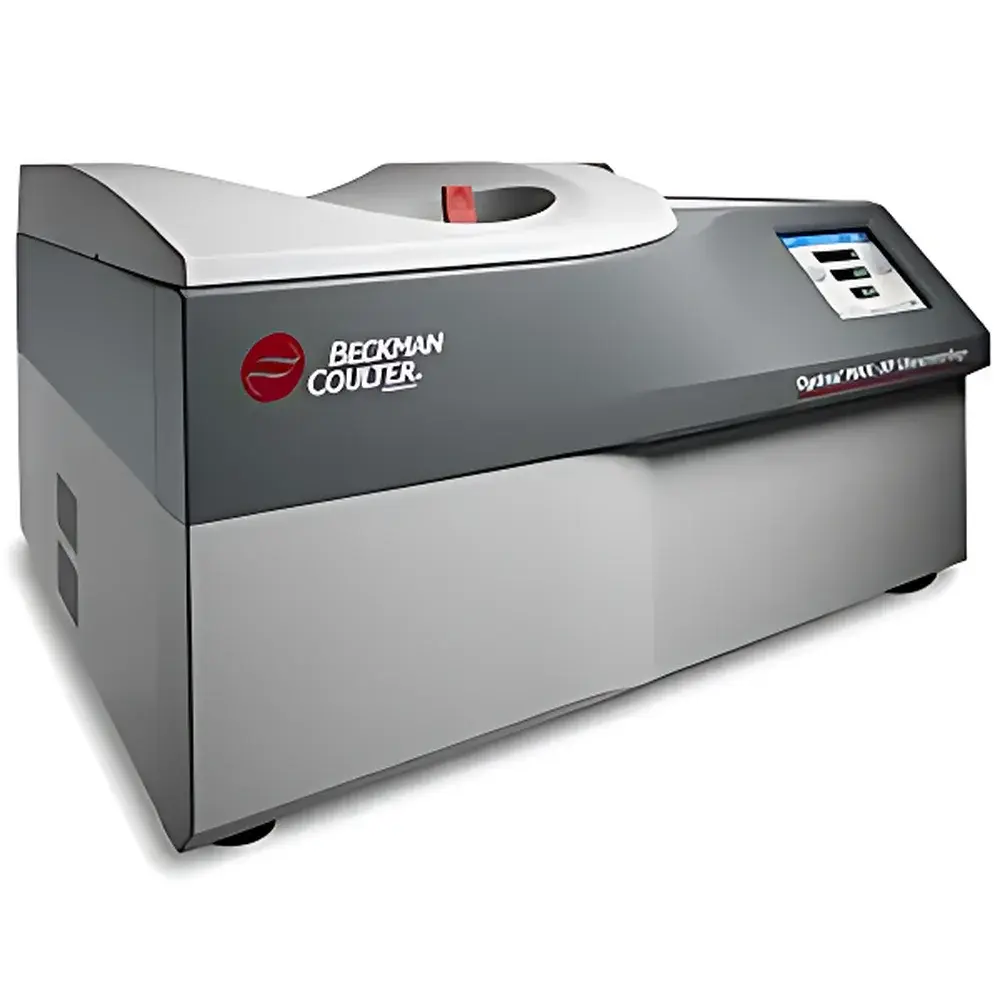
Beckman Coulter Optima MAX-XP Benchtop Ultracentrifuge
| Brand | Beckman Coulter |
|---|---|
| Origin | USA |
| Manufacturer | Beckman Coulter, Inc. |
| Product Type | Benchtop Ultracentrifuge |
| Speed Range | Up to 150,000 rpm |
| Max RCF | 1,019,400 × g |
| Max Capacity | 194.4 mL |
| Sample Volume Range | 0.175–194.4 mL |
| Dimensions (W × H × D) | 58.4 × 73.7 × 40.9 cm |
| Compliance | Designed for GLP/GMP environments with electronic audit trail support |
| Rotor Types | Fixed-angle, swinging-bucket, vertical, near-vertical |
| Safety | Integrated biosafety features including optional HEPA aerosol containment |
Overview
The Beckman Coulter Optima MAX-XP is a high-performance benchtop ultracentrifuge engineered for precision separation of subcellular components, viruses, macromolecular complexes, and nanoscale particles. Operating on the principles of sedimentation equilibrium and rate-zonal centrifugation, the system delivers exceptional resolution and reproducibility under extreme gravitational forces—up to 1,019,400 × g at 150,000 rpm. Its compact footprint (58.4 × 73.7 × 40.9 cm) integrates industrial-grade rotor dynamics, active temperature control (typically 0–40 °C), and vibration-damped architecture to ensure stable operation in shared laboratory environments. Unlike conventional high-speed centrifuges, the Optima MAX-XP employs a brushless induction motor coupled with a vacuum-sealed rotor chamber to minimize air resistance, thermal drift, and mechanical noise—enabling sustained ultra-high-speed runs with minimal sample heating or degradation.
Key Features
- Intelligent touchscreen interface with customizable icons (12 options), adjustable audio feedback, and dual-language support (English/Chinese) for multilingual lab teams.
- Comprehensive electronic logging: user authentication via password-protected login, timestamped run records, parameter traceability, and configurable audit trails compliant with FDA 21 CFR Part 11 requirements.
- Five-step programmable protocols supporting sequential gradients, delayed start, continuous cycling, and multi-step pelleting/resuspension workflows.
- Integrated biosafety design: compatible with biosafety cabinet placement; optional HEPA-filtered aerosol containment system mitigates risk during viral or pathogenic sample processing.
- Rotor-sensor interlock system verifies rotor identity, usage history, and fatigue status in real time—preventing unauthorized or over-cycled rotor deployment.
- Advanced rotor compatibility: supports fixed-angle (e.g., Type 70 Ti, Type 90 Ti), swinging-bucket (e.g., SW 41 Ti), vertical (e.g., VTi 65.2), and near-vertical (e.g., NVT 65) configurations for differential, isopycnic, and sucrose gradient applications.
Sample Compatibility & Compliance
The Optima MAX-XP accommodates sample volumes from 175 µL to 194.4 mL across a broad range of certified centrifuge tubes—including conical-bottom tubes for pellet concentration, quick-seal polyallomer tubes for contamination-sensitive workflows, g-Max tubes rated for >1,000,000 × g, and fingertip-seal polycarbonate tubes for rapid handling. All rotors and tube sets are validated per ISO 15189 and ASTM F2119 standards for mechanical integrity and dimensional consistency. The system meets IEC 61010-1 safety specifications and supports GLP/GMP documentation requirements through secure data export (CSV, PDF) and encrypted local storage. Optional FRIP (Field Rotor Inspection Program) enables on-site non-destructive rotor integrity assessment using ultrasonic pulse-echo methodology—ensuring compliance with Beckman Coulter’s lifetime rotor warranty conditions.
Software & Data Management
Controlled via the intuitive Optima MAX-XP Touch software, the instrument provides full experimental metadata capture—including operator ID, rotor serial number, tube lot code, acceleration/deceleration profiles, real-time RCF and temperature curves, and end-of-run diagnostics. Data files are stored with SHA-256 hash verification and support role-based access control (RBAC). Export formats include XML (for LIMS integration), CSV (for statistical analysis), and PDF (for regulatory submission). Software updates are delivered via secure HTTPS channel with digital signature validation, maintaining continuity of compliance throughout the instrument lifecycle.
Applications
- Virology: purification and concentration of enveloped/non-enveloped viruses (e.g., influenza, SARS-CoV-2 pseudovirions) using sucrose or iodixanol density gradients.
- Genomics: isolation of extracellular vesicles (EVs), exosomes, and ribonucleoprotein complexes from plasma, cell culture supernatants, or tissue homogenates.
- Structural biology: preparation of homogeneous samples for cryo-EM grid freezing, analytical ultracentrifugation (AUC), and small-angle X-ray scattering (SAXS).
- Nanotechnology: size-fractionation of lipid nanoparticles (LNPs), polymer micelles, and quantum dot suspensions based on sedimentation coefficient distributions.
- Cell biology: subcellular fractionation of mitochondria, lysosomes, peroxisomes, and microsomal membranes using differential centrifugation protocols.
FAQ
What is the maximum k-factor for the Optima MAX-XP when using the SW 41 Ti rotor?
The SW 41 Ti rotor achieves a k-factor of 122 at 41,000 rpm, enabling efficient pelleting of organelles and large macromolecular assemblies.
Can the Optima MAX-XP be integrated into an automated liquid handling workflow?
Yes—via RS-232 or Ethernet interface, the system supports bidirectional communication with third-party LIMS and robotic platforms using ASCII command protocol.
Is rotor calibration required before each run?
No—rotor identification is automatic via embedded RFID tags; however, periodic FRIP inspection is recommended every 12 months or after 1,000 runs.
Does the instrument support temperature-controlled runs below 4 °C?
The standard refrigeration module maintains setpoints between 0 °C and 40 °C; sub-zero operation requires external chiller coupling via optional dry-gas purge interface.
How does the system handle power interruptions during high-speed runs?
Integrated uninterruptible power supply (UPS) support ensures controlled deceleration and rotor coast-down without emergency brake activation, preserving sample integrity and rotor longevity.



