
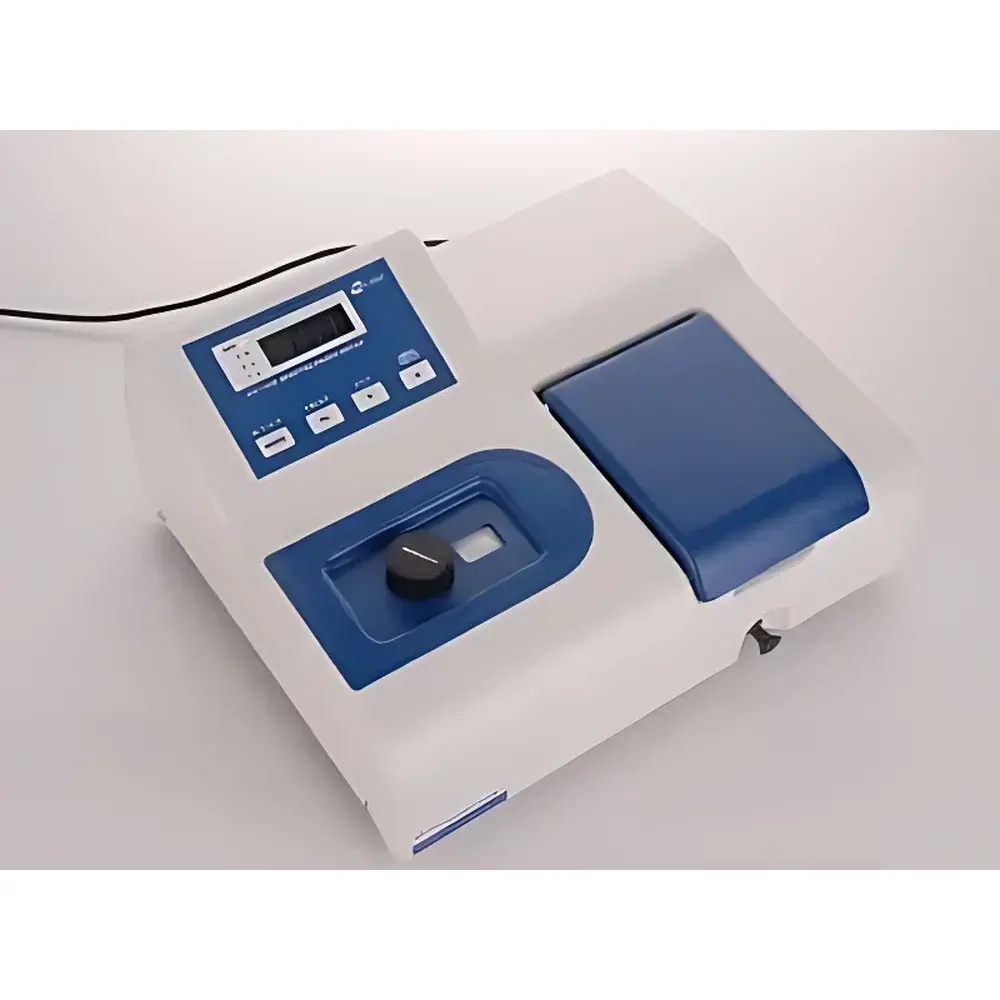
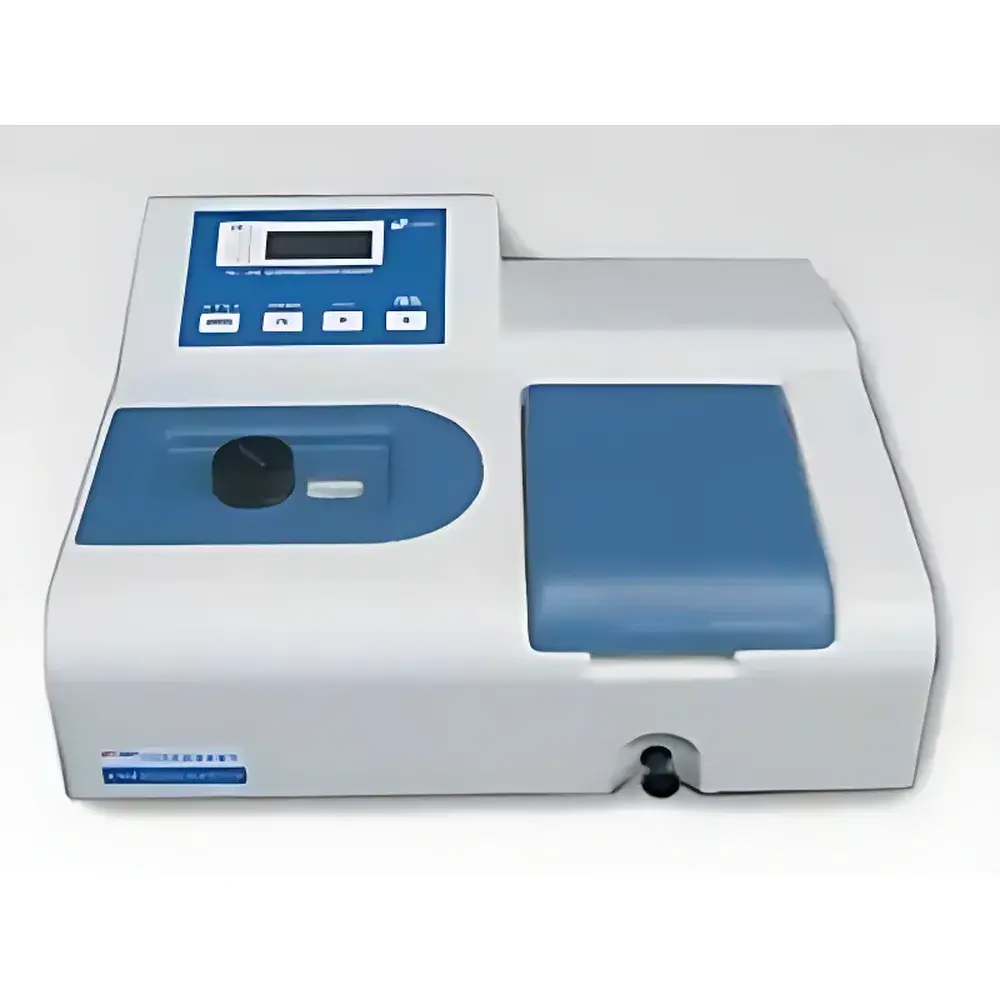
Beifen Ruili 722N Visible Spectrophotometer
| Brand | Beifen Ruili |
|---|---|
| Origin | Beijing, China |
| Model | 722N |
| Optical System | Single-beam Czerny-Turner with 1200 L/mm grating |
| Wavelength Range | 350–1020 nm |
| Spectral Bandwidth | 6 nm |
| Wavelength Accuracy | ±2 nm |
| Stray Light | ≤0.3% T at 400 nm |
| Photodetector | Silicon photodiode array |
| Measurement Modes | Transmittance (T), Absorbance (A), Concentration (C) |
| Display | 128×64 dot-matrix LCD |
| Zero Adjustment | Automatic |
| Weight | 8 kg |
| Dimensions (L×W×H) | 520×450×320 mm |
Overview
The Beifen Ruili 722N Visible Spectrophotometer is a precision single-beam optical instrument engineered for routine quantitative and qualitative analysis in the visible spectrum. Based on the Czerny-Turner monochromator design with a 1200 lines/mm holographic grating, it delivers stable spectral dispersion across a wavelength range of 350–1020 nm—covering the full visible region and extending into the near-infrared for broader method flexibility. Its optical architecture employs a high-stability imported tungsten-halogen lamp as the broadband source, optimized for consistent radiant output over extended operational lifetimes. The instrument operates on Beer–Lambert law principles, converting sample-induced attenuation of monochromatic light into quantifiable transmittance (%T) or absorbance (A) values, supporting concentration determination via calibration curves. Designed for robustness in teaching laboratories, QC environments, and field-deployable applications, the 722N maintains thermal and mechanical stability critical for reproducible measurements under non-climate-controlled conditions.
Key Features
- Single-beam optical path with automatic wavelength scanning and real-time digital display of %T, A, and concentration values
- Integrated auto-zero and auto-100%T calibration sequence—eliminates manual alignment drift and reduces operator dependency
- High-efficiency silicon photodiode array detector enabling rapid signal acquisition and low-noise performance (typical noise: ≤0.2% T)
- Spacious sample compartment accommodating cuvettes up to 10 cm pathlength—compatible with standard 10 mm, 20 mm, 50 mm, and custom macro-cells
- Front-panel RS232 serial interface for direct connection to external printers or host computers; supports ASCII-based data export for post-acquisition analysis in Excel or LIMS platforms
- Compact, fanless thermal design with aluminum alloy chassis—minimizes vibration-induced spectral artifacts and ensures long-term baseline stability (≤0.004 A/h at 500 nm)
Sample Compatibility & Compliance
The 722N accepts standard quartz, glass, or plastic cuvettes (10 × 10 mm, 20 × 20 mm, and 50 × 50 mm footprints) and accommodates both liquid and semi-solid suspensions when paired with appropriate cell holders. Its 6 nm spectral bandwidth meets typical resolution requirements for colorimetric assays per ASTM D1209 (platinum-cobalt scale), ISO 6271 (water clarity), and USP spectrophotometric absorbance verification protocols. While not designed for GLP/GMP-regulated environments requiring full 21 CFR Part 11 audit trails, its deterministic calibration workflow—including fixed-wavelength verification points at 440 nm, 546 nm, and 635 nm—supports documented method validation in ISO/IEC 17025-accredited labs. Stray light performance (≤0.3% T at 400 nm) complies with ISO 9001:2015 instrumentation control clauses for routine absorbance linearity verification.
Software & Data Management
The 722N operates autonomously via embedded firmware without proprietary PC software. All measurement data—including time-stamped %T/A readings, user-defined calibration coefficients, and wavelength-swept spectra—are accessible via RS232 output using standard terminal emulation (e.g., PuTTY, Tera Term) at 9600 bps, 8N1. Exported datasets follow tab-delimited ASCII format compatible with spreadsheet import, statistical packages (R, Python pandas), and laboratory information management systems (LIMS). No drivers or vendor-specific utilities are required. For regulatory traceability, users may implement local logging scripts to capture serial output with timestamping and file hashing—supporting basic ALCOA+ data integrity principles where full electronic records are not mandated.
Applications
- Quantitative analysis of transition metal ions (e.g., Fe²⁺/Fe³⁺, Cu²⁺, Cr⁶⁺) using established colorimetric reagents (1,10-phenanthroline, bicinchoninic acid)
- Enzyme kinetics monitoring (e.g., NADH/NADPH oxidation at 340 nm, though limited by lower UV sensitivity)
- Water quality testing: nitrate, phosphate, silica, and turbidity estimation per APHA Standard Methods
- Educational use in undergraduate analytical chemistry labs for Beer’s law validation, calibration curve construction, and instrumental error analysis
- Industrial QC of dyes, pigments, and food colorants across CIE L*a*b* and Hunter Lab parameter estimation workflows
FAQ
Does the 722N support wavelength scanning or only fixed-wavelength measurements?
It supports manual wavelength selection across its full 350–1020 nm range but does not perform continuous spectral scanning. Users set discrete wavelengths for endpoint or multi-point assays.
Can I use quartz cuvettes below 350 nm?
No—the optical system is optimized for visible/near-IR operation only. Below 350 nm, throughput drops significantly due to tungsten lamp output decline and grating efficiency roll-off; UV-grade instruments require deuterium lamps and fused silica optics.
Is the RS232 interface optically isolated?
No—it is a standard TTL-level serial port without galvanic isolation. Use shielded cables and ground-referenced peripherals to minimize EMI in electrically noisy lab environments.
What maintenance is required for long-term accuracy?
Annual verification of wavelength accuracy using holmium oxide or didymium filters, and periodic cleaning of the sample compartment mirror and grating housing with lint-free swabs and spectroscopic-grade ethanol.
Does the instrument comply with CE or FCC electromagnetic compatibility directives?
As a domestically certified Chinese-manufactured device, it carries CCC mark compliance; CE/FCC declarations are not provided and should be independently verified if deployed in EU/US markets.






