
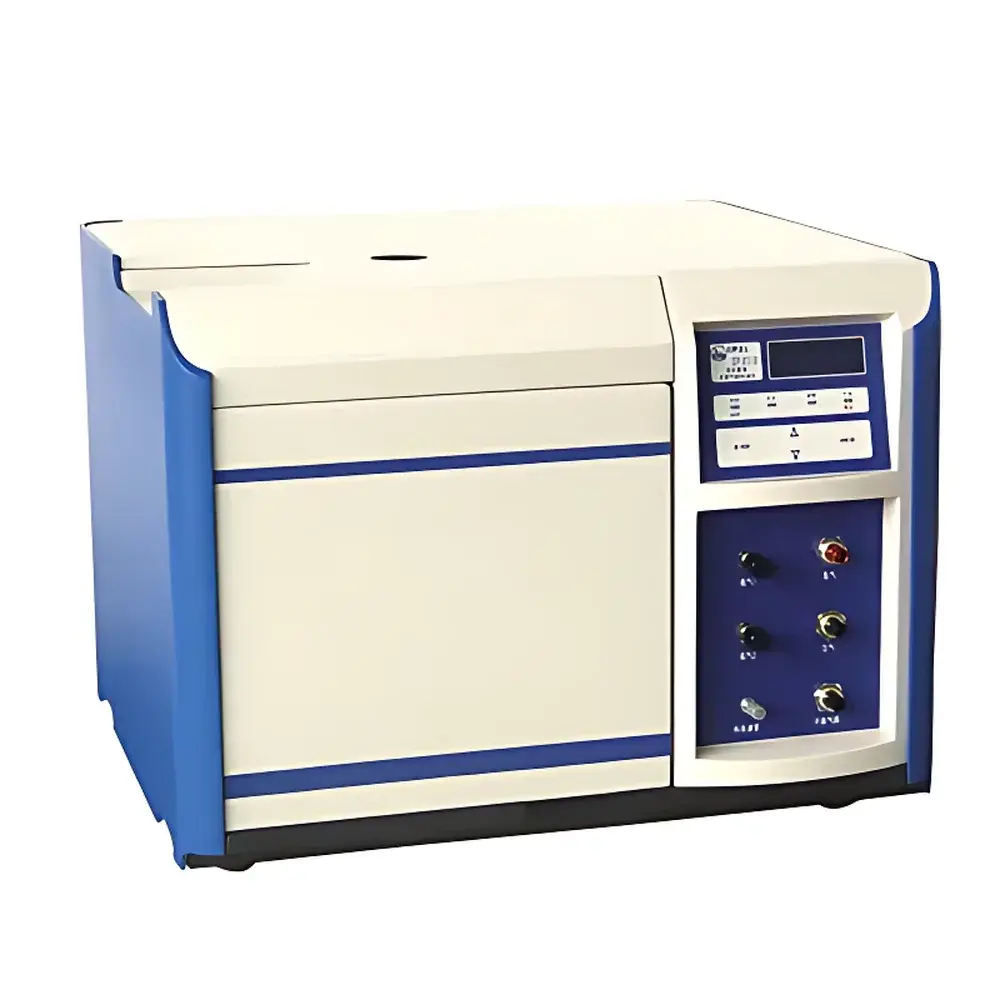
Beifen Ruili SP-2110 Transformer Oil Dedicated Gas Chromatograph
| Brand | Beifen Ruili |
|---|---|
| Origin | Beijing, China |
| Model | SP-2110 |
| Instrument Type | Dedicated Gas Chromatograph for Dissolved Gas Analysis (DGA) in Transformer Oil |
| Compliance | Designed to meet GB/T 17623–2017, DL/T 703–2015, and IEC 60567 requirements |
| Interface | USB 2.0 |
| Data Acquisition | Integrated with Transformer Oil DGA-Specific Chromatography Workstation |
| Injection System | Manual syringe injection with micro-switch trigger activation |
| Gas Control | Equipped with digital pressure and mass flow sensors for carrier gas (N₂, H₂, or Ar) and detector gases |
| Detector Configuration | Dual-TCD (Thermal Conductivity Detector) or TCD+FID (optional) |
| Column | Pre-packed stainless-steel capillary or packed column optimized for C₁–C₅ hydrocarbons and CO/CO₂ separation |
Overview
The Beifen Ruili SP-2110 Transformer Oil Dedicated Gas Chromatograph is a purpose-built analytical system engineered for dissolved gas analysis (DGA) in insulating mineral oils used in power transformers and high-voltage equipment. It operates on the principle of gas chromatography—separating gaseous components extracted from oil samples via headspace or vacuum extraction, followed by detection using thermal conductivity (TCD) and/or flame ionization (FID) detectors. The instrument is explicitly designed to fulfill the quantitative and qualitative requirements specified in national and international standards including GB/T 17623–2017 (“Guidelines for Gas Chromatographic Analysis of Dissolved Gases in Transformer Oil”), DL/T 703–2015 (“Technical Guidelines for DGA in Power Equipment”), and IEC 60567 (“Sampling of Gases and Oil from Oil-Filled Electrical Equipment and Analysis of Free and Dissolved Gases”). Its architecture prioritizes repeatability, trace-level sensitivity for key fault gases (H₂, CH₄, C₂H₂, C₂H₄, C₂H₆, CO, CO₂), and operational robustness in utility laboratory and substation maintenance environments.
Key Features
- Dedicated hardware and firmware configuration optimized exclusively for transformer oil DGA workflows—no generic GC method development required.
- Pre-calibrated, factory-set operating parameters—including column temperature ramp profiles, detector settings, and carrier gas flow rates—minimize setup time and reduce operator dependency.
- Integrated micro-switch injection port: mechanical activation synchronizes sample introduction with data acquisition start, eliminating timing errors and ensuring precise retention time alignment across runs.
- Digital gas pressure and mass flow monitoring system enables real-time verification of carrier and detector gas delivery, supporting audit-ready gas control documentation per ISO/IEC 17025 and GLP-compliant laboratories.
- USB 2.0 interface ensures plug-and-play connectivity with Windows-based DGA workstations; supports time-stamped raw data export in standard formats (.csv, .txt) for LIMS integration.
- Front-panel full Chinese graphical interface (GUI) with tactile keypad navigation—designed for technicians with varying levels of chromatographic expertise, reducing training overhead without compromising analytical integrity.
Sample Compatibility & Compliance
The SP-2110 accepts 5–15 mL oil samples prepared via standardized degassing techniques (e.g., vacuum extraction or headspace equilibration per ASTM D3612 or IEC 60567). It delivers reliable quantification of the seven critical fault gases relevant to IEEE C57.104 and IEC 60599 diagnostic interpretations. The system complies with metrological traceability requirements under CNAS-CL01 (equivalent to ISO/IEC 17025) when operated with certified reference gas mixtures and validated calibration curves. Its design supports routine compliance with utility-specific QA/QC protocols, including daily system suitability testing (SST), blank analysis, and duplicate sample analysis—fully documented within the workstation’s audit trail.
Software & Data Management
The dedicated DGA workstation software provides automated peak identification, baseline correction, and multi-point external standard calibration. It calculates gas concentration in µL/L (ppm v/v) using response factor normalization and applies correction factors for temperature, pressure, and oil density per GB/T 17623. All processing parameters, calibration history, user actions, and raw chromatograms are stored with immutable timestamps. The software supports 21 CFR Part 11–compatible user authentication, electronic signatures, and audit log generation—enabling deployment in regulated environments subject to regulatory inspection (e.g., grid operators under State Grid Corporation of China or provincial power company QA mandates).
Applications
- Routine dissolved gas monitoring in service-aged power transformers to detect incipient faults (partial discharge, thermal degradation, arcing).
- Commissioning verification of new or retrofilled units prior to energization.
- Root cause analysis following abnormal relay operations or dissolved gas alarms.
- Supporting Duval Triangle, Rogers Ratio, and IEC 60599 interpretation methods through structured gas concentration reporting.
- Quality control of insulating oils during manufacturing and reclamation processes.
FAQ
Does the SP-2110 support automatic calibration verification?
Yes—when used with certified multi-component gas standards and configured with the optional auto-calibration module, it performs periodic retention time and response factor checks per predefined schedules.
Can the instrument be integrated into an enterprise LIMS?
Yes—via its native CSV/TXT export functionality and configurable metadata tagging, it interfaces with major LIMS platforms including LabVantage, Thermo Fisher SampleManager, and custom SQL-based systems.
Is method validation documentation available?
Beifen Ruili provides a comprehensive Method Validation Package (MVP) upon request, including precision, accuracy, LOD/LOQ, linearity, and robustness data aligned with ICH Q2(R2) principles.
What maintenance intervals are recommended for long-term reliability?
Column conditioning every 200 injections; TCD filament inspection every 6 months; gas filter replacement every 12 months; annual full system performance verification using NIST-traceable standards.




