
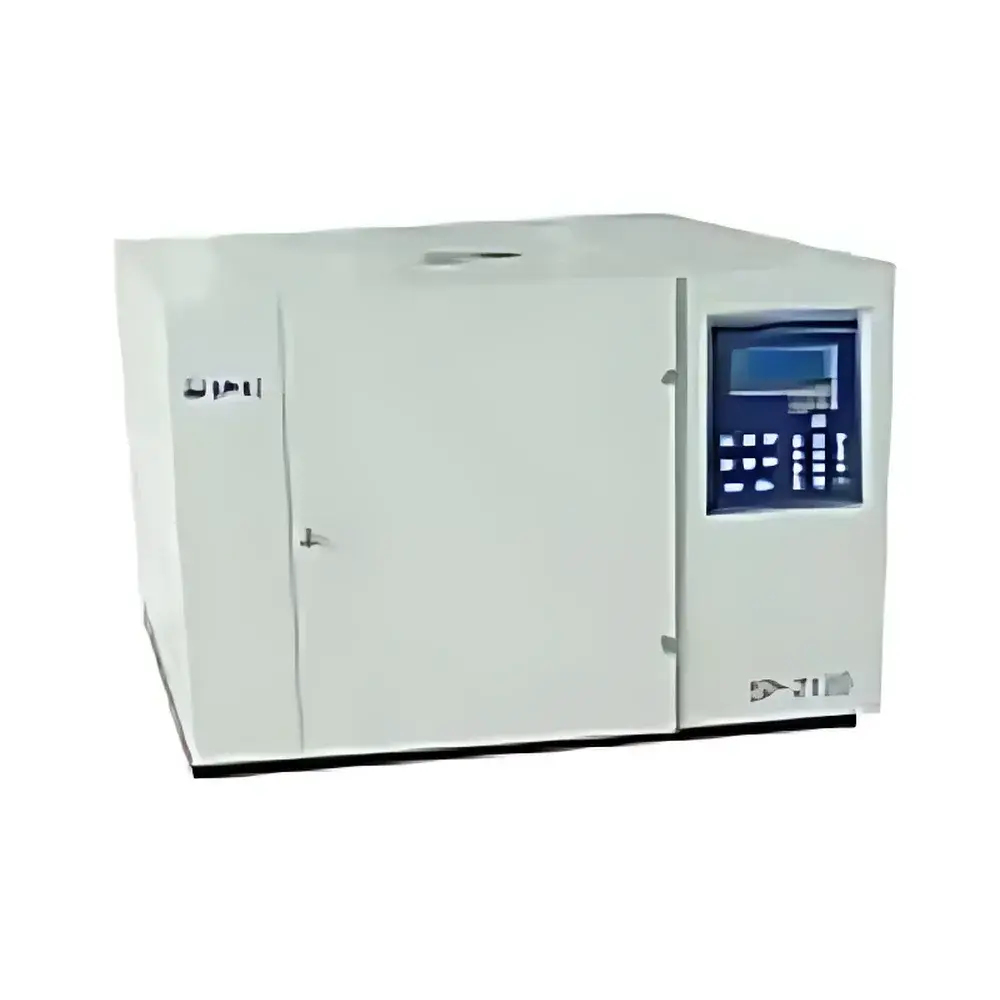
Beifen Ruili SP-2120 Mine Gas Analysis Dedicated Gas Chromatograph
| Brand | Beifen Ruili |
|---|---|
| Origin | Beijing, China |
| Model | SP-2120 |
| Temperature Control Range | 20–400 °C above ambient |
| Ramp Rate | 0.5–35 °C/min |
| Cool-down Time | <5 min (250 °C → 50 °C) |
| Carrier Gas Pressure Range & Control | 0–0.8 MPa |
| Injector Max Operating Temperature | 400 °C |
| Injector Pressure Setting Range | 0–0.8 MPa |
| Detection Limits | H₂ ≤5 ppm, CO ≤0.5 ppm, O₂/N₂ ≤0.05 vol%, CH₄/CO₂/C₂H₄/C₂H₆/C₂H₂ ≤0.1 ppm |
| Total Analysis Time | ≤7 min (single injection, 9-component full profile) |
| Simultaneous Active Detectors | 3 (TCD + dual FID) |
| Flow Sensors | 4-channel digital gas flow monitoring |
| Valve Configuration | High-reliability imported 10-port rotary valve |
| Explosion Risk Assessment | Real-time calculation per GB/T 20964–2007 and AQ 1018–2006 |
| Compliance | Designed for GLP-compliant coal mine safety labs |
Overview
The Beifen Ruili SP-2120 Mine Gas Analysis Dedicated Gas Chromatograph is a purpose-built analytical platform engineered for real-time, field-deployable compositional analysis of underground mine atmospheres. It operates on the fundamental principle of gas-phase partition chromatography, leveraging precise thermal programming, high-stability flow control, and selective detection to resolve and quantify critical gases—including H₂, O₂, N₂, CH₄, CO, CO₂, C₂H₄, C₂H₆, and C₂H₂—in a single 7-minute run. Unlike general-purpose GC systems, the SP-2120 integrates a dual-conversion furnace architecture (for CO/CO₂ quantification and hydrocarbon differentiation), a microprocessor-controlled 10-port rotary valve for automated column routing and backflushing, and co-located TCD and dual-FID detectors operating in parallel. Its design prioritizes operational robustness under harsh environmental conditions: mechanical shock resistance meets ISO 10816-3 Class III specifications; vibration tolerance conforms to IEC 60068-2-64 for mobile deployment; and thermal management ensures stable baseline performance across ambient fluctuations typical in mine portals or vehicle-mounted labs.
Key Features
- Dual-detection architecture: Simultaneous operation of one thermal conductivity detector (TCD) and two flame ionization detectors (FIDs), each with independent signal conditioning and digitization—enabling concurrent quantification of permanent gases (H₂, O₂, N₂) and hydrocarbons (CH₄ through C₂H₂) without compromise in sensitivity or linearity.
- High-integrity 10-port rotary valve system: Sourced from a Tier-1 European manufacturer, rated for >500,000 switching cycles, ensuring long-term reproducibility of retention times and peak area ratios essential for trending-based fire prediction models.
- Integrated methane conversion and CO oxidation furnaces: Two independently temperature-controlled catalytic reactors enable accurate speciation of CO/CO₂ and selective enhancement of C₁–C₂ alkyne/alkene response—critical for distinguishing spontaneous combustion signatures from ventilation air dilution effects.
- Four-channel digital mass flow sensing: Real-time monitoring of carrier, makeup, hydrogen, and air flows with ±0.5% full-scale accuracy; data logged at 10 Hz and synchronized with chromatographic acquisition for audit-ready flow integrity verification.
- Mobile-ready mechanical design: Shock-absorbing chassis, reinforced column oven enclosure, and sealed electronics compartment meet EN 61000-6-2 immunity requirements for industrial vehicle environments; optional 24 V DC power interface supports battery or generator operation.
- Flexible sampling interface: Supports both manual syringe injection and automated 32-channel sequential sampling via external multiplexer—enabling unattended 24/7 monitoring with timestamped report generation and configurable alarm thresholds.
Sample Compatibility & Compliance
The SP-2120 is validated for direct analysis of raw, moisture-compensated mine air samples collected via stainless-steel canisters or Tedlar® bags. No pre-concentration or cryogenic trapping is required for target analytes within the specified concentration ranges. All hardware and firmware comply with mandatory Chinese coal industry standards: AQ 1018–2006 (Technical Specification for Mine Fire Early Warning Systems), GB/T 20964–2007 (Gas Chromatographic Method for Mine Atmosphere Analysis), and MT/T 767–1998 (Safety Requirements for Electrical Equipment in Coal Mines). The system architecture supports 21 CFR Part 11–compliant electronic records when paired with the optional Audit Trail Module, including user authentication, immutable acquisition logs, and version-controlled method files—making it suitable for GLP-regulated safety laboratories conducting certified risk assessments.
Software & Data Management
The dedicated Mine Gas Chromatography Workstation (v4.2+) provides integrated instrument control, real-time chromatogram visualization, automated peak integration using ASTM D6299–22-compliant algorithms, and explosion hazard index calculation per the Graham’s Ratio and Trickett Index methodologies. Raw data are stored in vendor-neutral .cdf format (NetCDF 4.8 compliant); processed reports export to PDF, CSV, or XML with embedded metadata (operator ID, calibration status, ambient pressure/temperature). Remote diagnostics and method push deployment are supported via TLS 1.2–secured HTTP API. All software modules undergo annual third-party validation per ISO/IEC 17025:2017 Annex A.2 for computational traceability.
Applications
- Early-stage spontaneous combustion detection through time-series tracking of C₂H₄/C₂H₆ and CO/CH₄ ratios in return airways.
- Post-blast atmosphere assessment for residual NOₓ, CO, and unreacted explosives decomposition products.
- Coal seam gas composition profiling (CH₄ content, N₂ dilution factor, C₂+ hydrocarbon fingerprinting) for drainage feasibility studies.
- Continuous ventilation efficiency monitoring via O₂ depletion and CO₂ accumulation trends across working faces.
- Regulatory compliance reporting for national mine safety inspections (e.g., China National Administration of Coal Mine Safety).
FAQ
Can the SP-2120 be used for regulatory reporting under Chinese coal safety regulations?
Yes—the system is type-approved per AQ 1018–2006 and includes built-in calculation modules for Graham’s Ratio, Trickett Index, and Lower Explosive Limit (LEL) summation as mandated by provincial mine safety bureaus.
Is remote data transmission supported for centralized monitoring centers?
Yes—via optional 4G/LTE module or Ethernet interface; data streams include raw chromatograms, integrated peak tables, hazard indices, and instrument health metrics with SHA-256 checksums.
What maintenance intervals are recommended for field-deployed units?
Carrier gas filters every 3 months; FID jet cleaning every 6 months; TCD filament resistance verification quarterly; full system performance qualification (SPQ) annually per GB/T 33865–2017.
Does the system support analysis of C₃+ hydrocarbons such as propane or butane?
Yes—upon installation of a low-bleed C₃–C₅ separation column (e.g., DB-PONA), upgraded oven temperature ramp profile, and extended acquisition time (≤15 min); factory-configured upgrade kit available.
How is calibration traceability maintained for safety-critical measurements?
Certified gas standards (NIST-traceable, lot-numbered) are used for initial calibration and quarterly verification; all calibrations are stored with digital signatures and linked to instrument log entries for full audit trail reconstruction.
Related Products




