
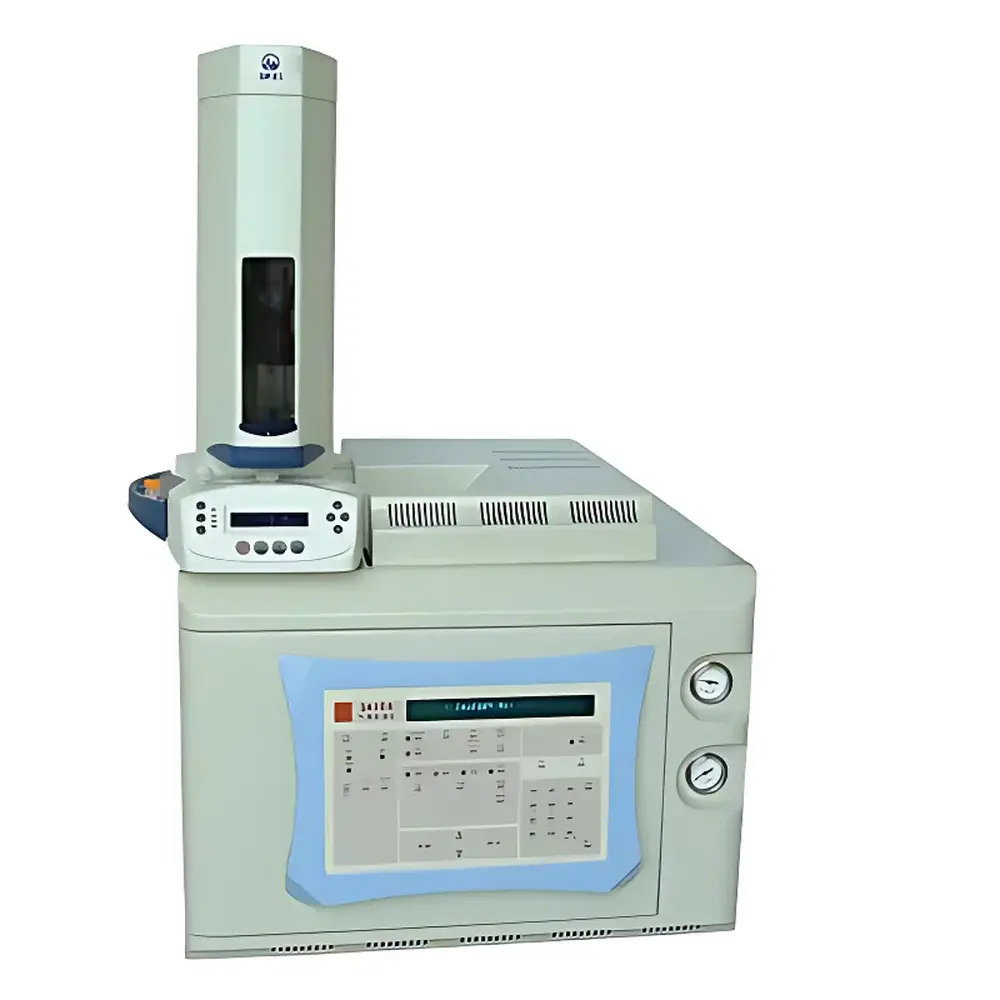
Beifen Ruili SP-3420A Gas Chromatograph
| Brand | Beifen Ruili |
|---|---|
| Origin | Beijing, China |
| Model | SP-3420A |
| Temperature Control Range | Ambient +12 °C to 400 °C |
| Maximum Oven Ramp Rate | >35 °C/min (100 °C to 200 °C in <3 min) |
| Injector Maximum Temperature | 400 °C |
| Injector Pressure Setting Range | 0–0.6 MPa |
| Compatible Detectors | TCD, FID, ECD, FPD, TSD |
| Injection Systems | Packed Column Injector, Split/Splitless Capillary Injector |
| Method Storage Capacity | 4 pre-programmed methods |
| Diagnostic Capability | Real-time self-diagnostic with fault localization |
| Safety Protections | TCD carrier-gas failure protection, overtemperature shutdown, FPD light-leak detection |
Overview
The Beifen Ruili SP-3420A Gas Chromatograph is a robust, microprocessor-controlled analytical instrument engineered for high reproducibility and operational reliability in routine and research-grade chromatographic separations. Based on technology transfer from Varian Inc. (USA), the SP-3420A implements classical gas chromatography principles—separation of volatile and semi-volatile compounds via differential partitioning between a mobile phase (inert carrier gas) and a stationary phase (capillary or packed column)—with enhanced thermal stability, precise temperature programming, and multi-detector flexibility. Its oven design supports rapid heating (≥35 °C/min) and stable isothermal holds up to 400 °C, enabling efficient analysis of complex mixtures across petroleum fractions, environmental pollutants (e.g., PAHs, PCBs, VOCs), pharmaceutical impurities, and industrial solvents. The system complies with fundamental GC operational requirements defined in ASTM D3606, ISO 10301, and USP , serving as a foundational platform for method development under GLP and GMP-aligned workflows.
Key Features
- 32-bit LED display interface with full-keyboard operation for intuitive parameter entry and real-time status monitoring
- Integrated self-diagnostic subsystem that continuously evaluates detector baseline stability, oven thermocouple integrity, injector pressure transducer response, and power supply regulation—reporting fault codes with localized troubleshooting guidance
- Programmable detector settings including gain range, attenuation time, and polarity switching for TCD and FID configurations
- Automated valve sequencing and dual-signal routing logic for unattended multi-dimensional or heart-cutting GC applications
- Comprehensive hardware safeguards: TCD filament protection during carrier gas interruption, oven overtemperature cutoff at ±5 °C deviation, and FPD photomultiplier tube shielding against ambient light ingress
- Non-volatile memory storage for four complete analytical methods—including column parameters, temperature ramps, detector voltages, and data acquisition intervals—accessible via recall function without PC dependency
Sample Compatibility & Compliance
The SP-3420A accommodates both packed and fused-silica capillary columns (0.1–0.53 mm ID) using interchangeable inlet modules. Its 400 °C maximum injector temperature supports derivatized analytes and high-boiling-point compounds (e.g., fatty acid methyl esters, sterols, organometallics). Pressure control (0–0.6 MPa) allows compatibility with standard helium, hydrogen, and nitrogen carrier gases per ISO 6425 and IUPAC GC nomenclature guidelines. While the base configuration does not include electronic flow control (EFC), it meets mechanical precision criteria for manual flow calibration per ASTM D2887 Annex A1. All detector options conform to relevant detector-specific standards: FID per EPA Method 8015B, ECD per EPA 8081B, and TCD per ISO 12966-2 for quantitative hydrocarbon profiling.
Software & Data Management
Data acquisition and processing are performed using optional Windows-based chromatography software compliant with FDA 21 CFR Part 11 requirements—including electronic signatures, audit trails, user access levels, and raw-data immutability. The software supports peak integration using tangent skim, valley-to-valley, and exponential curve fitting algorithms; retention time locking for method transfer; and report generation in PDF, CSV, and XML formats suitable for LIMS integration. Instrument control commands are transmitted via RS-232 or USB virtual COM port, ensuring backward compatibility with legacy laboratory networks. All method files and sequence logs are timestamped and checksum-verified to support regulatory inspections under ISO/IEC 17025 and GLP Annex 4.
Applications
The SP-3420A delivers validated performance in diverse sectors: hydrocarbon typing and sulfur speciation in refinery streams (ASTM D1319, D5599); residual solvent quantification in APIs (ICH Q2(R2)); pesticide residue screening in food matrices (AOAC 2007.01); chlorinated compound profiling in soil/water extracts (EPA 8081/8270); and monomer purity assessment in polymer manufacturing. Its modular detector architecture permits method optimization—for instance, pairing FID for total hydrocarbons with ECD for halogenated contaminants in a single run sequence. Educational laboratories utilize its transparent firmware architecture for teaching GC theory, retention indexing, and resolution optimization principles.
FAQ
Does the SP-3420A support electronic pressure control (EPC) or mass flow controllers (MFC)?
No—the base SP-3420A uses mechanical pressure regulation via adjustable back-pressure valves. EPC/MFC integration requires third-party retrofit or OEM upgrade kits.
Is the instrument compatible with modern LIMS systems?
Yes—when operated with certified chromatography data system (CDS) software, it exports structured data compliant with ASTM E1384 and HL7 LIS standards.
Can the SP-3420A perform splitless injection for trace analysis?
Yes—its configurable capillary inlet supports splitless, split, and programmed temperature vaporization (PTV) modes when equipped with appropriate liner geometry and septum purge settings.
What is the typical column bleed profile at 400 °C?
When using standard 5%-phenyl polysiloxane phases (e.g., DB-5ms), baseline drift remains within ±0.5 pA over 30 min at 400 °C isothermal hold, consistent with manufacturer specifications for low-bleed operation.
Are firmware updates available for extended detector support?
Firmware revisions are distributed annually via Beifen Ruili’s authorized service network and require authenticated hardware handshake; no field-upgradable flash memory is provided in the original design.






