
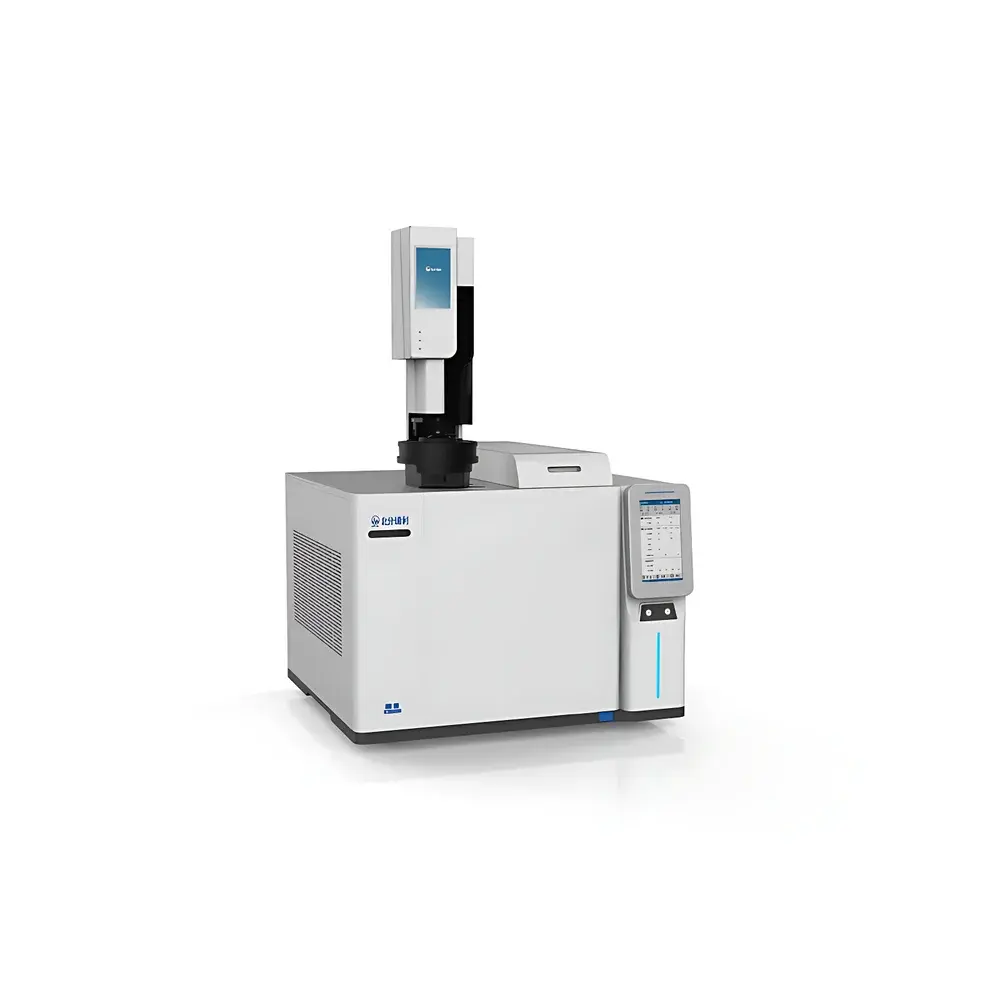
Beifen Ruili SP-3500 Gas Chromatograph
| Brand | Beifen Ruili |
|---|---|
| Origin | Beijing, China |
| Manufacturer Type | Authorized Distributor |
| Product Category | Domestic |
| Model | SP-3500 |
| Price Range | USD 14,000–21,000 (FOB) |
| Instrument Type | Laboratory Gas Chromatograph |
| Application Scope | General-Purpose |
| Oven Temperature Range | 5°C above ambient to 450°C |
| Maximum Ramp Rate | 50°C/min |
| Carrier Gas Flow Control | 0–1000 mL/min (H₂) |
| Carrier Gas Pressure Control | 0–100 psi |
| Injector Maximum Operating Temperature | 400°C |
| Injector Pressure Setting Range | 0–100 psi |
| Injector Total Flow Setting Range | 0–1000 mL/min (H₂) |
Overview
The Beifen Ruili SP-3500 Gas Chromatograph is a laboratory-grade, general-purpose analytical instrument engineered for precision separation and quantification of volatile and semi-volatile organic compounds. Based on decades of chromatographic design heritage—tracing back to Beifen Ruili’s first GC development in 1963—the SP-3500 integrates modern electronic pressure control (EPC), robust thermal management, and intuitive human-machine interface architecture. It operates on the fundamental principle of differential partitioning of analytes between a mobile phase (inert carrier gas) and a stationary phase (capillary or packed column), enabling high-resolution elution profiles under programmable temperature gradients. Designed for routine QC/QA, environmental monitoring, petrochemical screening, and academic research, the system meets the operational rigor required in ISO/IEC 17025-accredited laboratories and supports method validation per ASTM D3612, USP , and EPA Method 8260/8270 frameworks.
Key Features
- Advanced EPC architecture with independent, digitally regulated control of inlet pressure, column flow, and detector gas flows—ensuring retention time reproducibility ≤ 0.02% RSD across multi-day sequences.
- High-stability oven with uniform axial temperature distribution (±0.1°C) and rapid heating capability up to 50°C/min, enabling fast method development and short cycle times without compromising peak shape integrity.
- 7-inch high-resolution capacitive touchscreen interface with real-time graphical display of oven, injector, and detector temperatures; all system parameters—including valve timing, event programming, and alarm logs—are accessible via intuitive navigation menus.
- Comprehensive self-diagnostic system continuously monitors critical subsystems (e.g., filament status, gas leak detection, heater continuity) and provides actionable fault codes aligned with service manuals for accelerated troubleshooting.
- Dual safety protocols: automatic H₂ cutoff after three consecutive ignition failures; TCD filament overtemperature and current-limit protection to prevent thermal degradation during extended operation.
- Expandable timing control supporting up to eight external device triggers across ten user-defined time segments—enabling integration with autosamplers, PTV injectors, or auxiliary detectors without hardware modification.
Sample Compatibility & Compliance
The SP-3500 accommodates standard 0.53 mm, 0.32 mm, and 0.25 mm ID fused-silica capillary columns, as well as packed columns (2–4 mm ID). It supports split, splitless, and on-column injection modes. Compatible with common GC detectors including FID, TCD, ECD, and NPD (detector modules sold separately). The instrument conforms to IEC 61010-1:2010 for electrical safety and electromagnetic compatibility (EMC Class B). Its firmware architecture supports audit trail generation and user-access logging—key prerequisites for GLP-compliant environments and FDA 21 CFR Part 11 readiness when deployed with validated third-party LIMS or CDS platforms.
Software & Data Management
The SP-3500 operates with vendor-provided GC control software compatible with Windows 10/11 (64-bit), offering full remote configuration, real-time chromatogram visualization, peak integration using tangent skim and valley-to-valley algorithms, and customizable report templates. Raw data are stored in industry-standard .CDF format (compatible with OpenLab CDS, Chromeleon, and AIA-compliant viewers). All method files, sequence logs, and calibration records include embedded timestamps and operator IDs. Software updates are delivered via secure HTTPS portal with version-controlled release notes and backward-compatible data migration paths.
Applications
- Environmental analysis: BTEX, PAHs, chlorinated solvents, and pesticide residues in water, soil, and air samples per EPA SW-846 methods.
- Petrochemical QA: Hydrocarbon group-type analysis (PIONA), gasoline oxygenates (MTBE, ETBE), and sulfur compound profiling (e.g., mercaptans, sulfides).
- Pharmaceutical impurity testing: Residual solvents (ICH Q3C), extractables/leachables, and stability-indicating assays.
- Food & flavor chemistry: Volatile aroma profiling, fatty acid methyl ester (FAME) analysis, and adulteration screening (e.g., olive oil authenticity).
- Academic research: Reaction monitoring, polymer degradation product identification, and metabolite profiling in plant extracts.
FAQ
Is the SP-3500 compliant with 21 CFR Part 11 for electronic records and signatures?
The instrument itself does not include built-in Part 11 compliance features (e.g., biometric login or digital signature capture), but its data export architecture and audit-ready log structure enable full compliance when integrated with validated third-party chromatography data systems.
Can the SP-3500 be operated remotely via LAN or USB?
Yes—it supports Ethernet (TCP/IP) and USB 2.0 communication protocols for bidirectional command execution and real-time data streaming to host PCs located up to 100 meters away.
What column types and dimensions are supported?
Standard capillary columns (up to 60 m × 0.53 mm ID, 5 µm film thickness) and packed stainless-steel or glass columns (1–4 mm ID, up to 4 m length) are fully supported with appropriate inlet liners and ferrules.
Does the system support method transfer from other GC platforms?
Retention time alignment and method portability are facilitated by standardized parameter mapping (flow, pressure, temperature ramp), though column dimension and phase chemistry must be matched to ensure equivalent selectivity.
What maintenance intervals are recommended for optimal performance?
Injector liner replacement every 100–200 injections; septum change every 50–100 runs; detector cleaning per manufacturer schedule (e.g., FID jet polishing quarterly); full EPC calibration annually or after major component replacement.





