
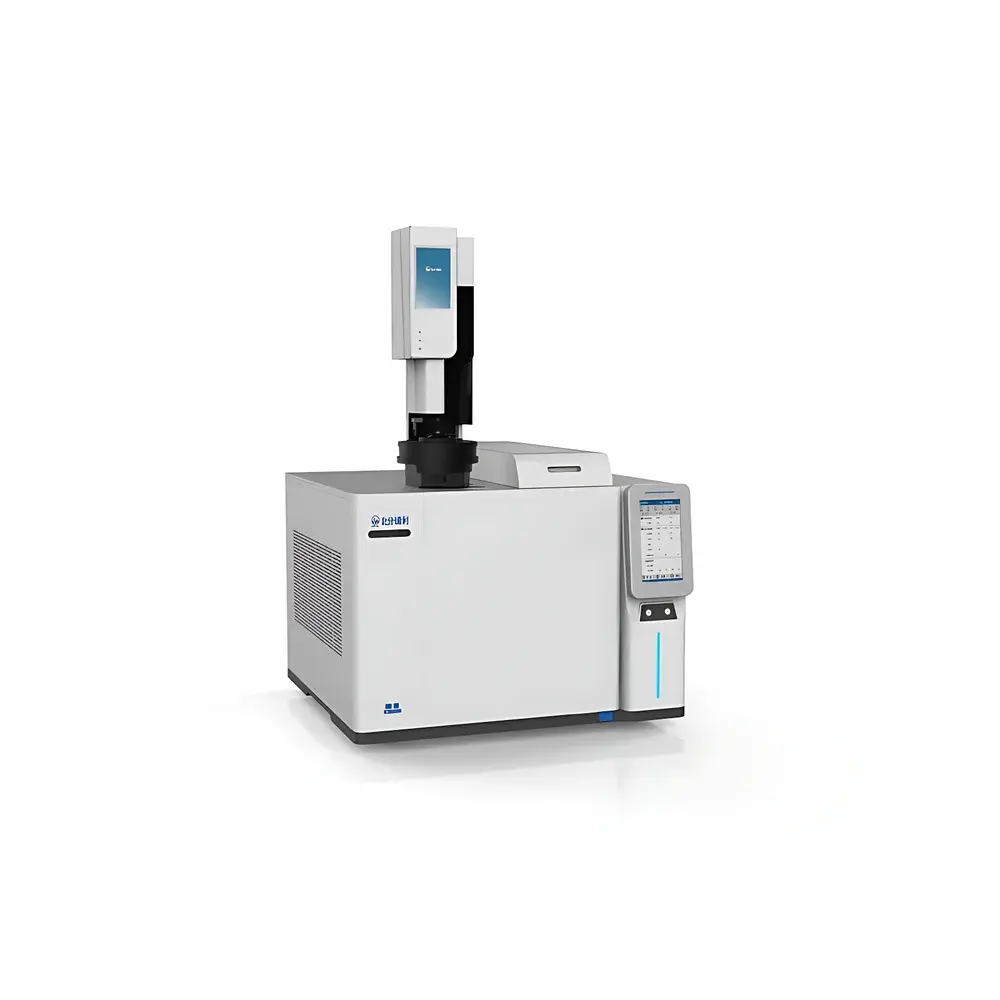
Beifen Ruili SP-3510 Gas Chromatograph
| Brand | Beifen Ruili |
|---|---|
| Origin | Beijing, China |
| Manufacturer Type | Authorized Distributor |
| Product Origin | Domestic (PRC) |
| Model | SP-3510 |
| Price Range | USD 14,000–21,000 (FOB Beijing) |
| Instrument Type | Laboratory Gas Chromatograph |
| Application Scope | General-Purpose |
| Oven Temperature Range | 5 °C above ambient to 450 °C |
| Maximum Ramp Rate | 50 °C/min |
| Cooling Capability | Forced-air cooling (no cryogenic option) |
| Carrier Gas Flow Control Range | 0–1000 mL/min (H₂) |
| Carrier Gas Pressure Control Range | 0–100 psi |
| Injector Maximum Operating Temperature | 400 °C |
| Injector Pressure Setting Range | 0–150 psi |
| Injector Total Flow Setting Range | 0–1000 mL/min (H₂) |
| Heating Zones | 9 independent temperature-controlled zones |
| Simultaneous Inlets/Detectors | Up to 3 inlets and 3 detectors operational concurrently |
| Detector Options | FID, TCD, ECD, FPD, TSD, AFD |
Overview
The Beifen Ruili SP-3510 Gas Chromatograph is a benchtop laboratory GC platform engineered for precision, modularity, and operational flexibility in routine and method-development environments. Built upon over five decades of chromatographic instrument design heritage in China, the SP-3510 implements classical gas chromatography separation principles—based on differential partitioning of analytes between a mobile phase (carrier gas) and a stationary phase (capillary or packed column)—with modern digital control architecture. Its core thermal management system features nine independently programmable heating zones, enabling precise temperature coordination across the oven, multiple injectors, and up to three detector modules. This architecture supports complex multi-dimensional workflows, such as heart-cutting GC-GC or simultaneous parallel analysis with complementary detection modes. Designed for general-purpose applications—including environmental monitoring, petrochemical profiling, food safety screening, and pharmaceutical impurity testing—the SP-3510 complies with foundational instrumental requirements outlined in ISO 17025-accredited laboratories and aligns with method validation frameworks referenced in USP , ASTM D3606, and EPA Methods 8021B and 8270.
Key Features
- Nine independent temperature-controlled zones ensure optimal thermal decoupling between injection, column, and detection stages—critical for minimizing band broadening and improving peak shape reproducibility.
- Triple-inlet, triple-detector configuration allows concurrent operation of diverse sample introduction methods (split/splitless, PTV, or on-column) paired with orthogonal detection technologies (e.g., FID for hydrocarbons + ECD for halogenated compounds + TCD for permanent gases).
- Digital pressure and flow control (DPFC) system delivers stable carrier gas delivery across H₂ (0–1000 mL/min) and N₂ (0–200 mL/min) with pressure regulation from 0–100 psi—enabling robust retention time locking and method transfer between instruments.
- High-temperature injector capable of 400 °C operation supports thermally labile sample derivatization and high-boiling-point compound analysis without degradation artifacts.
- Programmable oven ramp rates up to 50 °C/min facilitate rapid method optimization and high-throughput screening while maintaining column integrity under controlled thermal stress.
- Modular detector bay accepts six detector types—Flame Ionization (FID), Thermal Conductivity (TCD), Electron Capture (ECD), Flame Photometric (FPD), Thermionic Specific (TSD), and Atomic Emission (AFD)—each with factory-calibrated analog/digital signal output and configurable data acquisition parameters.
Sample Compatibility & Compliance
The SP-3510 accommodates liquid, gaseous, and volatile solid samples via standard 10 µL syringe injection, headspace autosampling (with optional HS module), or direct gas loop injection. It supports capillary columns (0.1–0.53 mm ID, up to 60 m length) and packed columns (2–4 mm ID). All hardware components meet RoHS Directive 2011/65/EU material restrictions. Firmware and system software support audit trail functionality compliant with FDA 21 CFR Part 11 when deployed with validated third-party chromatography data systems (CDS). The instrument satisfies mechanical and electrical safety requirements per IEC 61010-1:2010 and electromagnetic compatibility per EN 61326-1:2013.
Software & Data Management
The SP-3510 operates with Beifen Ruili’s proprietary GC Navigator™ control and acquisition software, available in English-language interface. It provides real-time chromatogram visualization, method editor with gradient and event programming, sequence queue management, and integrated calibration curve generation (linear, quadratic, or weighted least-squares). Raw data are stored in vendor-neutral .CDF format (compatible with OpenChrom and Chromeleon CDS), supporting post-run reprocessing and spectral library searching (NIST MS Search integration optional). System suitability tests—including resolution, tailing factor, and %RSD of retention time—are automated and exportable as PDF reports for GLP/GMP documentation.
Applications
- Environmental analysis: Quantification of BTEX, PAHs, chlorinated pesticides, and VOCs in soil, water, and air matrices per EPA SW-846 protocols.
- Petrochemical QA/QC: Hydrocarbon group-type analysis (PIONA), gasoline oxygenate determination (MTBE, ETBE), and sulfur speciation using FPD or AFD.
- Food & flavor chemistry: Residual solvent testing in packaging materials, essential oil fingerprinting, and pesticide residue screening in fruits and vegetables.
- Pharmaceutical development: Assay of residual solvents (ICH Q3C), chiral separation of enantiomers using cyclodextrin-based columns, and stability-indicating assay validation.
- Forensic toxicology: Detection and quantitation of drugs of abuse (e.g., amphetamines, benzodiazepines) in biological fluids using ECD/FID dual detection.
FAQ
Does the SP-3510 support method transfer from other GC platforms?
Yes—its digital pressure/flow control architecture, standardized detector signal outputs (±1 V full scale), and .CDF data format enable reliable migration of validated methods from Agilent, Shimadzu, or Thermo platforms with minimal re-optimization.
Is remote monitoring and control possible?
The instrument includes Ethernet (RJ-45) and RS-232 interfaces; GC Navigator™ supports LAN-based client-server operation for centralized lab management, though cloud connectivity requires local firewall configuration and IT policy approval.
What maintenance intervals are recommended for the FID and ECD detectors?
FID jet cleaning and electrode inspection are advised every 200 injections or 4 weeks (whichever occurs first); ECD cell bake-out and Ni-63 source activity verification should be performed quarterly or after exposure to highly chlorinated samples.
Can the SP-3510 be integrated into a LIMS environment?
Yes—via ASCII or XML result export triggered by completion events, or through ODBC-compliant database drivers when used with validated third-party CDS software meeting ISO/IEC 17025 data integrity requirements.
Are consumables and spare parts globally available?
Beifen Ruili maintains an international distributor network supplying certified columns, ferrules, septa, detector components, and OEM-certified electronics modules with documented traceability and shelf-life labeling.
Related Products






