
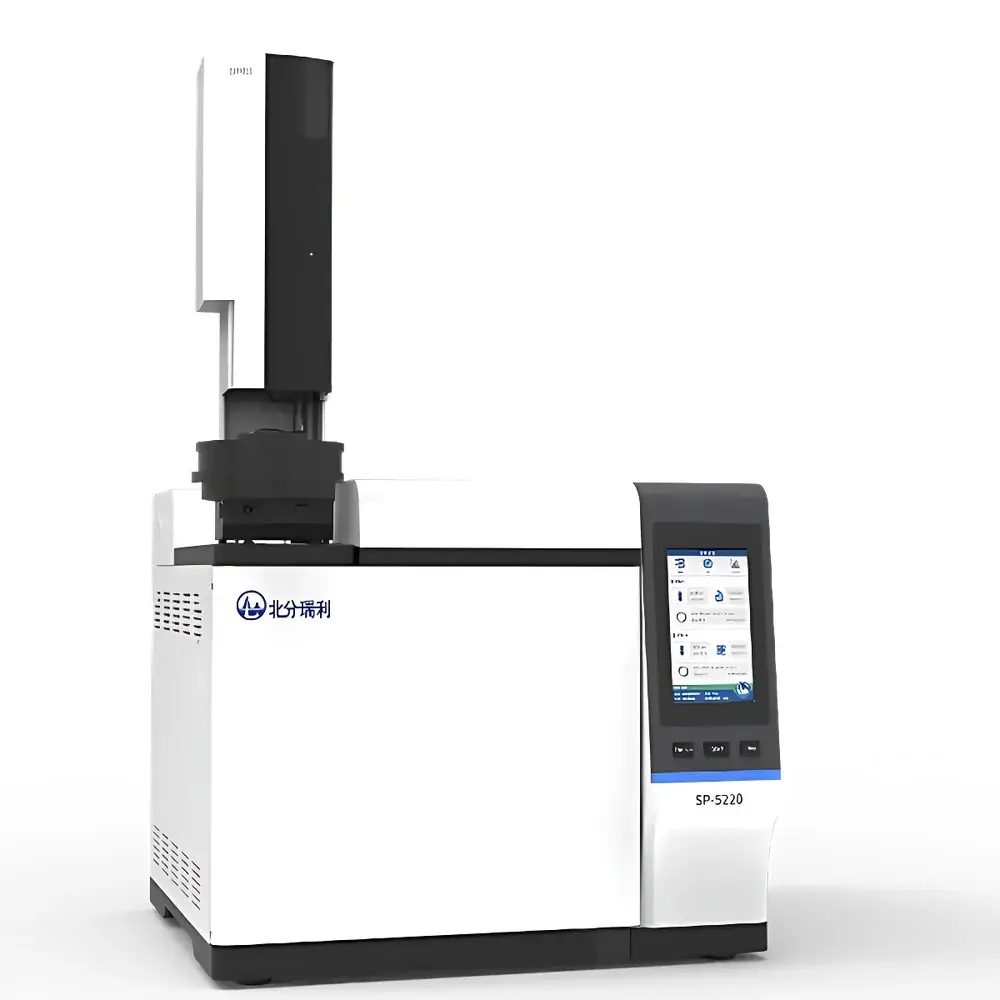
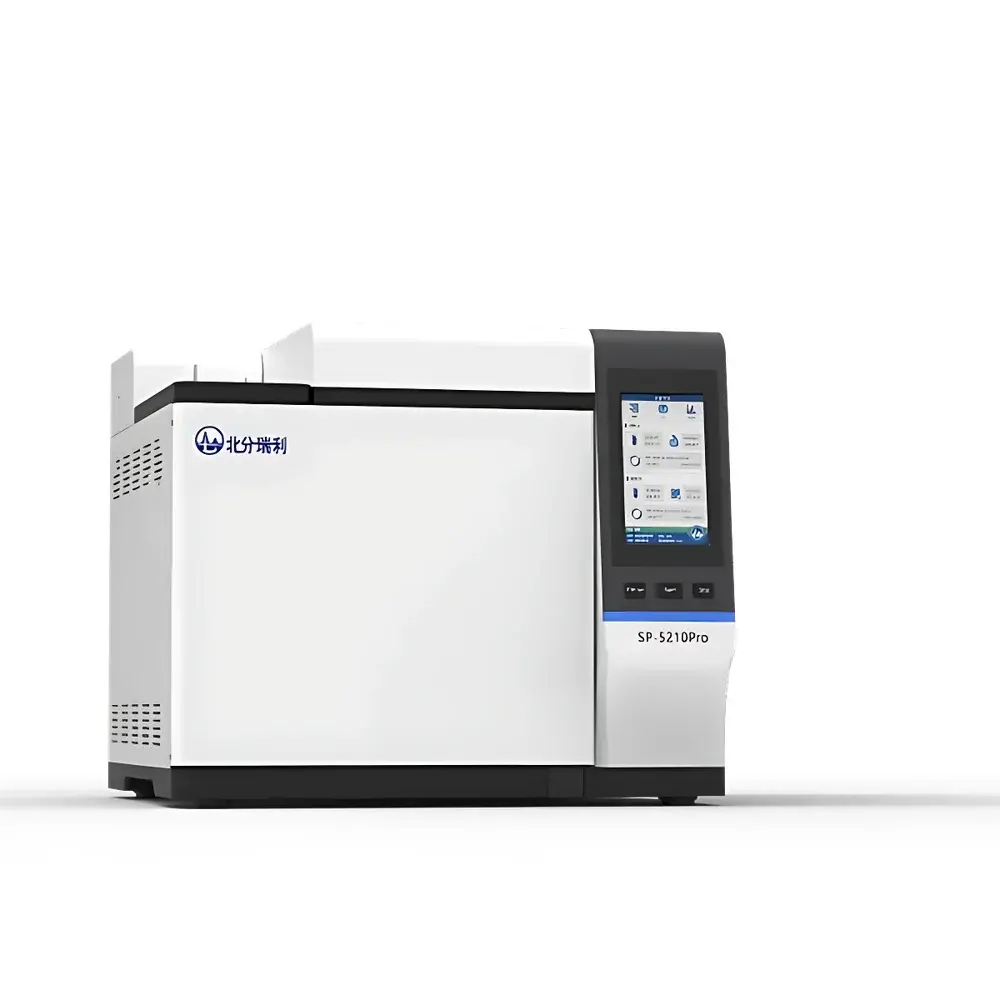
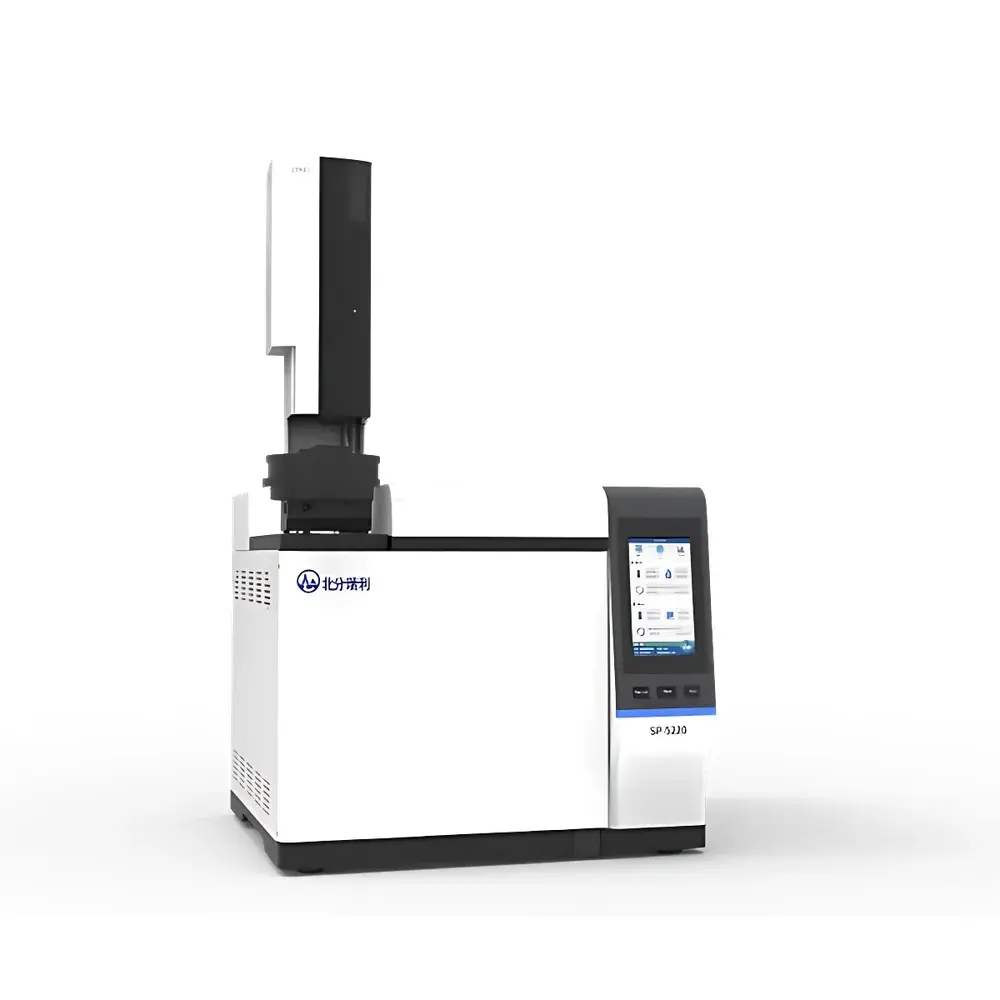
Beifen Ruili SP-5220 Gas Chromatograph with Integrated Cold Vapor Atomic Fluorescence Detector
| Brand | Beifen Ruili |
|---|---|
| Origin | Beijing, China |
| Model | SP-5220 |
| Instrument Type | Laboratory Gas Chromatograph |
| Application Scope | General-Purpose |
| Regulatory Compliance | CE-marked per EN 61010-1, IEC 61326-1 (EMC), ISO/IEC 17025-compatible operation |
| Control System | Linux-based embedded platform with Ethernet and USB 2.0 interfaces |
| Pressure Control Accuracy | ±0.001 psi (EPC) |
| Temperature Program Reproducibility | ±0.5% (RSD) |
| MTBF | >12,000 hours |
| Safety Certification | UL 61010-1 / GB 4793.1 compliant |
| Electromagnetic Compatibility | Tested to IEC 61326-1 Class A |
Overview
The Beifen Ruili SP-5220 Gas Chromatograph is a laboratory-grade analytical instrument engineered for high-fidelity separation and quantitative detection of volatile and semi-volatile organic compounds. Built upon the SP-5000 series platform—refined through six decades of chromatographic system development—the SP-5220 integrates a cold vapor atomic fluorescence detector (CVAFD) as a factory-installed, optically coupled module. This configuration enables trace-level mercury speciation analysis without post-column derivatization, leveraging the fundamental principle of atomic fluorescence spectroscopy: selective excitation of ground-state Hg⁰ atoms at 253.7 nm followed by isotropic emission detection. The system operates on conventional capillary GC principles—carrier gas-driven solute partitioning across a stationary phase—with precise control over column temperature, carrier gas linear velocity, and detector response dynamics. Designed for routine operation in regulated environments, the SP-5220 meets mechanical, thermal, and electromagnetic stability requirements aligned with ISO/IEC 17025 method validation frameworks.
Key Features
- Integrated cold vapor atomic fluorescence detection (CVAFD) optimized for sub-picogram mercury quantification in environmental, petrochemical, and food matrices
- High-precision electronic pressure control (EPC) with ±0.001 psi resolution across all gas channels (carrier, makeup, purge)
- Dual-zone oven architecture supporting independent ramp rates up to 60 °C/min and isothermal hold stability of ±0.01 °C
- Linux-based real-time embedded control system enabling deterministic I/O response, audit-trail logging, and TLS-secured remote access via web interface or CLI
- Comprehensive reliability validation: thermal cycling (–30 °C to +70 °C), HALT-compliant stress screening, MIL-STD-810G shock/vibration testing, and 1,000-hour continuous operation verification
- Modular detector bay accommodating optional FID, ECD, TCD, or NPD configurations without hardware modification
Sample Compatibility & Compliance
The SP-5220 accepts standard 0.53 mm, 0.32 mm, and 0.25 mm ID fused-silica capillary columns (up to 60 m length) and supports both split/splitless and direct injection modes. Sample introduction includes compatibility with liquid autosamplers (e.g., CTC PAL, Gerstel MPS), headspace samplers (HS-40), and purge-and-trap concentrators (e.g., Tekmar Atomx). The system complies with ASTM D6704 (mercury in coal), EPA Method 1631E (aqueous mercury), and ISO 17025 Clause 5.9 requirements for measurement uncertainty estimation. All firmware and data handling modules support 21 CFR Part 11-compliant user authentication, electronic signatures, and immutable audit trails—validated for GLP and GMP-aligned laboratories.
Software & Data Management
ChromaControl v4.2 software provides full instrument control, sequence management, peak integration (with baseline correction algorithms per USP ), and calibration curve generation (linear, quadratic, weighted least squares). Raw data files (.spc binary format) are stored with embedded metadata including instrument configuration, method parameters, operator ID, and timestamped environmental logs (oven temp, EPC setpoints, detector HV). Export options include CSV, PDF reports (per ISO/IEC 17025 Annex A.2), and XML for LIMS integration. Software validation documentation (IQ/OQ/PQ protocols) and source code checksums are provided upon request for regulatory submissions.
Applications
The SP-5220 delivers validated performance in mercury speciation workflows across multiple sectors: monitoring total mercury in flue gas condensates (coal-fired power plants), quantifying methylmercury in fish tissue hydrolysates (FDA seafood safety programs), analyzing elemental mercury in transformer oil (IEC 60429 compliance), detecting mercury vapor in ambient air using gold trap preconcentration (EPA TO-11A), and verifying catalyst poisoning in reformate streams (ASTM D7167). Its dual-oven design also supports multi-dimensional GC (GC×GC) configurations when paired with a cryogenic modulator.
FAQ
Does the SP-5220 support 21 CFR Part 11 compliance?
Yes—user authentication, role-based access control, electronic signature capture, and tamper-evident audit trails are implemented at the firmware level and verified during PQ.
Can the CVAFD be retrofitted to existing SP-5000 series instruments?
No—the CVAFD is a factory-integrated optical-mechanical assembly requiring dedicated gas routing, UV shielding, and synchronized timing circuits not present in legacy SP-5000 models.
What column types are certified for use with the CVAFD interface?
Only deactivated fused-silica columns with polyimide coating (e.g., DB-1ms, Rtx-1, HP-1) are qualified; metal or graphite-clad columns induce Hg adsorption and signal suppression.
Is method transfer supported from Agilent or Thermo GC platforms?
Yes—ChromaControl accepts .cdf and .axd method imports with automated parameter mapping; retention time alignment requires column dimension and flow rate recalibration.
What maintenance intervals are recommended for the CVAFD lamp and cell?
The 253.7 nm Hg lamp requires replacement every 5,000 operating hours; quartz fluorescence cell cleaning is advised after 200 injections of high-salt or sulfur-rich matrices.



