
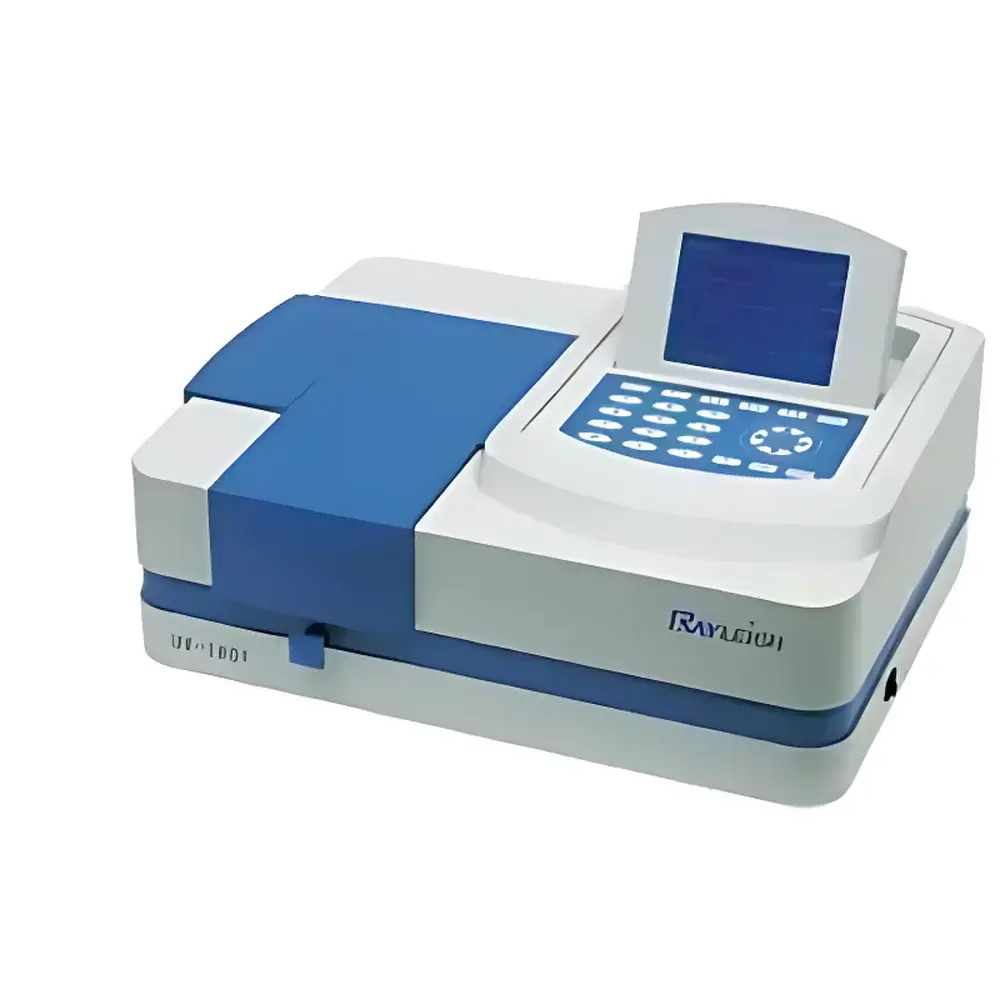
Beifen Ruili UV-1801 Ultraviolet-Visible Spectrophotometer
| Brand | Beifen Ruili |
|---|---|
| Origin | Beijing, China |
| Model | UV-1801 |
| Optical System | Single-beam |
| Detector | Photodiode Array |
| Wavelength Range | 190–1100 nm |
| Wavelength Accuracy | ±0.5 nm |
| Spectral Bandwidth | 1.0, 2.0, or 5.0 nm (user-selectable) |
| Stray Light | ≤0.05% T (at 220 nm with NaI solution |
| Display | 6-inch high-brightness blue LCD |
| Light Sources | Imported deuterium lamp and tungsten-halogen lamp |
| Power Supply | AC 220 V/50 Hz or 110 V/60 Hz |
| Power Consumption | 140 W |
| Dimensions (W×D×H) | 530 × 420 × 205 mm |
| Net Weight | 18 kg |
Overview
The Beifen Ruili UV-1801 Ultraviolet-Visible Spectrophotometer is a single-beam scanning instrument engineered for precision absorbance and transmittance measurements across the ultraviolet and visible spectrum (190–1100 nm). Based on Beer–Lambert law principles, it quantifies analyte concentration through photometric detection of light attenuation following passage through a sample. Its optical architecture integrates a high-stability imported deuterium lamp for UV emission and a tungsten-halogen lamp for visible-range illumination, coupled with a photodiode array detector to ensure consistent signal capture and low-noise spectral acquisition. Designed for routine laboratory use in regulated and research environments, the UV-1801 supports compliance-driven workflows in agricultural testing, pharmaceutical QC, environmental monitoring, food safety, and academic teaching—particularly where alignment with standardized protocols such as FERTREC (China Agricultural Testing Standard for Soil Nutrients) is required.
Key Features
- Single-beam optical design with automated wavelength scanning and real-time spectral display
- Three selectable spectral bandwidths (1.0 nm, 2.0 nm, and 5.0 nm) pre-configured to meet pharmacopeial requirements including Chinese Pharmacopoeia (ChP) and USP
- High-accuracy wavelength calibration (±0.5 nm) validated against traceable NIST-standard reference materials
- Stray light performance ≤0.05% T at critical wavelengths (220 nm using sodium iodide solution; 360 nm using sodium nitrite solution), ensuring reliable quantitation of low-absorbance samples
- Large-capacity four-position manual sample holder accommodating cuvettes up to 100 mm pathlength for specialized applications including turbid or highly diluted samples
- Robust electronic architecture featuring large-scale integrated circuits and optimized optical path geometry for long-term thermal and mechanical stability
- Integrated 6-inch high-brightness blue LCD interface enabling direct instrument control without external PC dependency
Sample Compatibility & Compliance
The UV-1801 accommodates standard 10 mm square quartz or glass cuvettes, as well as custom-length cells up to 100 mm for extended pathlength analysis. It interfaces seamlessly with third-party automated sample handling systems—including the CAAS (Chinese Academy of Agricultural Sciences) soil sample preparation and autosampler platform—enabling unattended batch analysis of soil extracts for nitrate-nitrogen (NO₃⁻-N), phosphorus, potassium, and organic matter content. Method validation conforms to FERTREC guidelines for agricultural soil testing, and its operational parameters support GLP-aligned documentation practices. While not inherently 21 CFR Part 11 compliant out-of-the-box, audit-trail functionality and user-access controls can be implemented via optional PC-based software modules meeting FDA-regulated data integrity requirements.
Software & Data Management
Instrument operation is supported by embedded firmware allowing standalone execution of wavelength scan, time scan, multi-wavelength quantitative analysis, and derivative spectroscopy (1st–3rd order). Optional PC connectivity via RS-232 (RS-485 and USB available upon request) enables remote control, method storage, and advanced data processing—including DNA/protein A₂₆₀/A₂₈₀ ratio calculation and molar extinction coefficient application. All measurement parameters and spectral datasets are retained in non-volatile memory during power interruption. Export formats include CSV and ASCII for integration with LIMS platforms and statistical analysis tools (e.g., JMP, OriginLab, R). Firmware updates are delivered via secure vendor portal and require local administrator authentication.
Applications
- Quantitative determination of nitrate nitrogen in soil extracts using dual-wavelength correction at 220 nm and 275 nm
- Pharmaceutical assay of active ingredients per ChP monographs requiring fixed-bandwidth UV quantitation
- Enzyme kinetics monitoring via time-scan mode under controlled temperature conditions
- Water quality assessment including COD, TOC surrogate estimation, and heavy metal complexation studies
- Food additive verification (e.g., preservatives, colorants) and nutritional component profiling (vitamins, pigments)
- Academic instruction in analytical chemistry, biochemistry, and environmental science laboratories
FAQ
Is the UV-1801 compliant with international pharmacopeial standards?
Yes—the instrument’s spectral bandwidth options (1.0 nm, 2.0 nm, 5.0 nm) and wavelength accuracy (±0.5 nm) align with specifications outlined in USP , EP 2.2.25, and ChP General Chapter 0401.
Can it be integrated into an automated soil testing workflow?
Yes—it features mechanical and electrical compatibility with CAAS-developed autosamplers and sample digestion systems used in national soil fertility monitoring programs.
What data security and traceability features does it offer?
Local parameter and result storage is persistent across power cycles; full electronic audit trail, electronic signatures, and role-based access require optional PC-hosted software licensed under GxP-compliant deployment frameworks.
Does it support protein and nucleic acid quantification?
Yes—via optional software module implementing A₂₆₀/A₂₈₀ and A₂₆₀/A₂₃₀ ratio algorithms, extinction coefficient lookup tables, and concentration back-calculation per standard biochemical protocols.
What maintenance intervals are recommended for lamp replacement and calibration verification?
Deuterium lamp lifetime is rated at ≥1,000 hours; tungsten lamp ≥2,000 hours. Wavelength and photometric accuracy verification is recommended every 6 months or after 200 operating hours, using certified reference filters and neutral density standards.




