
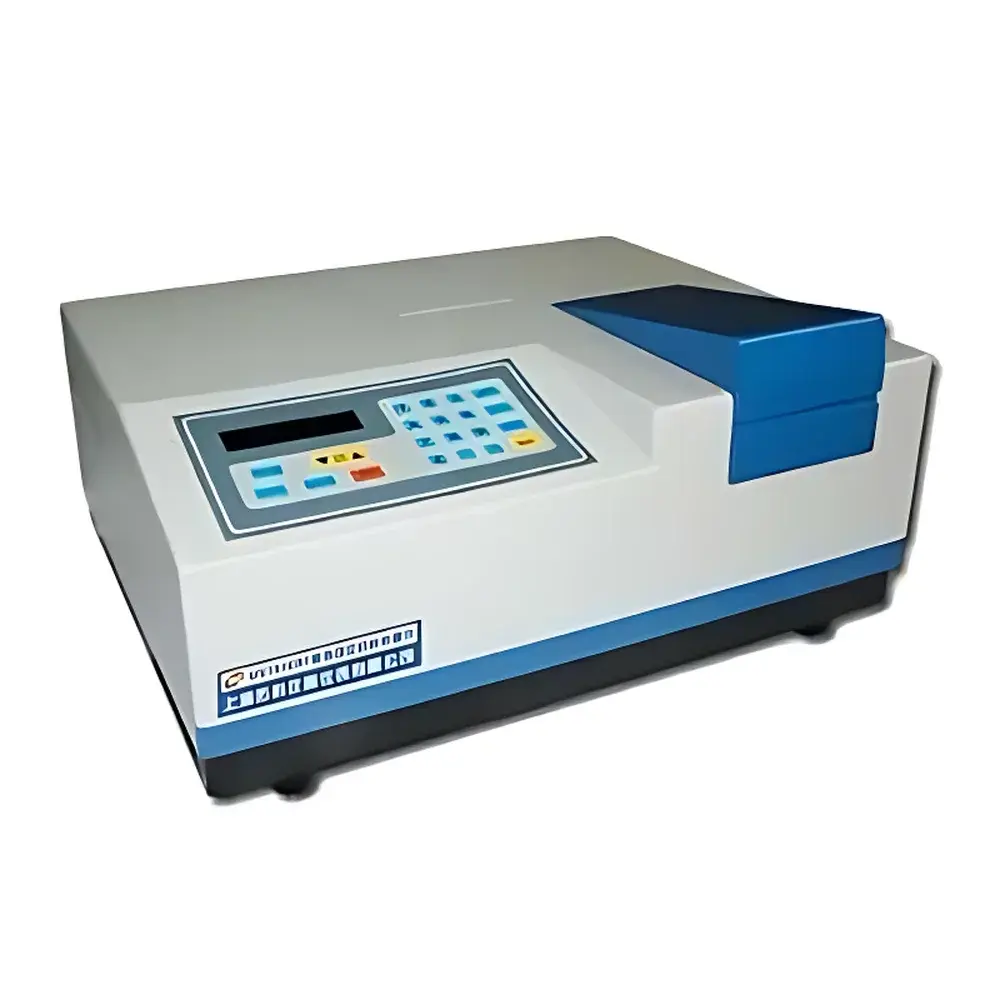
Beifen Ruili UV757 Ultraviolet-Visible Spectrophotometer
| Brand | Beifen Ruili |
|---|---|
| Origin | Beijing, China |
| Model | UV757 |
| Optical System | Single-beam |
| Detector | Photodiode Array |
| Wavelength Range | 190 nm – 1100 nm |
| Wavelength Accuracy | ±0.8 nm |
| Spectral Bandwidth | 3 nm |
| Stray Light | ≤0.15% T (at 220 nm and 360 nm) |
| Absorbance Range | −0.301 A to 4.000 A |
| Transmittance Range | 0.0% T to 200.0% T |
| Concentration Readout Range | 0–9999 (arbitrary units) |
| Absorbance Repeatability | ±0.002 A |
| Transmittance Accuracy | ±0.5% T (verified with NIST-traceable NBS 930D filter) |
| Baseline Linearity | ±0.004 A |
| Drift | ≤0.004 A/30 min |
| Noise | 0.5% T (at 100% T), 0.2% T (at 0% T) |
| Power Supply | AC 220 V, 50 Hz |
| Dimensions | 520 mm × 410 mm × 200 mm |
| Net Weight | 18 kg |
Overview
The Beifen Ruili UV757 Ultraviolet-Visible Spectrophotometer is a precision single-beam optical instrument engineered for routine and research-grade quantitative and qualitative analysis across the ultraviolet and visible spectral regions (190–1100 nm). It operates on the fundamental principle of Beer–Lambert law-based absorbance measurement, where sample-induced attenuation of monochromatic light is quantified to determine analyte concentration or characterize electronic transitions in molecules. Designed for laboratories requiring reliable performance without the complexity and cost of double-beam architectures, the UV757 delivers high reproducibility in pharmaceutical QC, environmental monitoring, food safety testing, and academic teaching applications. Its optimized optical path—featuring a deuterium lamp (UV) and tungsten-halogen lamp (VIS)—ensures stable intensity output, while the photodiode array detector enables rapid spectral acquisition and robust signal-to-noise ratio under standard operating conditions.
Key Features
- Single-beam optical design with automatic wavelength scanning and real-time T/A conversion
- Integrated dual-light source system: 2.5A deuterium lamp (190–350 nm) and 12V/20W tungsten-halogen lamp (320–1100 nm)
- High-stability wavelength drive mechanism with ≤3 s wavelength settling time
- Automatic zeroing (0% T) and full-scale calibration (100% T) functions, minimizing operator dependency
- Eight-position automated sample changer with built-in cuvette error compensation algorithm
- Multi-point concentration calibration with linear and polynomial (1st–3rd order) regression support
- RS-232 serial interface compliant with standard PC communication protocols; parallel printer port available as optional hardware
- Front-panel 2×20 character LCD display for direct instrument control and real-time parameter readout
Sample Compatibility & Compliance
The UV757 accommodates standard 10 mm pathlength quartz, glass, or plastic cuvettes (12.5 mm × 12.5 mm cross-section), supporting both liquid and solution-phase samples. Its optical design meets essential performance criteria referenced in ASTM E275, ISO 6223, and USP for spectrophotometric instrumentation validation. While not pre-certified for GMP environments, the system supports GLP-compliant workflows through audit-trail-capable software logging (via UVCONTROL), configurable user access levels, and exportable raw data files suitable for regulatory submission. Stray light performance (<0.15% T at critical wavelengths) satisfies requirements for low-absorbance measurements in trace-level analysis, including nucleic acid and protein quantification per A260/A280 protocols.
Software & Data Management
UVCONTROL—a Windows-based control and analysis application—provides full remote operation of the UV757. It supports spectral scanning (190–1100 nm), time-based kinetic assays, multi-wavelength quantitation, and advanced data processing including baseline correction, peak detection, integration, smoothing, derivative calculation (1st–4th order), and T↔A interconversion. All measurement results—including spectra, calibration curves, and quantitative reports—are stored in native binary format with metadata tagging (date, operator ID, method name). Export options include CSV, TXT, and direct Excel-compatible .XLSX output. The software enforces data integrity through timestamped records and allows configurable autosave intervals, ensuring traceability aligned with FDA 21 CFR Part 11 principles when deployed with appropriate IT infrastructure and procedural controls.
Applications
- Pharmaceutical assay development and release testing (e.g., dissolution profiling, excipient compatibility studies)
- Environmental water quality assessment (nitrate, phosphate, COD estimation via colorimetric methods)
- Food and beverage analysis (vitamin C, preservative content, pigment stability)
- Academic instruction in analytical chemistry and molecular spectroscopy
- Quality control of dyes, pigments, and optical filters
- Enzyme kinetics and ligand-binding studies using kinetic scanning mode
FAQ
What is the recommended maintenance schedule for the UV757?
Routine lamp replacement is advised every 1,000–1,500 hours of operation; optical alignment verification should be performed annually or after mechanical shock.
Can the UV757 perform kinetic measurements?
Yes—the instrument supports time-scan mode with user-defined interval and duration settings, enabling enzyme activity or reaction rate monitoring.
Is the UV757 compatible with third-party data analysis software?
Raw spectral and quantitative data can be exported in ASCII or Excel formats, facilitating import into MATLAB, OriginLab, or custom Python-based analysis pipelines.
Does the system meet ISO/IEC 17025 requirements for accredited testing labs?
While the hardware meets key metrological specifications cited in ISO/IEC 17025 Annex B, formal accreditation requires documented validation procedures, uncertainty budgets, and ongoing proficiency testing conducted by the end-user laboratory.
What cuvette materials are supported at 190 nm?
Only UV-grade fused silica or synthetic quartz cuvettes are suitable below 220 nm; standard glass or PMMA cuvettes exhibit significant absorption and must be avoided.
Related Products




