
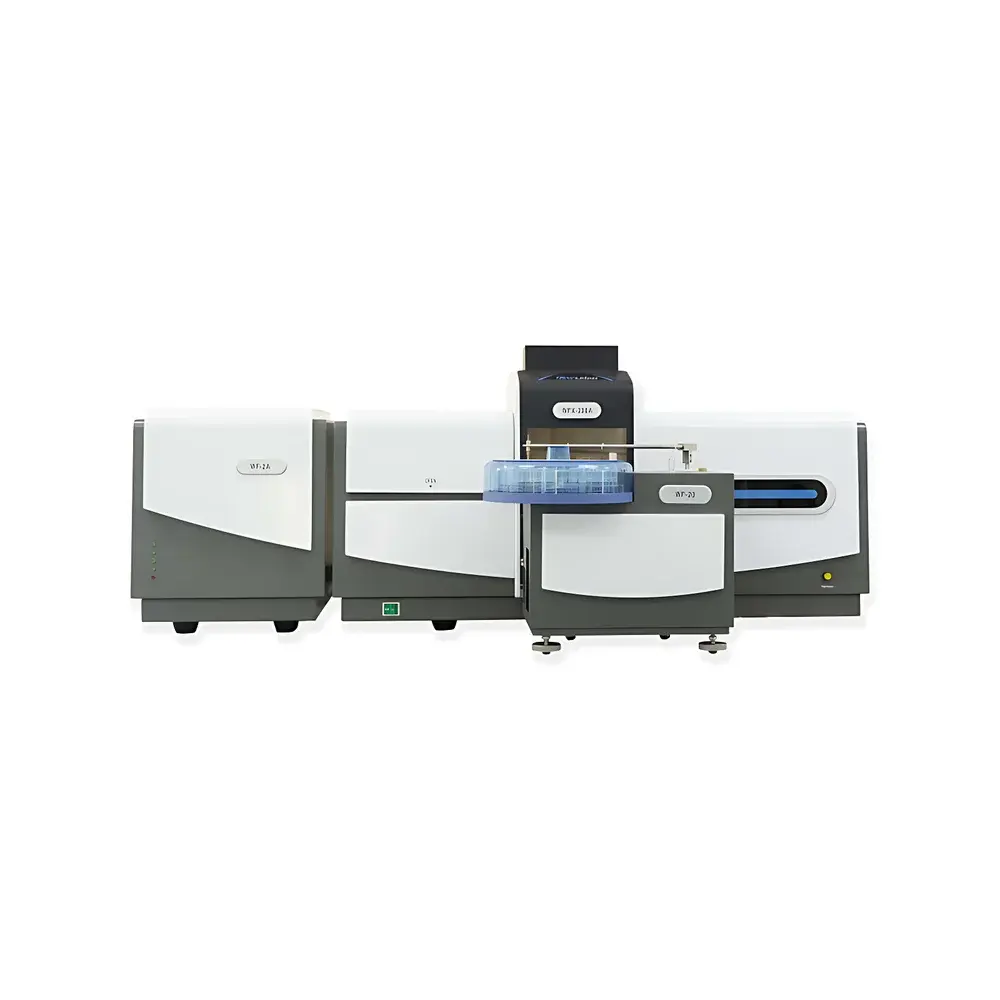
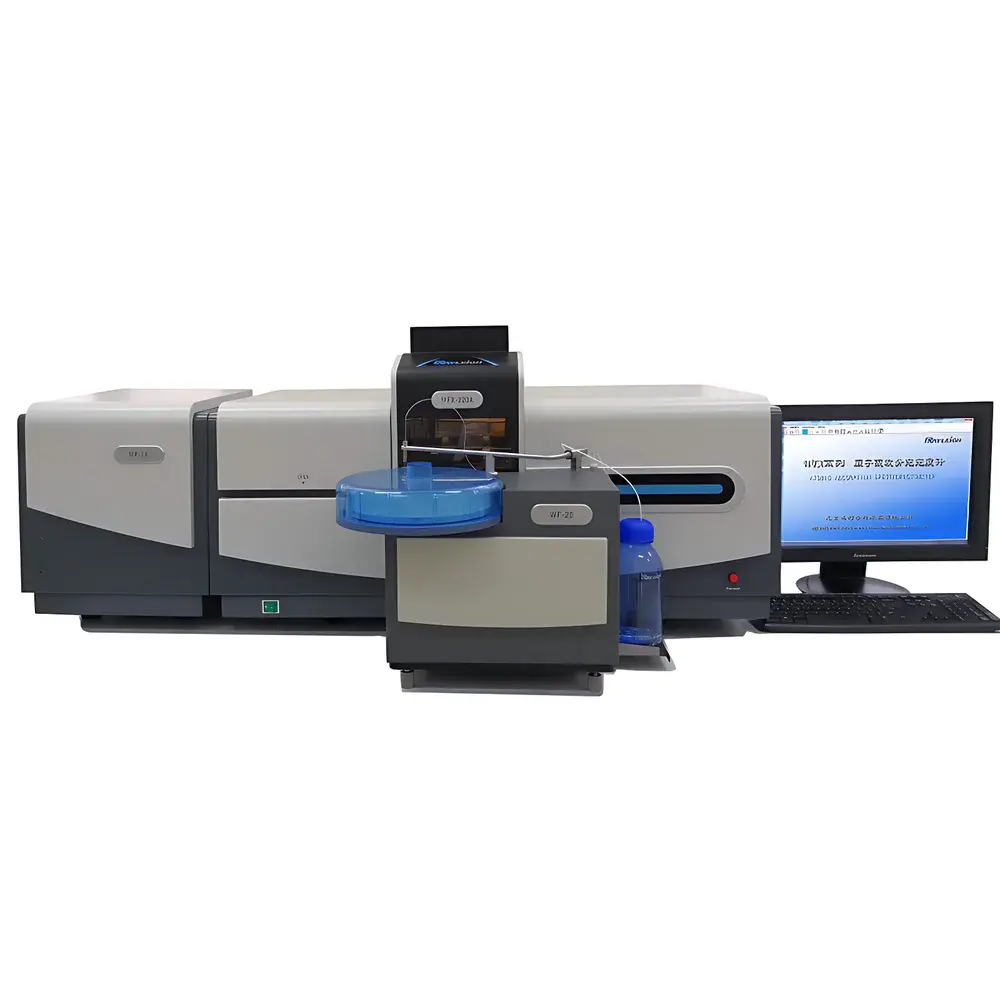
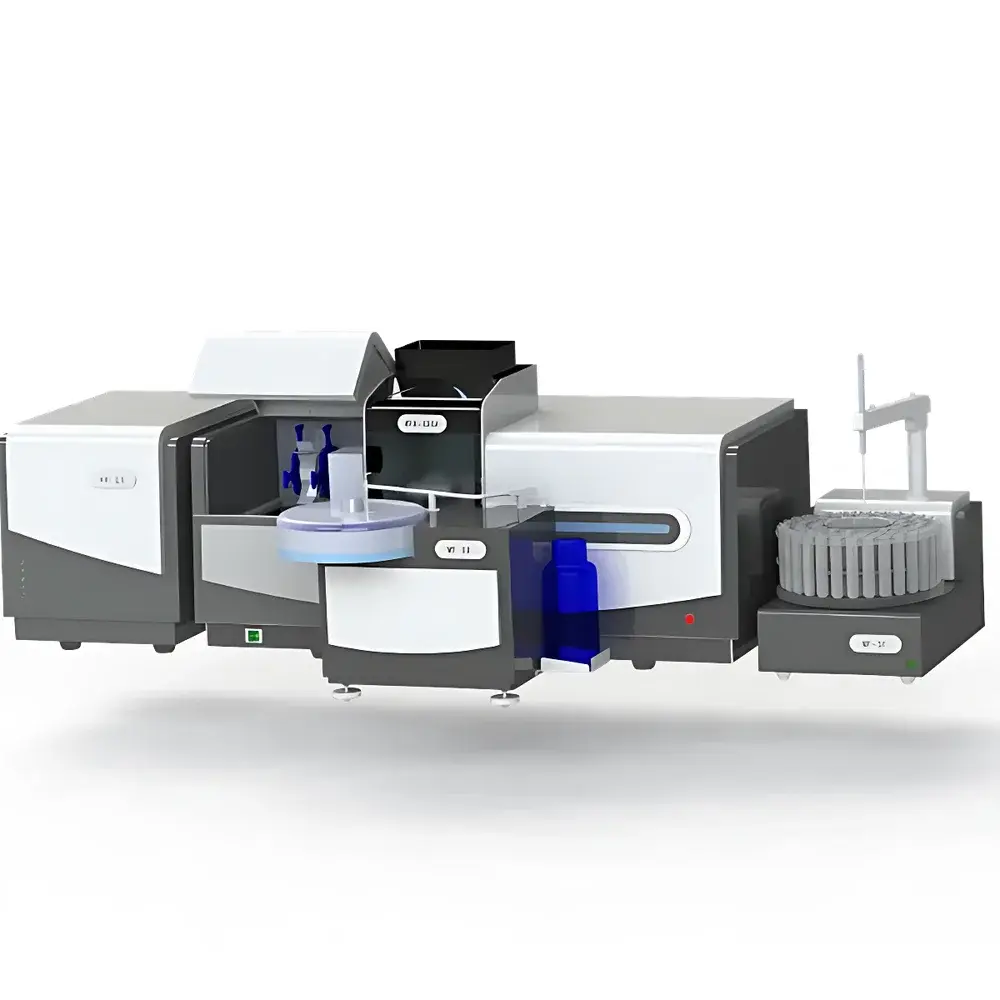
Beifen Ruili WFX-220A Flame and Graphite Furnace Atomic Absorption Spectrometer
| Brand | Beifen Ruili |
|---|---|
| Origin | Beijing, China |
| Model | WFX-220A |
| Instrument Type | Flame and Graphite Furnace AAS |
| Monochromator | Plane Grating |
| Optical System | Single-beam |
| Detector | Photomultiplier Tube (PMT) |
| Background Correction | Deuterium Lamp + Self-absorption Method |
| Spectral Bandwidth | 0.2 nm ± 0.02 nm (at 0.2 nm setting) |
| Sensitivity | Flame mode — Cu ≤0.03 µg/mL/1% |
| Precision (RSD) | Flame mode — Cu ≤0.5% |
| Detection Limit | Flame mode — Cu ≤0.003 µg/mL |
| Baseline Stability | ≤0.002 absorbance units/30 min |
Overview
The Beifen Ruili WFX-220A Flame and Graphite Furnace Atomic Absorption Spectrometer is a dual-mode analytical instrument engineered for trace elemental quantification in environmental, pharmaceutical, food safety, clinical, and industrial quality control laboratories. It operates on the fundamental principle of atomic absorption spectroscopy (AAS), where ground-state free atoms in a gaseous state absorb characteristic radiation emitted by a hollow cathode lamp (HCL). The instrument integrates flame atomization (for higher concentration samples) and electrothermal graphite furnace atomization (for ultra-trace analysis), enabling detection across a dynamic range spanning three to six orders of magnitude. Its single-beam optical architecture—featuring a Czerny-Turner monochromator with plane grating dispersion—ensures high wavelength accuracy and long-term spectral fidelity. Designed and manufactured in Beijing under strict ISO 9001-aligned production protocols, the WFX-220A meets foundational requirements for GLP-compliant routine analysis and supports method validation per ASTM E2016, ISO 11170, and USP <730> guidelines.
Key Features
- Intelligent Lamp Current Monitoring: Real-time feedback circuitry prevents DC lamp operation, extending HCL lifetime and ensuring stable emission intensity across extended measurement sequences.
- Modular Circuit Architecture: Fully isolated functional modules—including power supply, detector signal processing, and atomizer control—minimize electromagnetic interference and simplify field diagnostics or component-level maintenance.
- Dual-Mode Background Correction: Simultaneous deuterium lamp and self-absorption correction enables accurate compensation for structured and non-structured background absorption, particularly critical for complex matrices such as soil digests or biological fluids.
- Enhanced Safety Engineering: Flame module incorporates mass flow controllers (MFCs) for precise fuel/oxidant regulation; graphite furnace features dual thermal cutoffs, air circuit breakers, and hardware-enforced interlocks that automatically terminate power upon door opening, coolant failure, or temperature anomaly.
- Optimized Atomization Flexibility: Flame burner head is interchangeable for dedicated alkali-metal analysis (e.g., K, Na), delivering up to 3× wider linear dynamic range versus standard configurations; graphite furnace supports both optical pyrometry and constant-voltage heating modes, allowing method-specific optimization of atomization efficiency and tube longevity.
- 8-Position Automated Lamp Carousel: Enables fully automated lamp selection, alignment, and pre-heating sequencing—supporting concurrent warm-up of up to seven lamps while one remains active—reducing turnaround time between multi-element analyses.
Sample Compatibility & Compliance
The WFX-220A accommodates liquid samples introduced via nebulizer (flame) or autosampler (graphite furnace), with compatibility extended to acid-digested environmental solids (EPA Method 200.7, 3050B), biological tissues (AOAC 999.10), and pharmaceutical excipients (ICH Q2(R2)). Its modular design permits integration of optional accessories—including hydride generation systems for As, Se, Sb, and Bi; high-temperature flame assemblies for refractory elements (e.g., V, Mo); and flame emission capability for alkali/alkaline earth metals. All firmware and operational logic comply with basic data integrity expectations outlined in FDA 21 CFR Part 11 Annex 11 principles, including audit trail logging (user actions, parameter changes, calibration events) and electronic signature support when paired with validated LIMS interfaces. Mechanical construction adheres to IEC 61010-1 safety standards for laboratory electrical equipment.
Software & Data Management
The embedded application workstation provides a unified GUI for instrument control, method development, calibration curve fitting (linear, quadratic, weighted least squares), QC monitoring (spike recovery, bracketing standards), and report generation. Built-in expert libraries include preconfigured methods for >60 elements, annotated sample preparation workflows, preventive maintenance schedules, and troubleshooting decision trees. Data export conforms to ASTM E1382-compliant ASCII formats and supports direct transfer to Microsoft Excel, CSV, or LIMS via USB or Ethernet. All raw absorbance/time and absorbance/wavelength datasets are stored with metadata (lamp ID, slit width, integration time, gas flow rates) to ensure full traceability during regulatory audits. Software updates are delivered via secure firmware package installation with version-controlled rollback capability.
Applications
- Environmental monitoring: Pb, Cd, Cr, Ni, Zn in wastewater per EPA 200.9 and ISO 11885
- Food and beverage testing: As in rice, Cu in wine, Fe in infant formula per AOAC and Codex Alimentarius protocols
- Pharmaceutical quality control: Catalyst residue analysis (Pd, Pt, Rh) in APIs per ICH Q2(R2) and USP <233>
- Clinical toxicology: Blood lead screening (CLIA-waived workflow compatible) and urinary Cd quantification
- Geological and metallurgical assay: Multi-acid digest analysis of ores and alloys using matrix-matched calibration
FAQ
Does the WFX-220A support compliance with GLP or GMP requirements?
Yes—the system records full audit trails for all analytical runs, includes user access controls, and supports electronic signatures when deployed with validated third-party LIMS or ELN platforms.
Can the instrument be upgraded from flame-only to flame/graphite furnace configuration post-purchase?
No—the WFX-220A is shipped as a factory-integrated dual-mode platform; retrofitting is not supported due to structural, thermal, and electrical integration requirements.
What maintenance intervals are recommended for the graphite furnace system?
Daily: Visual inspection of graphite tube integrity and purge gas lines; Weekly: Cleaning of autosampler probe and furnace cavity; Quarterly: Replacement of graphite contacts and recalibration of optical pyrometer.
Is hydrogen fluoride (HF) compatible with the nebulizer system?
No—standard quartz nebulizers and spray chambers are not HF-resistant; use of HF-containing digests requires prior neutralization or specialized PFA components (available as optional accessories).
How is baseline stability verified during performance qualification?
Baseline drift is measured over 30 minutes at 250 nm with no lamp current or sample introduction; acceptance criterion is ≤0.002 absorbance units, per manufacturer’s PQ protocol and aligned with ISO/IEC 17025 internal verification standards.




