
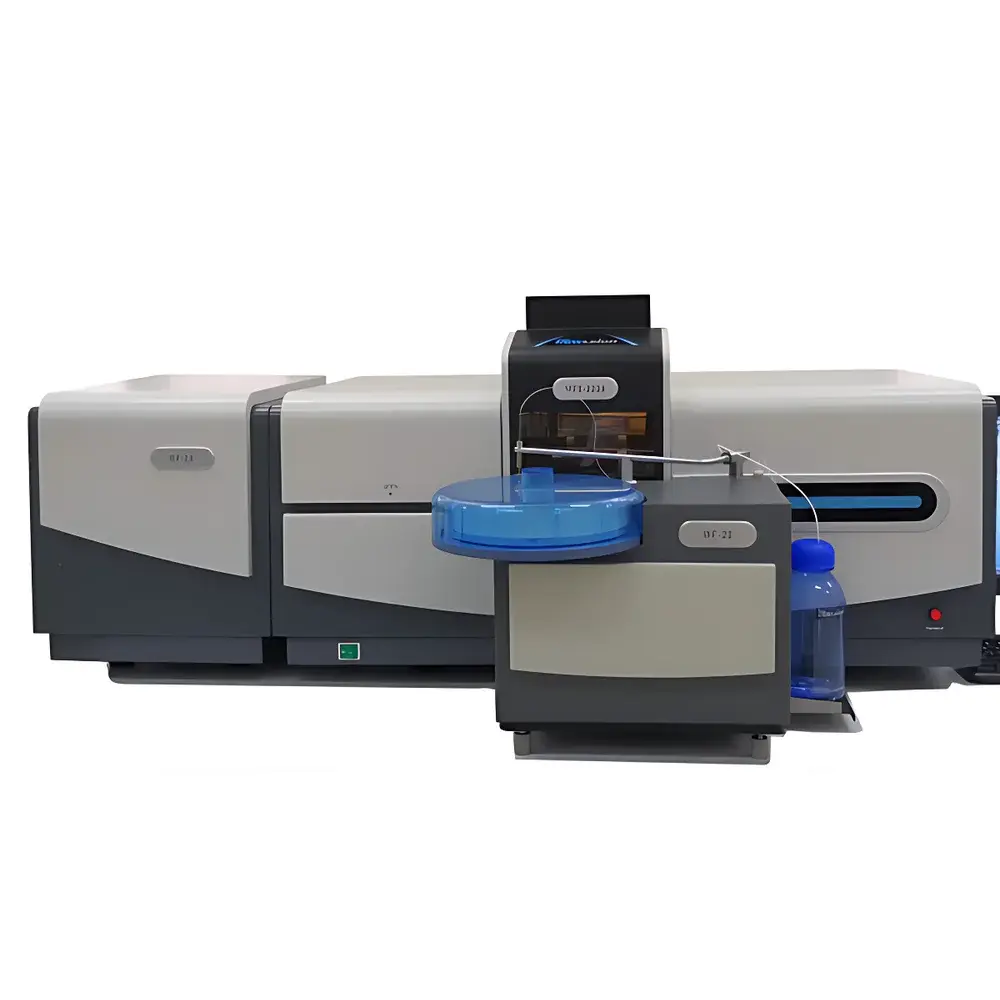
Beifen Ruili WFX220 Flame and Graphite Furnace Atomic Absorption Spectrometer
| Brand | Beifen Ruili |
|---|---|
| Origin | Beijing, China |
| Model | WFX220 |
| Instrument Type | Flame and Graphite Furnace AAS |
| Monochromator | Plane Grating |
| Optical System | Single-Beam |
| Detector | Photomultiplier Tube (PMT) |
| Background Correction | Automatic Deuterium Lamp Background Correction |
| Spectral Resolution | 0.2 nm |
| Sensitivity | ≤0.03 µg/mL for Cu (Flame), ≤0.4 pg for Cd (Graphite Furnace) |
| Relative Standard Deviation (RSD) | ≤0.5% |
| Detection Limit | ≤0.003 µg/mL for Cu (Flame), ≤0.4 pg for Cd (Graphite Furnace) |
| Baseline Stability | ≤0.003 µg/mL (Flame Cu), ≤0.4 pg (Graphite Furnace Cd) |
Overview
The Beifen Ruili WFX220 is a dual-mode atomic absorption spectrometer engineered for high-precision elemental quantification in routine and research-grade laboratories. It integrates flame atomic absorption (FAAS) and graphite furnace atomic absorption (GFAAS) capabilities within a single, modular platform—enabling trace-level analysis across environmental, clinical, pharmaceutical, food safety, and metallurgical applications. The instrument operates on the fundamental principle of atomic absorption spectroscopy: ground-state atoms in the gaseous phase absorb characteristic radiation emitted by a hollow cathode lamp (HCL), with absorbance proportional to analyte concentration per Beer–Lambert law. Its single-beam optical architecture employs a plane grating monochromator (0.2 nm resolution) and a photomultiplier tube detector, delivering robust signal-to-noise performance and long-term baseline stability. Designed and manufactured in Beijing under stringent quality control protocols, the WFX220 complies with core international performance benchmarks aligned with ISO 7098 (general requirements for AAS instruments) and supports method validation in accordance with ASTM D1688 (copper in water), EPA Method 200.9 (trace metals in drinking water), and USP (heavy metals testing).
Key Features
- Intelligent lamp current feedback system prevents DC lamp ignition, extending HCL lifetime and ensuring stable spectral output.
- Proven Czerny-Turner (C-T) monochromator design minimizes optical aberrations and maintains wavelength accuracy over extended operation cycles.
- Fully modular electronic architecture isolates power supply, detector, and atomization subsystems—reducing cross-talk and simplifying field diagnostics and maintenance.
- Dual-atomization safety architecture: flame module incorporates mass flow controllers for precise fuel/oxidant regulation; graphite furnace integrates dual thermal cutoffs and air circuit breakers to prevent overheating or electrical overload.
- Eight-position automated lamp turret supports simultaneous preheating of up to seven lamps with real-time power balancing and timing synchronization—optimized for multi-element workflows.
- Quick-swap flame emission burner head designed specifically for alkali metals (K, Na), expanding linear dynamic range by up to 3× compared to standard FAAS configurations.
- Adaptive temperature control modes for graphite furnace: users select between optical pyrometry or constant-voltage heating depending on element volatility and tube type—enhancing reproducibility and extending graphite tube service life.
Sample Compatibility & Compliance
The WFX220 accommodates liquid samples across a broad matrix spectrum—including aqueous standards, digested environmental extracts (EPA SW-846 Methods 3050B/3052), biological fluids, and acid-digested food or soil samples. Its automatic background correction (deuterium lamp-based) compensates for non-specific absorption from complex matrices, enabling reliable quantitation in high-salt or organic-rich solutions. The system meets essential regulatory prerequisites for GLP and GMP environments: audit-trail-capable software logging (with user authentication), secure method storage, and full parameter traceability. While not inherently 21 CFR Part 11 compliant out-of-the-box, its data management framework supports integration with validated LIMS platforms and third-party electronic signature modules for regulated labs.
Software & Data Management
The embedded application workstation features an intuitive GUI developed from decades of Chinese laboratory usage patterns. It automates instrument alignment, wavelength scanning, lamp optimization, and calibration curve generation. Built-in expert libraries provide context-aware guidance—including recommended operating conditions per element, sample digestion protocols (e.g., HNO₃/HF for silicates), daily maintenance checklists, and safety best practices for acetylene handling and graphite furnace operation. All measurement data—including raw absorbance, peak area/intensity, calibration parameters, and QC metrics—are timestamped and exportable in CSV or ASCII format. Software logs retain full operator history, method versioning, and instrument status snapshots—supporting internal audits and external accreditation reviews (e.g., CNAS, ILAC-G13).
Applications
The WFX220 delivers validated performance in multiple regulated and industrial use cases: quantification of lead and cadmium in drinking water per WHO guidelines; monitoring copper, zinc, and iron in serum and urine for clinical nutrition studies; trace arsenic and mercury determination in rice and seafood using hydride generation accessories; elemental profiling of catalysts and battery materials in R&D settings; and routine quality control of metal impurities in pharmaceutical excipients per ICH Q2(R2). Its modular design permits future expansion with optional accessories—including dual autosamplers, graphite furnace video monitoring, flame readout enhancement kits, and automated water-seal waste detection systems—ensuring long-term adaptability to evolving analytical needs.
FAQ
What atomization methods does the WFX220 support?
It supports flame AAS, graphite furnace AAS, and flame emission spectroscopy (FES) for alkali metals—each implemented as interchangeable hardware modules.
Is the instrument compatible with hydride generation techniques?
Yes—via optional accessory integration, enabling As, Se, Sb, Bi, Te, and Pb analysis at sub-pg/mL levels.
How is background correction implemented?
Deuterium lamp-based continuous-source background correction is applied automatically during both flame and graphite furnace measurements.
Can the software meet FDA 21 CFR Part 11 requirements?
Out-of-the-box functionality includes audit trails and user access control; full Part 11 compliance requires integration with validated third-party e-signature and electronic record systems.
What maintenance intervals are recommended for routine operation?
Daily: burner head cleaning and gas line inspection; weekly: lamp alignment verification and PMT voltage calibration; quarterly: monochromator slit cleaning and graphite furnace temperature calibration using certified reference materials.






