
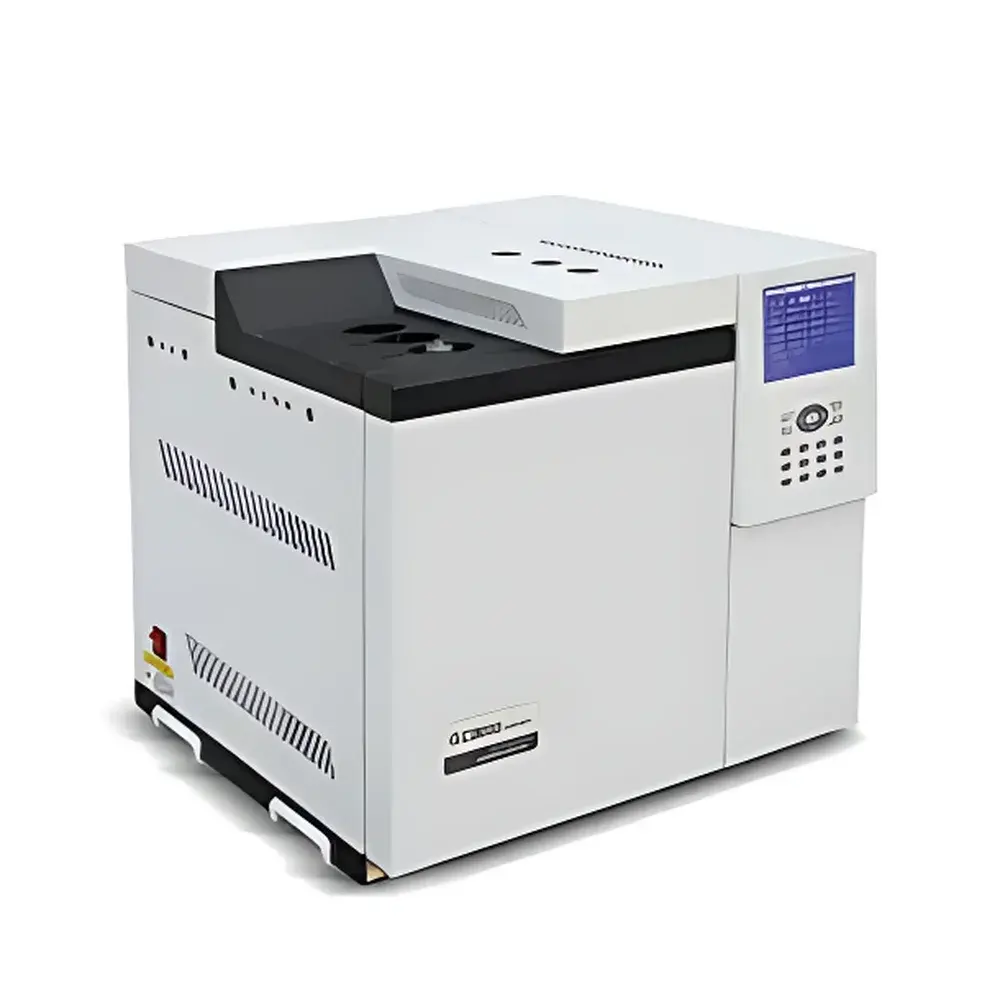
Beifen Sanpu G-C-9860 Environmental NMHC Gas Chromatograph for Fixed Source Emission Monitoring
| [Brand | Beifen Sanpu |
|---|---|
| Origin | Beijing, China |
| Manufacturer Type | Direct Manufacturer |
| Instrument Type | Laboratory Gas Chromatograph |
| Application | Environmental Emission Monitoring (Fixed Sources & Ambient Air) |
| Oven Temperature Range | 15–380 °C |
| Oven Ramp Rate | 15–23 °C/min |
| Oven Cool-down Rate | 320 °C → 45 °C |
| Carrier Gas Flow Range | 0–672 mL/min (electronically controlled) |
| Carrier Gas Pressure Range | 0–850 kPa (pressure-programmable) |
| Injector Max Temp | 320 °C |
| Injector Pressure Setting Range | 0–540 kPa |
| Injector Total Flow Setting Range | 0–820 mL/min |
| Detection Principle | Flame Ionization Detection (FID) with Dual-Packed Column Configuration (Total Hydrocarbons Column + Methane-Specific Column) |
| Compliance | HJ 38–2017, HJ 604–2017 |
| Column Configuration | Dual 2 m × 4 mm Stainless Steel Packed Columns (THC and CH₄ separation) |
| Injection System | Ten-Port Valve for Direct Gas Sampling |
| Data Acquisition | Integrated GC Workstation with Audit Trail Support] |
Overview
The Beifen Sanpu G-C-9860 Environmental NMHC Gas Chromatograph is a dedicated laboratory-scale gas chromatographic system engineered for precise, regulatory-compliant quantification of total hydrocarbons (THC), methane (CH₄), and nonmethane hydrocarbons (NMHC) in gaseous environmental samples. It operates on the principle of dual-column, direct-gas-injection gas chromatography coupled with flame ionization detection (FID). In accordance with Chinese national standard methods HJ 38–2017 (for fixed source emissions) and HJ 604–2017 (for ambient air), the instrument separates THC and CH₄ on two parallel packed columns — one optimized for total hydrocarbon response and the other selectively retaining methane — enabling accurate NMHC calculation as the arithmetic difference (NMHC = THC − CH₄), reported as carbon-equivalent mass concentration (mg C/m³ or ppmv C). The system incorporates robust thermal management, pressure/flow-controlled carrier gas delivery, and FID stability engineering to ensure high reproducibility (<2% RSD for repeated injections under routine QC conditions) and long-term baseline stability required for continuous environmental compliance monitoring.
Key Features
- Integrated dual-FID configuration with independent signal amplification channels for simultaneous THC and CH₄ detection
- Programmable ten-port gas sampling valve enabling automated, contamination-free direct injection of stack gas or ambient air samples
- High-precision oven temperature control (±0.1 °C) over 15–380 °C range, supporting up to six programmable temperature ramps with hold times adjustable in 0.1-min increments
- Intelligent back-door airflow modulation system ensuring rapid, stable cool-down (320 °C → 45 °C in <12 min) and precise isothermal control near ambient temperatures
- Dual independently controllable packed-column inlets with septum purge, pressure programming, and flow optimization for nitrogen (carrier), hydrogen (fuel), and synthetic air (combustion oxidant)
- Real-time LCD interface (320 × 240 pixels) displaying all critical parameters: oven temp, injector temps, detector voltages, pressure/flow setpoints, and diagnostic status codes
- Comprehensive hardware-level safety protocols including overtemperature cutoff, carrier gas failure shutdown, and leak-responsive power interlock
Sample Compatibility & Compliance
The G-C-9860 is validated for use with uncompressed or pressure-regulated gas streams from fixed emission sources (e.g., industrial stacks, incinerators, chemical reactors) and ambient air sampling canisters or Tedlar bags. Sample introduction is exclusively via gas-tight loop injection using the integrated ten-port valve, eliminating liquid-phase artifacts and adsorption losses common in sorbent-based methods. All operational parameters—including column dimensions (2 m × 4 mm stainless steel), stationary phases, carrier gas composition (high-purity N₂ ≥ 99.999%), and calibration gas traceability—conform strictly to HJ 38–2017 and HJ 604–2017 requirements. The system supports full method validation per ISO/IEC 17025:2017 for testing laboratories, and its electronic logs and audit-ready data structure align with GLP principles for environmental testing accreditation.
Software & Data Management
The embedded chromatography workstation provides full acquisition, integration, calibration curve generation (linear and quadratic), and report export (PDF, CSV, XML). It maintains time-stamped, user-identifiable audit trails for all method edits, sequence changes, calibration updates, and result approvals—meeting foundational expectations of FDA 21 CFR Part 11 for electronic records where locally mandated. Raw data files are stored in vendor-neutral formats compatible with third-party LIMS integration. Optional add-ons include remote monitoring via Ethernet, scheduled auto-calibration triggers, and digital signature-enabled report finalization workflows.
Applications
- Regulatory compliance testing of VOC emissions from petrochemical, pharmaceutical, coating, and printing facilities per local environmental protection bureau mandates
- Stack testing for NMHC mass emission rate calculations (kg/h) in permit renewal and Best Available Control Technology (BACT) assessments
- Ambient air quality monitoring networks requiring standardized NMHC trend analysis across urban, industrial, and background sites
- Method development and validation studies for alternative NMHC measurement approaches (e.g., FTIR cross-validation)
- QA/QC support for field portable GC systems through laboratory reference analysis
FAQ
Does the G-C-9860 meet international standards such as ISO 10156 or EPA Method 25?
The instrument is specifically designed and factory-validated for HJ 38–2017 and HJ 604–2017. While it shares core technical architecture with systems used in EPA Method 25 applications (dual-column FID), formal EPA certification requires site-specific performance qualification per 40 CFR Part 60 Appendix A.
Can the system be configured for capillary column analysis?
No—the G-C-9860 is purpose-built for packed-column operation per regulatory method requirements; capillary inlet modules are not supported in this model variant.
What is the minimum detectable level for NMHC under standard operating conditions?
Based on typical system configuration (2-m packed columns, 1-mL gas loop, H₂–air FID), the method detection limit (MDL) for NMHC is ≤0.05 mg C/m³ at standard temperature and pressure (STP), consistent with HJ 38–2017 validation data.
Is remote diagnostics and firmware update capability available?
Yes—via optional Ethernet module, technicians can perform secure remote health checks, parameter diagnostics, and controlled firmware upgrades without physical access.
How is oxygen interference corrected during THC measurement?
The system implements the HJ 38–2017 “hydrocarbon-free air” blank correction protocol: a certified dehydrocarbonized air standard is injected prior to each sample batch to quantify and subtract the O₂-derived FID response offset on the THC column.



