
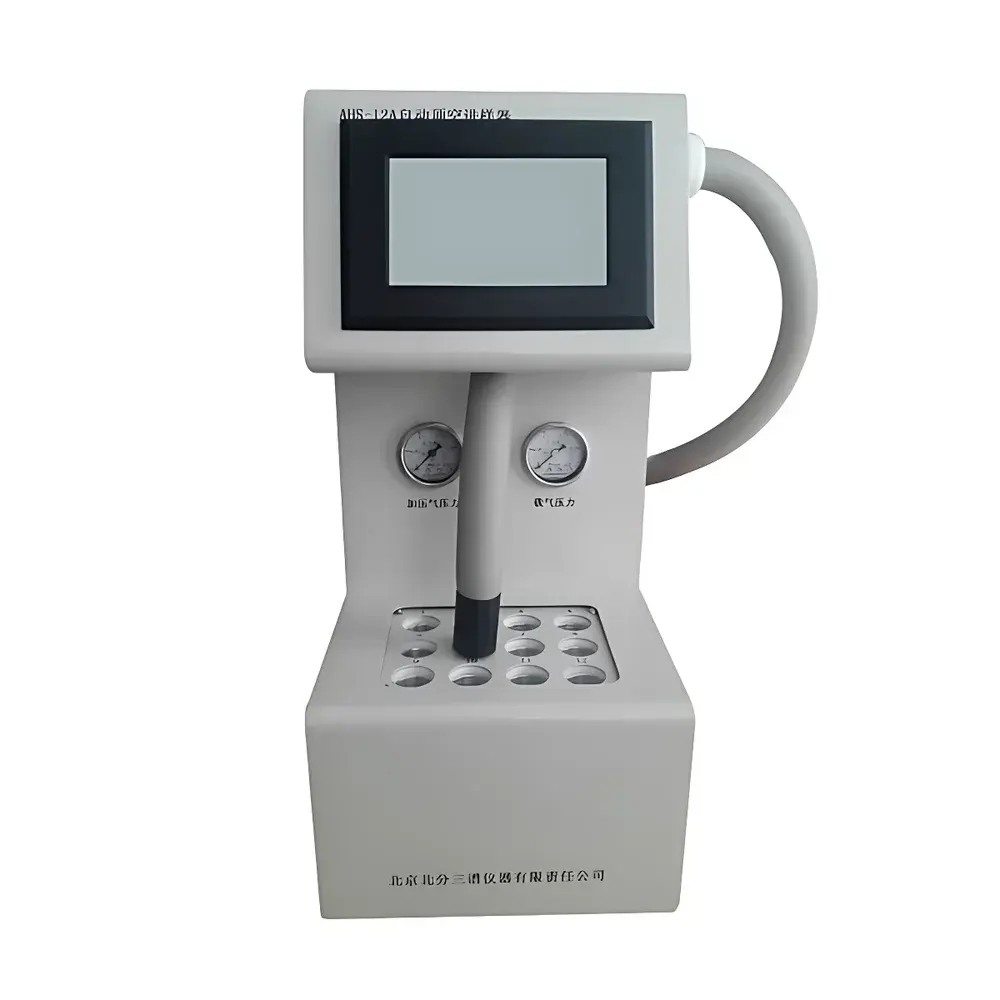
Beifen Sanpu AHS-10A Static Headspace Sampler
| Brand | Beifen Sanpu |
|---|---|
| Origin | Beijing, China |
| Manufacturer Type | Direct Manufacturer |
| Instrument Type | Static Headspace Sampler |
| Automation Level | Semi-Automatic |
| Sample Vial Heating Range | Ambient to 200 °C (1 °C increments) |
| Injection Valve Temperature Control Range | Ambient to 200 °C (1 °C increments) |
| Quantitative Loop Volume | 1 mL |
| Vial Capacity | 12 positions |
| Compatible Vial Sizes | 10 mL or 20 mL |
| Integrated GC Trigger Output | Yes |
| Method Storage | 10 user-editable methods |
| Safety Features | Overtemperature cutoff with thermal shutdown |
Overview
The Beifen Sanpu AHS-10A Static Headspace Sampler is a robust, semi-automated sample introduction system engineered for reliable and reproducible analysis of volatile and semi-volatile organic compounds (VOCs and SVOCs) in complex, non-volatile matrices. It operates on the principle of static headspace equilibrium—where a sealed sample vial is heated to promote partitioning of analytes into the vapor phase above the sample; after equilibration, a precise volume of this headspace gas is withdrawn via a pressurized, temperature-controlled loop and transferred directly into a gas chromatograph (GC) injector. Designed specifically for routine QC/QA laboratories in pharmaceutical, environmental, food safety, and forensic applications, the AHS-10A delivers high analytical precision without requiring cryogenic cooling or complex carrier gas management. Its architecture adheres to fundamental chromatographic preconcentration requirements—minimizing adsorption losses, eliminating carryover, and maintaining thermal integrity across all fluidic pathways.
Key Features
- 12-position heated sample carousel with uniform thermal distribution—reducing inter-vial temperature gradients to ≤±0.5 °C at 150 °C, thereby enhancing method reproducibility across batch runs.
- Semi-automatic operation with integrated 5-inch full-color capacitive touchscreen interface—supporting intuitive method setup, real-time status monitoring, and on-device diagnostics without external PC dependency.
- Electrically actuated six-port valve coupled with a 1 mL stainless-steel quantitative loop—enabling positive-pressure sampling for improved sensitivity and reduced variability in injection volume.
- Triple-zone independent temperature control: sample vials, injection valve assembly, and transfer lines—all heated up to 200 °C in 1 °C increments—to prevent condensation and ensure quantitative transfer of high-boiling-point analytes (e.g., alcohols, ketones, chlorinated solvents).
- Integrated back-flush functionality for both sampling needle and valve flow path—effectively purging residual analytes between injections to eliminate cross-contamination, critical for trace-level analysis per USP & EP guidelines.
- Front-accessible vial tray design—optimized for seated operation and ergonomic laboratory workflow integration.
- Modular needle interface—compatible with standard GC inlet septa and adaptable to Agilent, Thermo Fisher, Shimadzu, and PerkinElmer GC systems via universal ferrule configurations.
Sample Compatibility & Compliance
The AHS-10A supports standard crimp-top 10 mL and 20 mL headspace vials (with PTFE/silicone septa), accommodating aqueous, viscous, solid, and semi-solid samples—including pharmaceutical tablets, soil slurries, polymer extracts, and biological fluids. All wetted surfaces are chemically inert (electropolished stainless steel, PTFE-lined seals), ensuring compatibility with aggressive solvents and acidic/basic matrices. The instrument conforms to key regulatory expectations for data integrity and method validation: audit-trail-capable method storage (10 programmable protocols), synchronized GC start trigger output (TTL-compatible), and thermal safety interlocks meeting IEC 61010-1 requirements. While not inherently 21 CFR Part 11 compliant out-of-the-box, its deterministic method execution and timestamped run logs support GLP/GMP-aligned documentation when paired with validated chromatography data systems (CDS).
Software & Data Management
Operation is fully self-contained within the onboard firmware—no proprietary PC software required for daily use. Each of the 10 stored methods retains complete thermal profiles (vial temp, valve temp, loop temp), equilibration time, pressurization duration, sampling time, and GC trigger parameters. All method edits, run logs, and error events are timestamped and retained in non-volatile memory. For laboratories requiring electronic records, the AHS-10A provides RS-232 and optional USB-to-serial interfaces to integrate with third-party CDS platforms (e.g., OpenLab CDS, Chromeleon, Empower) for automated method recall and result correlation. Raw thermal and timing data can be exported in CSV format for retrospective review during method validation or internal audit.
Applications
- Pharmaceutical residual solvent analysis per ICH Q3C and USP <467>—including Class 1–3 solvents (e.g., dichloromethane, ethanol, ethyl acetate) in active pharmaceutical ingredients (APIs) and finished dosage forms.
- Environmental VOC screening in water per EPA Method 502.2 and 8260D—detection of BTEX, chlorinated ethenes, and trihalomethanes at sub-ppb levels.
- Food and beverage flavor profiling and off-odor compound identification—e.g., acetaldehyde in PET-bottled beverages or geosmin in drinking water.
- Forensic toxicology screening for volatile intoxicants (e.g., ethanol, isopropanol, acetone) in blood and urine specimens.
- Polymer and packaging material testing for extractables and leachables—compliant with ISO 10993-12 and ASTM D6866 protocols.
FAQ
Is the AHS-10A compatible with my existing gas chromatograph?
Yes—the instrument features a universal injection needle design and TTL-level GC start signal output, enabling seamless integration with all major GC platforms.
Can I validate this system under GMP/GLP conditions?
While the AHS-10A itself does not include electronic signature or audit trail modules, its deterministic thermal control, method recall capability, and timestamped event logging support IQ/OQ/PQ protocols when documented alongside your CDS and SOPs.
What maintenance is required for long-term reliability?
Routine maintenance includes quarterly cleaning of the six-port valve rotor seal, annual replacement of PTFE septa, and biannual calibration verification using certified reference standards (e.g., n-butanol in water).
Does it support dynamic headspace or purge-and-trap modes?
No—the AHS-10A is strictly a static headspace sampler; it does not incorporate carrier gas sweeping, trapping columns, or cryofocusing capabilities.
How is temperature uniformity verified across the 12 vial positions?
Uniformity is factory-verified using NIST-traceable PT100 probes placed in representative vial wells at multiple setpoints (50 °C, 100 °C, 150 °C); deviation remains within ±0.5 °C at steady state.
Related Products






