
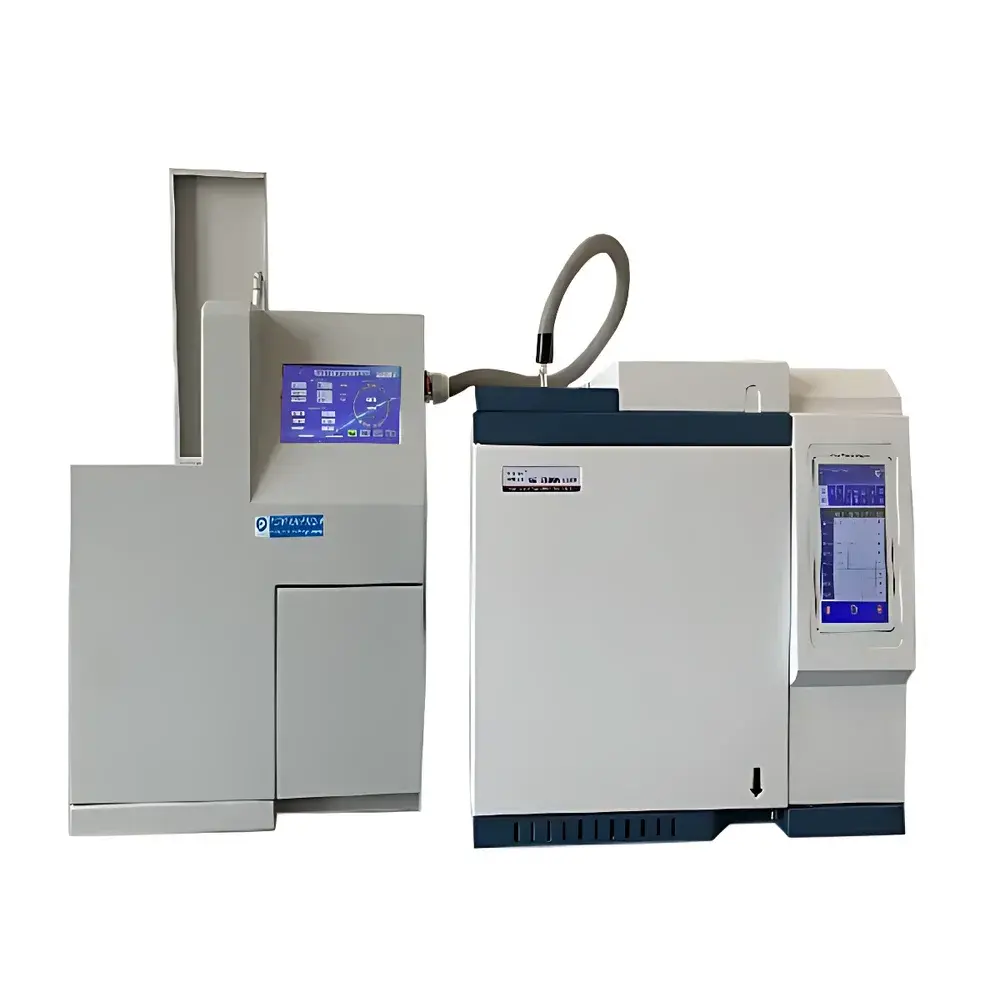
Beifen Sanpu AHS-20A Plus 20-Position Fully Automated Static Headspace Sampler
| Brand | Beifen Sanpu |
|---|---|
| Origin | Beijing, China |
| Manufacturer Type | OEM Manufacturer |
| Instrument Type | Static Headspace Sampler |
| Automation Level | Fully Automatic |
| Sample Heating Range | Ambient to 200 °C (1 °C increment) |
| Valve & Transfer Line Temperature Control Range | 40–220 °C (±1 °C accuracy) |
| Quantitative Loop Volume | 1 mL |
| Sample Position Capacity | 20 positions |
| Vial Size Compatibility | 10 mL or 20 mL vials |
| RSD | <1.0% (at 100 ppm ethanol in water) |
| Pressure Control Range | 0–0.25 MPa (continuously adjustable) |
| Sampling Time | 0–30 min |
| Injection Time | 0–999 s |
| Purge/Flush Time | 0–30 min |
| Minimum Time Resolution | 1 ms |
| Communication Interface | USB |
Overview
The Beifen Sanpu AHS-20A Plus is a fully automated static headspace sampler engineered for precise, reproducible, and high-throughput analysis of volatile organic compounds (VOCs) in solid, liquid, or semi-solid matrices. It operates on the principle of phase equilibrium partitioning: samples are sealed in crimp-top vials and heated to a defined temperature, allowing volatile analytes—including residual solvents such as ethanol and 1,2-dichloroethane—to equilibrate between the sample matrix and the headspace gas phase. A precisely metered volume of this equilibrated vapor is then transferred via pressurized sampling into a gas chromatograph (GC) for separation and detection. Designed specifically for compliance-driven pharmaceutical QC laboratories, the AHS-20A Plus supports ICH Q3C guidelines for residual solvent analysis, enabling accurate quantification at trace levels (e.g., ≤5 ppm for Class 1 solvent 1,2-dichloroethane). Its robust thermal architecture—featuring independently controlled heating zones for sample vials, six-port valve, and transfer lines—eliminates cold spots and ensures quantitative transfer integrity across extended analytical sequences.
Key Features
- Fully automated 20-position carousel with auto-sampling scheduling, eliminating manual intervention and minimizing operator variability.
- Independent PID-controlled heating zones: sample block (ambient to 200 °C), valve oven (40–220 °C), and transfer line (40–220 °C), all with ±1 °C thermal stability and <±0.5 °C long-term drift.
- High-inertness fluidic path: de-activated fused silica capillary tubing and passivated stainless-steel components minimize adsorption, carryover, and cross-contamination—critical for low-level VOC analysis.
- Positive-pressure sampling mechanism with adjustable pressure (0–0.25 MPa) and fine temporal resolution (1 ms step), ensuring consistent loop filling and injection repeatability (RSD <1.0% at 100 ppm ethanol).
- Integrated fault-detection system: automatic vial position recognition, mechanical motion monitoring, and real-time error logging—including vial absence detection and collision avoidance logic.
- 7-inch full-color graphical LCD interface with animated workflow guidance; supports both front-panel and remote USB-based parameter configuration.
- Universal GC synchronization: TTL-triggered start/stop compatibility with all major GC systems (including Agilent, Thermo, Shimadzu, and domestic models), plus optional EPC flow control integration.
Sample Compatibility & Compliance
The AHS-20A Plus accommodates standard 10 mL and 20 mL headspace vials (crimp-seal compatible), with optional configurations available for 50 mL and 100 mL formats. It is validated for use with diverse sample types—pharmaceutical actives (e.g., ibuprofen), excipients, polymers, environmental solids (soil, sediment), aqueous matrices (drinking water, wastewater), and food-contact materials. The system adheres to multiple regulatory method frameworks, including USP , EP 2.4.24, ICH Q3C, and Chinese Pharmacopoeia 2020 Edition Vol. IV (General Chapter 0521: Headspace Gas Chromatography). It supports method development per EPA Method 502.2, HJ 736–2015 (soil VOCs), HJ 810–2016 (water VOCs), and GB/T 17130–1997 (halogenated hydrocarbons), fulfilling GLP/GMP audit requirements through configurable event logging, user access controls, and electronic signature-ready operation records.
Software & Data Management
Instrument parameters—including incubation time, pressurization duration, sampling delay, loop fill time, and purge cycles—are programmable via intuitive USB-connected software or local touchscreen interface. All method files and run logs are timestamped and stored with metadata (operator ID, instrument serial number, date/time stamp), supporting traceability per FDA 21 CFR Part 11 when paired with compliant chromatography data systems (e.g., N2000, Chromeleon, OpenLab CDS). The system provides hardware-level synchronization signals (TTL pulses) for seamless integration with GC autosamplers and mass spectrometers, enabling unattended multi-day batch runs. Audit trails capture parameter changes, error events, and maintenance alerts, facilitating internal quality reviews and regulatory inspections.
Applications
- Pharmaceutical residual solvent testing: quantification of Class 1 (e.g., 1,2-dichloroethane, benzene), Class 2 (e.g., chloroform, toluene), and Class 3 (e.g., ethanol, acetone) solvents in APIs and finished dosage forms per ICH Q3C.
- Environmental analysis: determination of volatile halocarbons (e.g., vinyl chloride, trichloroethylene) in groundwater, soil extracts, and air samples per EPA and HJ standards.
- Food safety and packaging: migration testing of solvents (e.g., ethyl acetate, isopropanol) from printing inks and adhesives into food simulants (SN/T 4068–2014).
- Tobacco and agricultural products: screening of residual fumigants (e.g., dichloropropane) and flavor volatiles in leaf tobacco (YC/T 207–2014).
- Chemical manufacturing QA/QC: batch release testing of polymer pellets, resins, and coatings for trapped monomers or processing solvents.
FAQ
What sample vial sizes does the AHS-20A Plus support?
Standard configurations accommodate 10 mL and 20 mL crimp-top headspace vials. Custom trays for 50 mL and 100 mL vials are available upon request.
Is the system compatible with GC-MS platforms?
Yes—the AHS-20A Plus delivers clean, inert vapor transfer suitable for direct coupling to single-quadrupole and triple-quadrupole GC-MS systems without modification.
How is method validation supported?
The instrument enables full system suitability testing (SST) per USP : precision (RSD <1.0%), linearity (5–200 ppm), LOD/LOQ verification, and carryover assessment using blank vials post-high-concentration injections.
Does it meet regulatory requirements for electronic records?
When operated with validated chromatography data systems, its USB-based parameter logging, event timestamps, and error reporting satisfy ALCOA+ principles and 21 CFR Part 11 Annex 11 expectations for audit-ready data integrity.
What maintenance is required for long-term reliability?
Recommended quarterly checks include valve seal inspection, quantitative loop calibration verification, and inertness validation using surrogate spikes (e.g., deuterated chloroform); no routine gas supply or pneumatic consumables are needed due to motor-driven actuation.






