
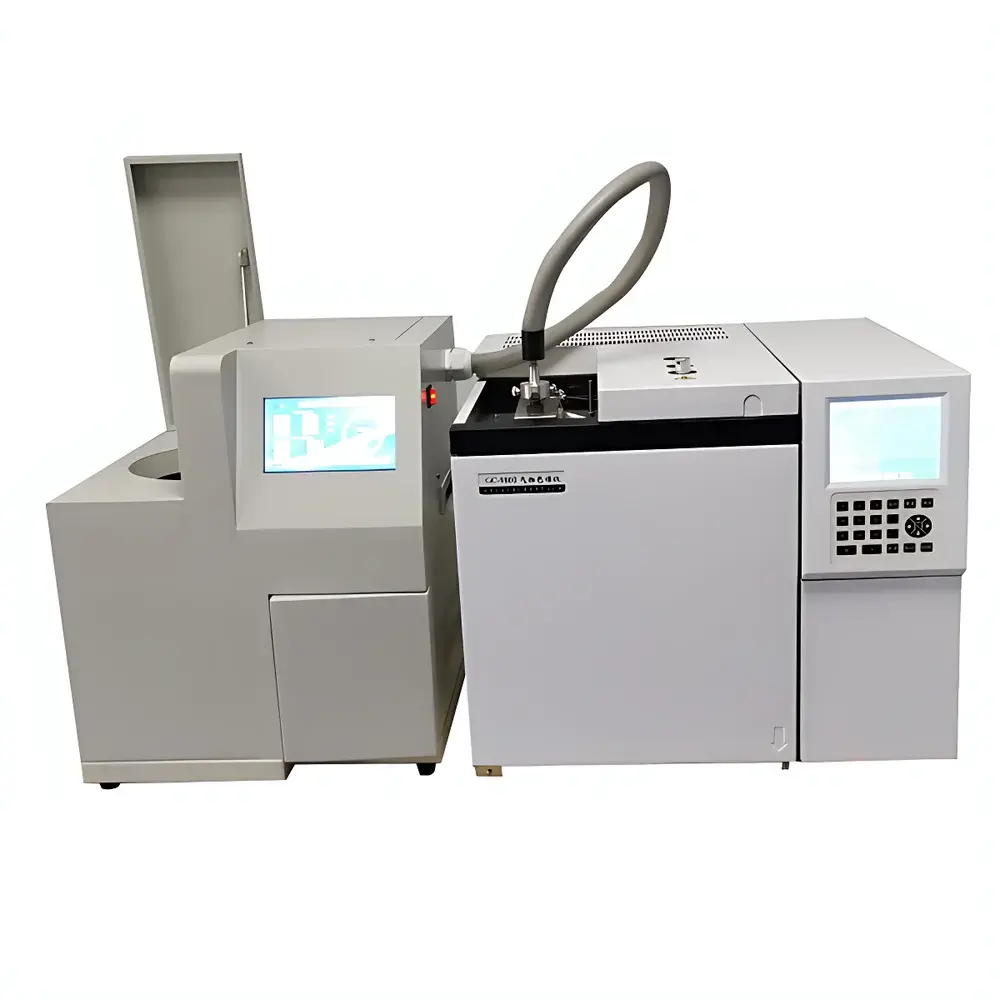
Beifen Sanpu AHS-20A Plus Automated Static Headspace Sampler for Ethylene Oxide Residue Analysis
| Brand | Beifen Sanpu |
|---|---|
| Origin | Beijing, China |
| Manufacturer Type | Direct Manufacturer |
| Instrument Category | Domestic |
| Model | AHS-20A Plus |
| Instrument Type | Static Headspace Sampler |
| Automation Level | Fully Automatic |
| Sample Vial Heating Range | Ambient to 200 °C (1 °C increment) |
| Valve & Transfer Line Temperature Control Range | 40–220 °C (±1 °C accuracy) |
| Quantitative Loop Volume | 1 mL |
| Sample Capacity | 20-position carousel |
| Compatible Vial Sizes | 10 mL or 20 mL vials |
Overview
The Beifen Sanpu AHS-20A Plus is a fully automated static headspace sampler engineered for precise, reproducible quantification of residual ethylene oxide (EO) in medical devices and single-use healthcare products. It operates on the principle of equilibrium headspace gas-phase extraction: solid or liquid samples are sealed in heated vials, allowing volatile EO to partition into the headspace above the matrix; the equilibrated vapor is then pressurized, transferred via a high-inertness six-port valve and heated transfer line, and injected directly into a gas chromatograph (GC) for separation and detection—typically using flame ionization (FID) or mass spectrometric (MS) detection. This methodology aligns with internationally recognized pharmacopeial and regulatory frameworks—including USP , EP 2.2.48, ISO 10993-7, and GB/T 16886.7—where static headspace-GC remains the reference method for EO residue verification due to its robustness, minimal sample preparation, and low risk of analyte loss or degradation.
Key Features
- Fully automated 20-position carousel with real-time positional feedback and mechanical fault detection—enables unattended overnight analysis of multiple batches.
- Independent temperature control for sample vials (ambient to 200 °C), injection valve (40–220 °C), and transfer lines (40–220 °C), all maintained within ±1 °C stability and <0.5 °C drift over 8-hour operation.
- High-inertness, de-activated fused-silica capillary tubing and quantitative loop (1 mL standard; optional 0.5/2/5 mL) minimize adsorption, carryover, and cross-contamination—validated by RSD <1.0% at 100 ppm ethanol in water.
- Positive-pressure sampling architecture eliminates baseline drift during GC injection and ensures compatibility with both liquid and solid matrices—including polypropylene masks, PVC tubing, PET packaging, and lyophilized pharmaceuticals.
- Integrated EPC-ready interface (optional) supports electronic pressure control synchronization with modern GC systems for enhanced retention time reproducibility.
- 7-inch graphical LCD interface with animated workflow guidance, USB computer connectivity, and full parameter remote configuration—no proprietary software required.
- Comprehensive self-diagnostic suite: automatic vial position recognition, motor stall detection, heater fault logging, and thermal runaway prevention.
Sample Compatibility & Compliance
The AHS-20A Plus accommodates standard 10 mL and 20 mL crimp-top headspace vials, with custom support available for 50 mL and 100 mL formats. It is validated for use with aqueous, saline, and buffer-diluted samples per GB/T 14233.1–2008 and ISO 10993-7 protocols. All wetted surfaces employ silanized glass and PTFE/silicone septa compliant with USP Class VI requirements. The system supports GLP-compliant audit trails when paired with 21 CFR Part 11–enabled chromatography data systems (CDS). Routine calibration verification follows ASTM D6866–22 guidelines for EO quantitation accuracy, and method suitability testing includes precision (n=6), linearity (R² ≥0.999 over 0.5–50 µg/g), limit of quantitation (LOQ ≤0.2 µg/g), and recovery (95–105%) across representative device matrices.
Software & Data Management
Instrument parameters—including equilibration time (0–30 min), pressurization duration (0–999 s), loop fill time, injection time, and post-run bake-out—are programmable via front-panel keypad or USB-connected PC. Timestamped operational logs (date/time, vial ID, temperature setpoints, valve actuation events) are stored internally and exportable as CSV. When synchronized with third-party CDS platforms (e.g., OpenLab CDS, Chromeleon, Empower), the sampler triggers GC sequence start, injects timing pulses, and accepts status acknowledgments—ensuring full traceability from sample loading to report generation. Optional firmware upgrade enables encrypted data logging and user-access-level permissions for multi-operator environments.
Applications
Primary applications include EO residue testing in sterilized medical devices (syringes, catheters, gowns, surgical drapes), personal protective equipment (N95 respirators, face shields), pharmaceutical primary packaging (blister foils, stoppers), and biocompatible polymers (polyethylene, polyurethane, silicone elastomers). Secondary uses extend to residual solvent analysis in APIs (ICH Q3C), flavor volatiles in food packaging, and VOC profiling in environmental monitoring standards. Its design meets the throughput and repeatability demands of QC laboratories performing batch release testing under ISO 13485 and FDA QSR requirements.
FAQ
What regulatory standards does the AHS-20A Plus support for EO testing?
It is configured to meet GB/T 16886.7–2015, ISO 10993-7:2019, USP , and ASTM F1980–22 for accelerated aging correlation studies.
Can the system handle heterogeneous solid samples like surgical masks?
Yes—samples are homogenized manually prior to vial loading; the 20 mL vial format accommodates up to 1.0 g of cut material with 5 mL water diluent, per GB/T 16886.7 Annex B protocols.
Is method validation documentation provided?
Beifen Sanpu supplies IQ/OQ protocol templates, system suitability test procedures, and a certified reference standard handling guide aligned with ISO/IEC 17025 requirements.
How is carryover prevented between high-concentration and low-concentration samples?
Programmable post-injection purge cycles (0–30 min) with adjustable inert gas flow (0–100 mL/min) ensure quantitative removal of residual EO from the valve and loop.
Does the instrument require external gas cylinders for operation?
No—actuation is fully motor-driven; only carrier gas (helium, hydrogen, or nitrogen) from the GC is consumed during sample transfer.
Related Products




