
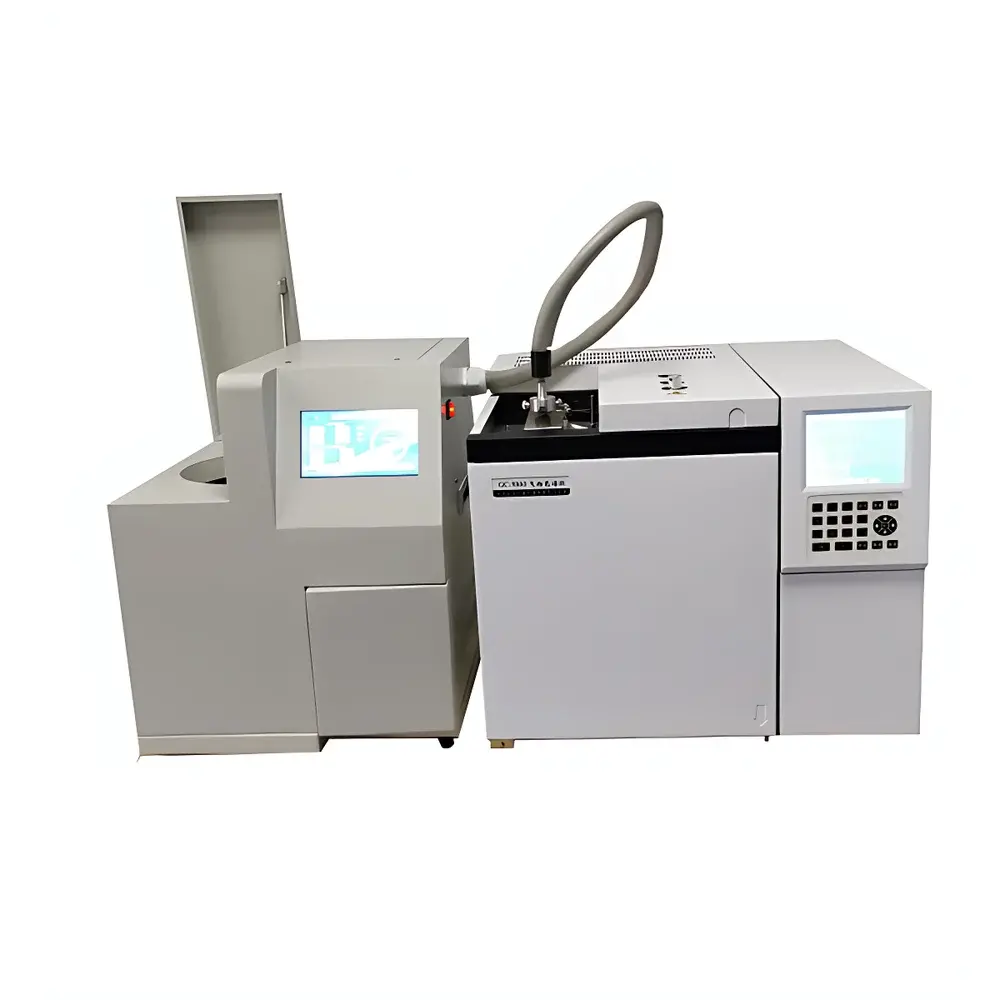
Beifen Sanpu AHS-20A Plus Fully Automated Static Headspace Sampler
| Brand | Beifen Sanpu |
|---|---|
| Origin | Beijing, China |
| Manufacturer Type | Manufacturer |
| Product Origin | Domestic (China) |
| Model | AHS-20A Plus |
| Instrument Type | Static Headspace Sampler |
| Automation Level | Fully Automatic |
| Vial Heating Range | Ambient to 200 °C (1 °C increment) |
| Valve Temperature Control Range | 40–220 °C (±1 °C accuracy) |
| Sample Loop Volume | 1 mL |
| Sample Capacity | 20 positions |
| Vial Compatibility | 10 mL or 20 mL standard headspace vials |
Overview
The Beifen Sanpu AHS-20A Plus is a fully automated static headspace sampler engineered for precise, reproducible quantification of volatile organic compounds (VOCs) in solid and liquid matrices—particularly critical for residual ethylene oxide (EO) analysis in medical devices. It operates on the principle of equilibrium headspace gas-phase extraction: samples sealed in thermostatted vials are heated to establish vapor-phase equilibrium between the matrix and headspace; the equilibrated gas is then transferred via a temperature-controlled injection valve and loop into a gas chromatograph (GC) for separation and detection. This methodology complies with ISO 10993-7:2008 and GB/T 16886.7–2015, the internationally harmonized standards governing EO residue limits in implantable and surface-contacting medical devices—including surgical masks, gowns, and sterilized disposables. The system’s robust architecture ensures compliance with GLP and GMP laboratory requirements, supporting audit-ready workflows under FDA 21 CFR Part 11 when integrated with validated GC software.
Key Features
- Fully automated 20-position carousel with programmable vial indexing and priority queue handling for unattended overnight operation.
- Independent dual-zone temperature control: precisely regulated vial oven (ambient to 200 °C, ±0.5 °C stability) and high-fidelity injection valve/heating block (40–220 °C, ±1 °C accuracy), minimizing carryover and ensuring thermal consistency across sequences.
- 1 mL fixed-volume quantitative loop with inert Siltek-coated internal surfaces, optimized for trace-level EO recovery and reduced adsorption losses.
- Integrated pressure-balanced vial pressurization using carrier gas (N₂ or He), enabling consistent headspace transfer without sample disturbance or dilution artifacts.
- Intuitive touchscreen interface with password-protected method storage, real-time status monitoring, and event logging aligned with ALCOA+ data integrity principles.
Sample Compatibility & Compliance
The AHS-20A Plus accommodates standard 10 mL and 20 mL crimp-top headspace vials with PTFE/silicone septa, compatible with aqueous suspensions, polymer films, nonwoven textiles (e.g., melt-blown polypropylene mask layers), and lyophilized pharmaceuticals. It supports extraction protocols defined in GB/T 16886.7–2015 (equivalent to ISO 10993-7), ASTM D6866, and USP . All thermal and timing parameters are configurable to match pharmacopeial methods—including extended equilibration times (up to 90 min) and multi-step temperature ramps required for low-volatility EO recovery from dense polymeric substrates. System validation documentation includes IQ/OQ/PQ templates, uncertainty budgets per ISO/IEC 17025, and traceability to NIST-traceable reference standards.
Software & Data Management
When paired with compliant GC systems (e.g., GC-9860 series), the AHS-20A Plus interfaces via RS-232 or Ethernet using standardized GC control commands. Method files embed full audit trails: operator ID, timestamped sequence logs, parameter change history, and electronic signatures. Raw data files adhere to ASTM E1947-compliant formats, enabling seamless import into LIMS platforms. Firmware supports encrypted backup, role-based access control, and automatic generation of 21 CFR Part 11–compliant electronic records—including instrument calibration certificates, maintenance logs, and EO standard curve reports with R² ≥ 0.999 over 1–10 µg/mL range.
Applications
Primary applications include residual EO quantification in Class I–III medical devices per ISO 10993-7 limits (e.g., ≤ 4 µg/g for externally contacting devices; ≤ 2 µg/g for prolonged contact). It is routinely deployed for QC release testing of surgical masks, N95 respirators, catheter packaging, and sterile barrier systems. Secondary uses span environmental VOC screening (e.g., formaldehyde in adhesives), flavor/aroma profiling in pharmaceutical excipients, and residual solvent analysis in API manufacturing per ICH Q3C guidelines. Its thermal precision and low dead-volume design also support method development for emerging analytes such as propylene oxide and chloroform in biocompatibility studies.
FAQ
What regulatory standards does this headspace sampler support for EO testing?
It fully supports GB/T 16886.7–2015, ISO 10993-7:2008, and ASTM F2723–19 for medical device EO residue analysis.
Can the system handle 20 mL vials without hardware modification?
Yes—vial tray inserts are field-replaceable; both 10 mL and 20 mL formats are supported natively.
Is method transfer possible from other headspace platforms?
Yes—retention time alignment and peak area reproducibility meet RSD ≤ 2% across platforms when using identical column chemistry and GC parameters.
Does the system provide electronic records suitable for FDA inspection?
With validated GC software, it generates 21 CFR Part 11–compliant audit trails, including user authentication, parameter change logs, and raw data archiving.
What maintenance intervals are recommended for routine operation?
Valve seal replacement every 10,000 injections; loop cleaning with methanol every 500 runs; annual thermocouple calibration and leak testing per ISO/IEC 17025.





