
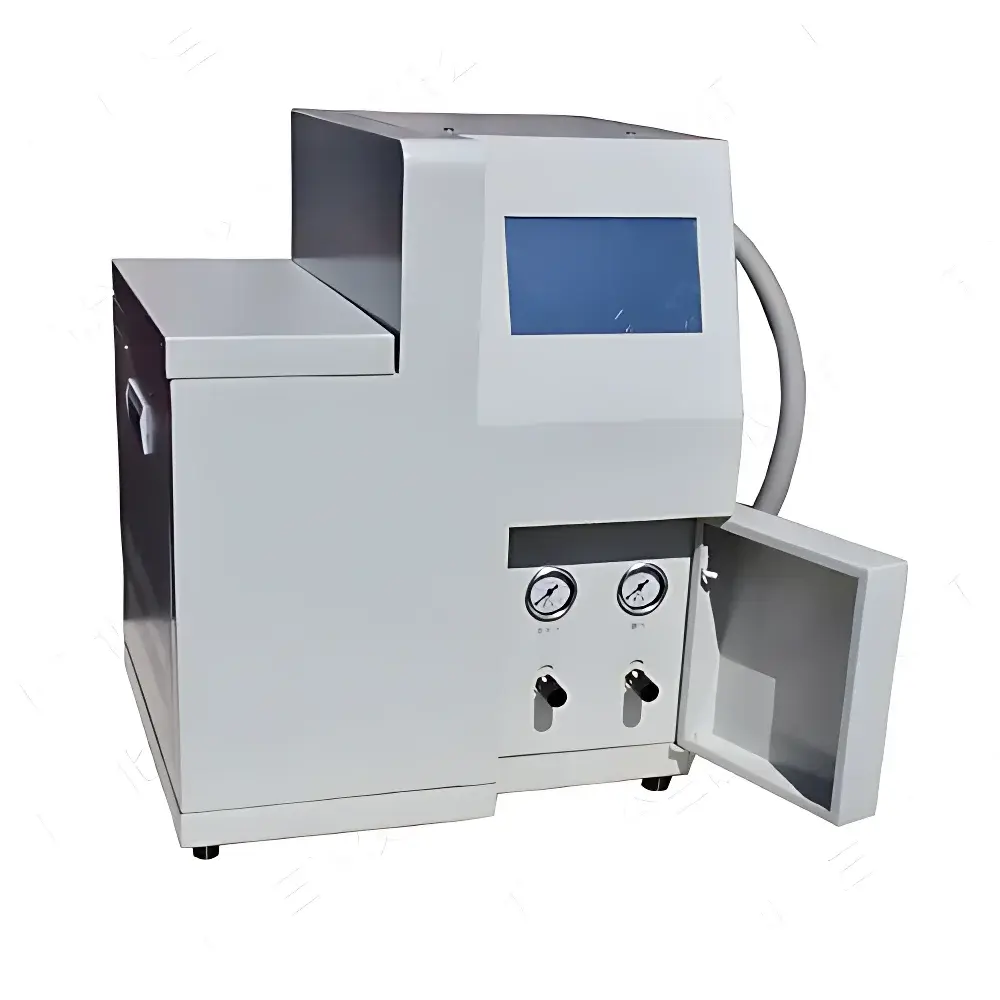
Beifen Sanpu AHS-20A Plus Fully Automated Static Headspace Sampler for Chloroform and Carbon Tetrachloride Analysis in Drinking Water
| [Brand | Beifen Sanpu |
|---|---|
| Origin | Beijing, China |
| Manufacturer Type | Direct Manufacturer |
| Instrument Type | Static Headspace Sampler |
| Automation Level | Fully Automatic |
| Vial Heating Range | Ambient to 200 °C (1 °C increments) |
| Valve Temperature Control Range | 40–220 °C (±1 °C accuracy) |
| Sample Loop Volume | 1 mL |
| Vial Capacity | 20 positions |
| Compatible Vial Sizes | 10 mL or 20 mL] |
Overview
The Beifen Sanpu AHS-20A Plus is a fully automated static headspace sampler engineered for precise, reproducible quantification of volatile halogenated hydrocarbons—specifically chloroform (CHCl₃) and carbon tetrachloride (CCl₄)—in drinking water and source water matrices. It operates on the principle of phase equilibrium partitioning: analytes are thermally equilibrated in sealed vials, after which the vapor-phase concentration above the aqueous sample is directly proportional to its liquid-phase concentration (governed by Henry’s law). This equilibrium-based approach eliminates matrix interference from non-volatile components and enables trace-level detection without liquid-phase extraction or derivatization. Designed to comply with GB/T 5750.8–2006—the Chinese national standard for drinking water quality testing—the AHS-20A Plus delivers robust performance in routine regulatory monitoring laboratories where method validation, audit readiness, and long-term operational stability are critical requirements.
Key Features
- Fully automated 20-position carousel with programmable vial recognition and collision avoidance logic, minimizing manual intervention and operator-induced variability.
- Precise, independent temperature control for vial oven (ambient to 200 °C), injection valve (40–220 °C), and transfer line (40–220 °C), all calibrated to ±1 °C accuracy per ASTM E2655 and ISO 17025 traceability protocols.
- 1 mL fixed-volume quantitative loop ensures consistent sample introduction volume across runs, supporting high inter-run reproducibility (RSD < 1.5% at 1 µg/L level).
- Integrated leak-tight sealing mechanism and pressure-balanced vial piercing system prevent analyte loss during needle insertion and ensure quantitative transfer of headspace gas.
- Intuitive touchscreen interface with password-protected method storage, run scheduling, and real-time status monitoring—including vial position, temperature ramp progress, and valve actuation timing.
- Modular architecture compatible with major GC platforms (e.g., Agilent, Shimadzu, Thermo Fisher, and domestic GC-7900 systems), supporting both split and splitless inlet configurations via standard 1/16″ stainless steel transfer lines.
Sample Compatibility & Compliance
The AHS-20A Plus is validated for use with 10 mL and 20 mL crimp-top headspace vials (standard 20 mm septa), accommodating both direct aqueous injection and acidified/antioxidant-stabilized samples per GB/T 5750.8–2006 requirements. For chloroform and carbon tetrachloride analysis, samples must be preserved with ascorbic acid (0.3–0.5 g/vial) and stored at ≤4 °C prior to analysis; the instrument supports rapid thermal equilibration at 60 °C for 40 min—a condition optimized for maximum analyte volatility while maintaining aqueous phase integrity. The system meets essential regulatory expectations for GLP and GMP environments: audit trails are generated for all method parameters, temperature logs, and run sequences; data integrity aligns with FDA 21 CFR Part 11 principles when paired with compliant chromatography data systems (CDS). It also supports ISO/IEC 17025-compliant uncertainty estimation workflows through documented calibration records and periodic performance verification using certified reference materials (e.g., NIST SRM 3138a for chlorinated solvents).
Software & Data Management
Control software provides ISO/IEC 17025-aligned method development tools, including multi-step temperature programming (vial oven, valve, line), customizable equilibration and pressurization times, and automatic vial-to-vial carryover compensation. All acquisition parameters—including valve timing, loop fill/flush cycles, and purge gas flow—are timestamped and archived in human-readable XML format. Raw method files support version control and electronic signature integration. When interfaced with validated CDS platforms (e.g., OpenLab CDS, Chromeleon, or LabSolutions), the AHS-20A Plus enables full electronic record retention, including chromatograms, calibration curves, QC check results, and instrument maintenance logs—facilitating internal audits and external accreditation reviews. Audit trail functionality captures user ID, action type, timestamp, and pre-/post-change values for every parameter modification.
Applications
- Regulatory compliance testing of municipal drinking water per GB/T 5750.8–2006, EPA Method 502.2, and ISO 15681-2 for trihalomethanes (THMs) and haloalkanes.
- Source water assessment in reservoirs, groundwater wells, and surface intakes for disinfection by-product (DBP) formation potential.
- Validation of water treatment efficacy—including activated carbon adsorption, air stripping, and advanced oxidation—by tracking chloroform and carbon tetrachloride removal kinetics.
- Environmental monitoring of distribution system stagnation zones, where DBP reformation may occur due to residual chlorine and natural organic matter interactions.
- Reference laboratory participation in proficiency testing schemes (e.g., FAPAS, LGC, or CNAS PT programs) requiring demonstrated measurement traceability and within-laboratory precision.
FAQ
What is the minimum detectable concentration achievable with this system for chloroform and carbon tetrachloride in drinking water?
The AHS-20A Plus, when coupled with an ECD-equipped GC (e.g., GC-7900) and HP-5 capillary column, achieves method detection limits (MDLs) of 0.2 µg/L for chloroform and 0.1 µg/L for carbon tetrachloride—fully meeting GB/T 5750.8–2006 specifications.
Can the AHS-20A Plus be used with other detectors besides ECD?
Yes. While electron capture detection (ECD) is recommended for optimal sensitivity to halogenated compounds, the sampler is fully compatible with FID, PID, and mass spectrometric detectors (GC-MS), provided appropriate transfer line temperatures and carrier gas flows are maintained.
Is method validation documentation available for regulatory submissions?
Beifen Sanpu provides a comprehensive IQ/OQ protocol package—including temperature uniformity mapping, carryover testing, precision/repeatability reports, and linearity verification data—for installation qualification and operational qualification under GLP or ISO/IEC 17025 frameworks.
How often does the system require calibration or maintenance?
Vial oven and valve temperature sensors should be verified quarterly using NIST-traceable dry-block calibrators; the quantitative loop volume should be confirmed annually via gravimetric testing; septa and vial caps are consumables replaced per batch or daily, depending on throughput.
Does the instrument support unattended overnight operation?
Yes. The 20-vial capacity, integrated power-fail recovery mode, and auto-restart function enable fully unattended execution of multi-batch analyses—including calibration curves, QC samples, and unknowns—with email/SNMP alerts triggered upon completion or error conditions.






