
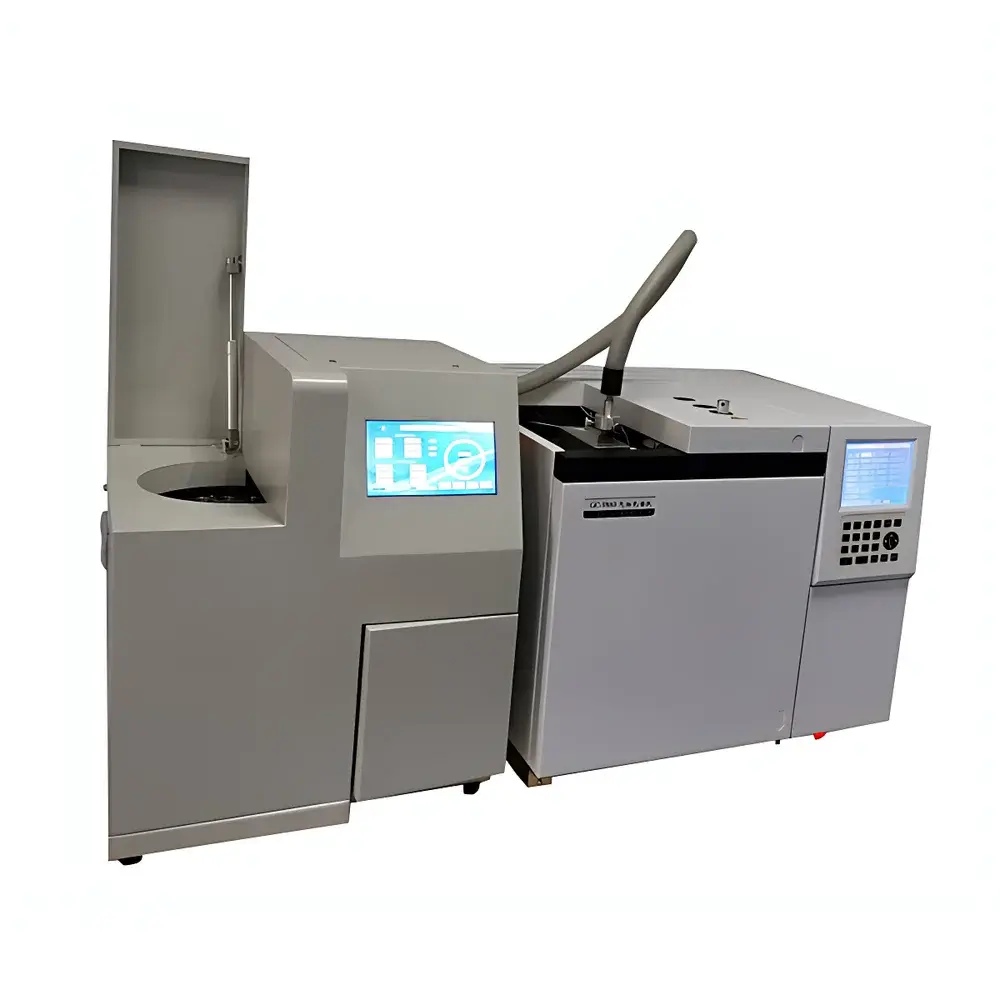
Beifen Sanpu AHS-20A Plus Fully Automated Static Headspace Sampler for Ethylene Oxide Residue Analysis in Medical Masks
| Brand | Beifen Sanpu |
|---|---|
| Origin | Beijing, China |
| Manufacturer Type | Manufacturer |
| Product Origin | Domestic (China) |
| Model | AHS-20A Plus |
| Instrument Type | Static Headspace Sampler |
| Automation Level | Fully Automatic |
| Vial Heating Range | Ambient to 200 °C (1 °C increment) |
| Valve Temperature Control Range | 40–220 °C (±1 °C accuracy) |
| Sample Loop Volume | 1 mL |
| Vial Capacity | 20 positions |
| Compatible Vial Sizes | 10 mL or 20 mL |
Overview
The Beifen Sanpu AHS-20A Plus is a fully automated static headspace sampler engineered for precise, reproducible quantification of residual ethylene oxide (EO) in sterilized medical devices—particularly surgical masks and other single-use personal protective equipment (PPE). EO is widely employed as a low-temperature gaseous sterilant due to its high microbiocidal efficacy against spores, viruses, and resistant bacteria. However, EO is classified by IARC as a Group 1 carcinogen and exhibits acute neurotoxicity and mutagenic potential. Regulatory frameworks—including ISO 10993-7, GB/T 16886.7–2015, and USP —mandate strict control of residual EO levels (typically ≤10 µg/g for most medical masks, ≤4 µg/g for implantables). The AHS-20A Plus enables compliant, high-throughput analysis by thermally equilibrating sealed sample vials under controlled conditions, followed by quantitative transfer of the vapor-phase EO into a gas chromatograph (GC) via a thermostated sampling valve and fixed-volume loop. Its design adheres to fundamental principles of Henry’s law-based partitioning and phase equilibrium kinetics, ensuring robust method transferability across laboratories operating under GLP or ISO/IEC 17025 accreditation requirements.
Key Features
- Fully automated 20-position carousel with programmable vial sequencing and collision-free robotic arm operation
- Independent dual-zone temperature control: vial oven (ambient–200 °C, ±0.5 °C stability) and sampling valve (40–220 °C, ±1 °C precision), minimizing condensation and carryover
- 1 mL fixed-volume pressurized loop with inert Siltek-coated internal surfaces to prevent EO adsorption or degradation
- Integrated pressure-balanced vial pressurization system using carrier gas (N2, He, or air) to ensure quantitative transfer and eliminate needle clogging
- Real-time monitoring of vial equilibration time, temperature ramp profiles, and valve actuation status via embedded LCD interface and RS-232/Ethernet connectivity
- Compliance-ready architecture supporting audit trails, user-level access control, and electronic signatures when paired with 21 CFR Part 11–compliant GC data systems
Sample Compatibility & Compliance
The AHS-20A Plus accommodates standard 10 mL and 20 mL crimp-top headspace vials with PTFE/silicone septa—compatible with GB/T 16886.7–2015 extraction protocols requiring aqueous extraction at 60 °C for 1 hour prior to headspace analysis. It supports direct injection of solid mask specimens (cut to ≤100 mg pieces) or extracted solutions, enabling both solid-phase and liquid-phase EO quantification. The system meets essential performance criteria outlined in ISO 15197:2013 (for analytical instrument qualification) and aligns with validation parameters required under ISO/IEC 17025 Clause 5.4.3 for method verification—including repeatability (RSD <3% for EO at 2 µg/mL), linearity (r² ≥0.999 over 1–10 µg/mL range), and limit of quantitation (LOQ ≤0.2 µg/mL). All thermal zones are traceably calibrated using NIST-traceable reference thermometers.
Software & Data Management
The AHS-20A Plus operates via Beifen Sanpu’s proprietary HS-Control software (v3.2+), compatible with Windows 10/11 and major GC platforms including Agilent, Shimadzu, and Thermo Fisher. Software functions include multi-step method programming (equilibration time, agitation speed, oven ramp rates), real-time event logging with timestamped metadata, and automatic generation of QC reports per batch. When integrated with chromatography data systems (CDS) such as OpenLab CDS or Chromeleon, the sampler supports full 21 CFR Part 11 compliance through electronic signature workflows, role-based permissions, and immutable audit trails covering all method changes, calibration events, and run sequences. Raw method files are stored in XML format with SHA-256 checksums to ensure data integrity.
Applications
- Residual EO analysis in Class I–III medical devices per GB/T 16886.7–2015, ISO 10993-7:2018, and ASTM F2735
- Quality control testing of surgical masks, gowns, drapes, and catheters during post-sterilization release
- Validation of EO sterilization cycle parameters (time, temperature, humidity, concentration) in contract manufacturing organizations (CMOs)
- Stability studies assessing EO off-gassing kinetics during shelf-life monitoring
- Regulatory submission support for FDA 510(k), CE Marking, and NMPA registration dossiers
FAQ
What is the recommended equilibration temperature and time for EO analysis in mask samples?
For consistency with GB/T 16886.7–2015, equilibrate at 80 °C for 30 minutes; however, method optimization may require empirical evaluation between 60–100 °C depending on polymer composition.
Can the AHS-20A Plus be used with flame ionization detection (FID) and mass spectrometry (MS)?
Yes—it is fully compatible with both FID and single-quadrupole or triple-quadrupole MS detectors; valve and loop materials are inert to EO and common carrier gases.
Does the system support unattended overnight operation?
Yes—the 20-vial capacity, auto-shutdown protocol, and error-recovery logic enable 24-hour batch processing without operator intervention.
How is carryover minimized during sequential high-concentration EO injections?
The system includes programmable valve bake-out (up to 220 °C), needle purge cycles with inert gas, and optional cold trap integration to suppress ghost peaks.
Is method transfer from manual headspace possible?
Yes—Beifen Sanpu provides documented equivalence studies demonstrating <5% bias versus manual injection across three independent labs, satisfying ICH Q2(R2) comparability requirements.




