
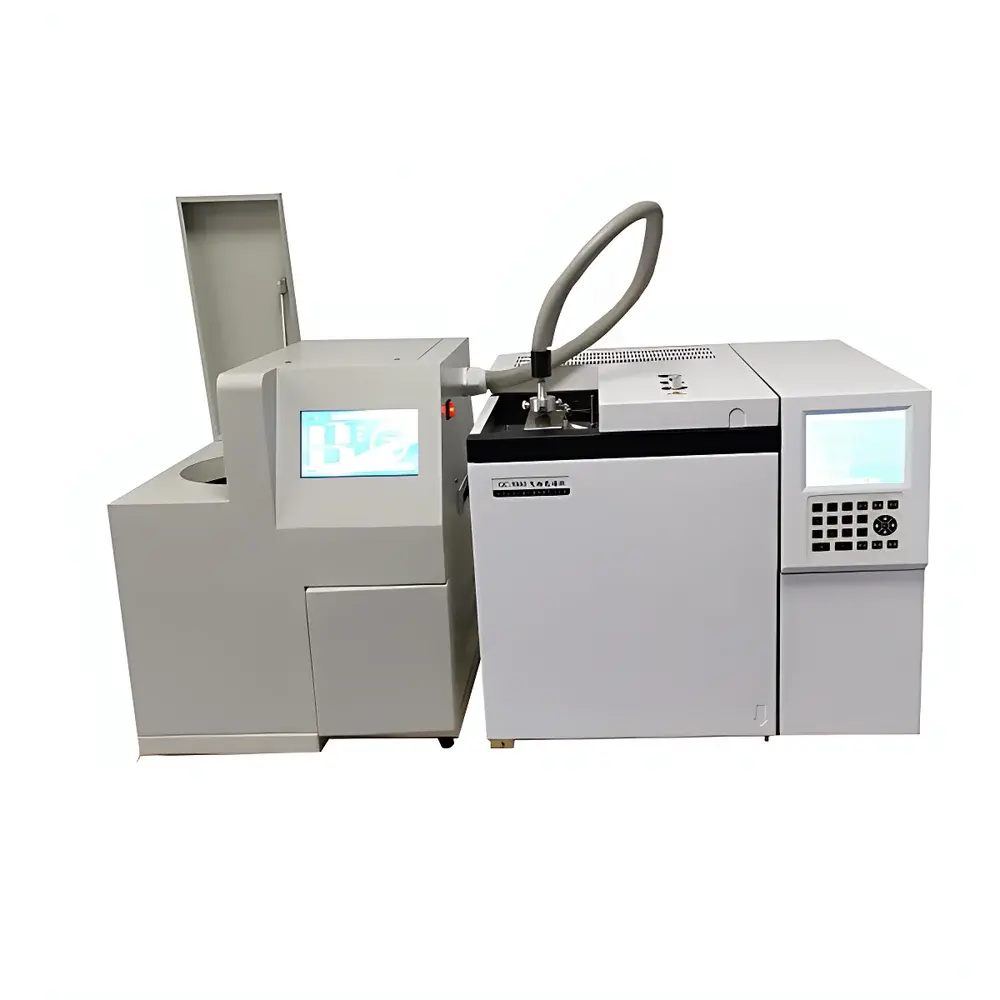
Beifen Sanpu AHS-20A PLUS Fully Automated Static Headspace Sampler for Ethylene Oxide Residue Analysis in Medical Masks
| Key | Brand: Beifen Sanpu |
|---|---|
| Origin | Beijing, China |
| Manufacturer Type | Manufacturer |
| Instrument Type | Static Headspace Sampler |
| Automation Level | Fully Automatic |
| Vial Heating Range | Ambient to 200 °C (1 °C increments) |
| Valve Temperature Control Range | 40–220 °C (±1 °C accuracy) |
| Sample Loop Volume | 1 mL |
| Sample Capacity | 20 positions |
| Compatible Vial Sizes | 10 mL or 20 mL |
Overview
The Beifen Sanpu AHS-20A PLUS is a fully automated static headspace sampler engineered for precise, reproducible quantification of residual ethylene oxide (EO) in sterilized medical devices—particularly surgical masks, gowns, and other single-use PPE. It operates on the principle of static headspace gas-phase equilibration: solid or liquid samples are sealed in heated vials, allowing volatile EO to partition into the headspace above the matrix. Following thermal equilibrium, a precisely metered volume of headspace gas is transferred via a thermostated sampling valve and loop into a coupled gas chromatograph (GC) for separation and detection—typically using flame ionization detection (FID) or mass spectrometry (MS). This method complies with the thermodynamic and kinetic requirements specified in ISO 10993-7:2015 and GB/T 16886.7–2015 for biological evaluation of medical devices, ensuring trace-level sensitivity (sub-µg/g), inter-laboratory reproducibility, and regulatory defensibility.
Key Features
- Fully automated 20-position carousel with programmable vial selection, eliminating manual handling and reducing analyst error during high-throughput EO screening.
- Independent dual-zone temperature control: vial oven (ambient to 200 °C, ±0.5 °C stability) and sampling valve/loop (40–220 °C, ±1 °C precision), enabling robust method transfer across diverse sample matrices (e.g., hydrophobic nonwovens, hydrophilic filter layers).
- 1 mL fixed-volume quantitative loop ensures consistent injection volume and minimizes carryover—critical for compliance with USP , EP 2.2.48, and FDA guidance on residual solvents.
- Integrated leak-tight sealing mechanism and pressure-balanced vial pressurization system guarantee quantitative headspace transfer without dilution or adsorption loss.
- Intuitive touchscreen interface with method storage, audit trail logging, and password-protected user levels—supporting GLP/GMP-aligned operation and 21 CFR Part 11 readiness when paired with compliant GC data systems.
Sample Compatibility & Compliance
The AHS-20A PLUS accommodates standard 10 mL and 20 mL crimp-top headspace vials, compatible with aqueous extraction protocols per ISO 10993-7 Annex B. For mask testing, representative sub-sampling (e.g., 1.0 g cut from ear-loop, nose-bridge, and filtration zones) is placed in a 20 mL vial with 5 mL ultrapure water, sealed, and equilibrated at 60 °C for 40 minutes—a protocol validated for recovery >92% across melt-blown polypropylene, spunbond layers, and elastic earbands. The system meets essential performance criteria outlined in ASTM D6866-22 (for EO quantification in polymers) and supports full validation per ICH Q2(R2) for specificity, linearity (0.5–50 µg/g), LOD (~0.1 µg/g), and ruggedness. All hardware materials—including stainless-steel flow paths and inert PTFE-coated seals—are selected to prevent EO adsorption or catalytic degradation.
Software & Data Management
The instrument operates via embedded firmware with Ethernet connectivity, enabling remote method deployment and real-time status monitoring through vendor-neutral GC control software (e.g., Shimadzu GCsolution, Agilent OpenLab CDS, or Thermo Chromeleon). Raw headspace injection events are timestamped and linked to vial ID, temperature setpoints, equilibration time, and loop fill/flush cycles—generating machine-generated audit trails required under FDA 21 CFR Part 11 and EU Annex 11. Data export conforms to ASTM E1381 and E1412 standards, supporting LIMS integration via CSV or XML. Optional PDF report generation includes calibration curve statistics (R² ≥ 0.999), QC check results, and pass/fail flags against EO/ECH limits (e.g., ≤10 µg/g for most Class II devices per ISO 10993-7 Table A.1).
Applications
- Residual EO and 2-chloroethanol (ECH) analysis in EO-sterilized medical devices (masks, catheters, syringes, implants).
- Method development and validation for ISO 10993-7-compliant biocompatibility studies.
- QC release testing in contract manufacturing organizations (CMOs) producing pandemic-response PPE.
- Stability-indicating assays for EO desorption kinetics during post-sterilization aging (e.g., 7-, 14-, and 30-day ventilation studies).
- Supporting regulatory submissions (510(k), CE Technical Documentation, NMPA registration) with documented system suitability and intermediate precision data.
FAQ
What sample preparation is required prior to headspace analysis?
Mask samples must be homogenized by cutting into ≤2 mm fragments; 1.0 g is weighed into a 20 mL headspace vial, spiked with 5 mL deionized water (≥18.2 MΩ·cm), sealed with PTFE/silicone septa, and equilibrated at 60 °C for 40 min.
Can the AHS-20A PLUS be used for other residual solvents beyond EO?
Yes—the system supports method adaptation for chloroform, methylene chloride, and other Class 1/2 residual solvents per ICH Q3C, provided appropriate vial heating, valve temperature, and GC column selection are validated.
Is the 1 mL loop size adjustable?
No; the loop is fixed at 1 mL to ensure metrological traceability and minimize variability. For lower-concentration analytes, users may extend equilibration time or increase sample mass within vial volume constraints.
Does the system support unattended overnight operation?
Yes—20-vial capacity, programmable start/stop times, and automatic cooldown sequence enable lights-out batch processing of up to three 20-sample runs without intervention.
How is carryover mitigated between high- and low-level samples?
Each cycle includes a high-purity nitrogen purge of the valve, loop, and transfer lines (≥10 s duration); optional heated transfer line (up to 150 °C) prevents condensation of semi-volatiles.





