
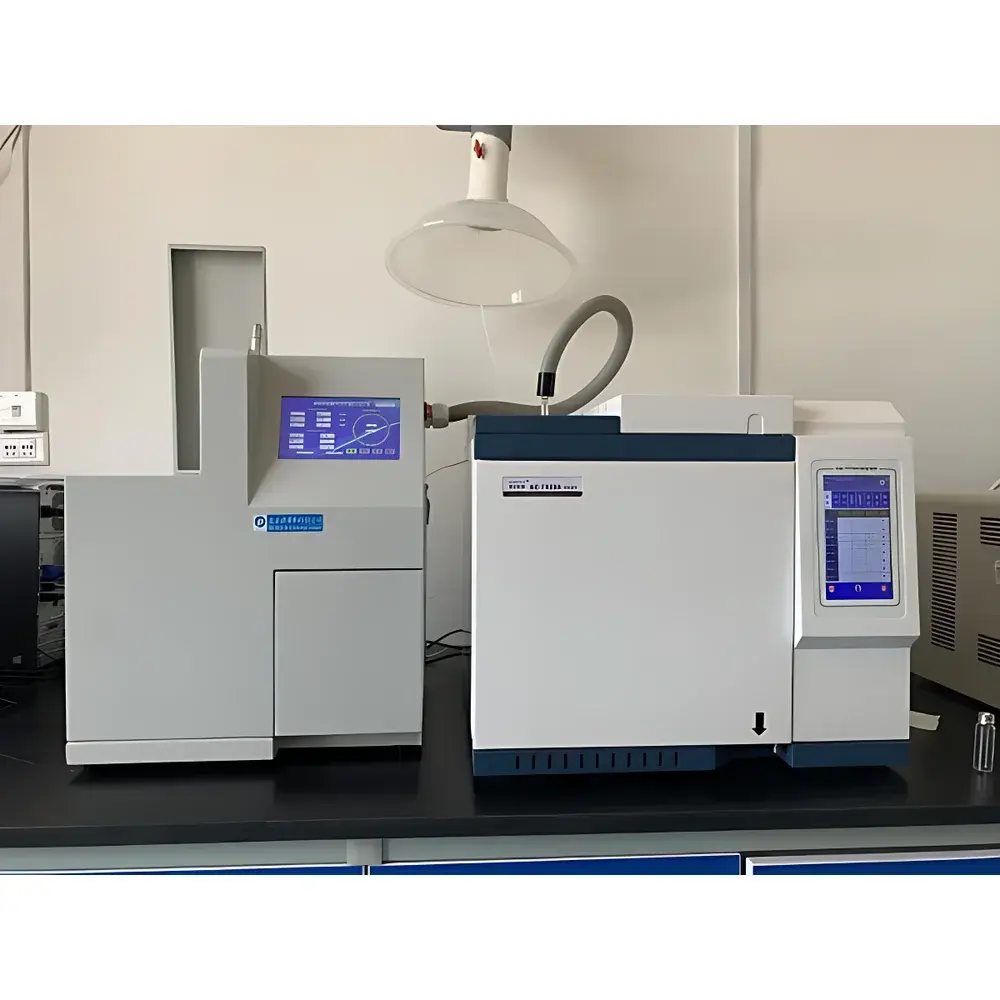
Beifen Sanpu AHS-20Aplus Fully Automated Static Headspace Sampler for HJ-741-2015 Compliant VOC Analysis in Soils and Sediments
| Brand | Beifen Sanpu |
|---|---|
| Origin | Beijing, China |
| Manufacturer Type | Direct Manufacturer |
| Instrument Type | Static Headspace Sampler |
| Automation Level | Fully Automatic |
| Vial Heating Range | Ambient to 200 °C (1 °C increments) |
| Valve Oven Temperature Range | 40–220 °C (±1 °C accuracy) |
| Sample Loop Volume | 1 mL |
| Sample Capacity | 20-position carousel |
| Compatible Vial Sizes | 10 mL or 20 mL vials |
Overview
The Beifen Sanpu AHS-20Aplus is a fully automated static headspace sampler engineered for precise, reproducible quantification of volatile organic compounds (VOCs) in solid environmental matrices—specifically soils and sediments—according to the Chinese Ministry of Ecology and Environment’s standard method HJ-741-2015. This method mandates static headspace gas chromatography with flame ionization detection (HS-GC-FID) for regulatory monitoring of priority VOCs including benzene, toluene, ethylbenzene, xylenes (BTEX), chlorinated solvents, and low-molecular-weight aliphatics. The AHS-20Aplus operates on the principle of thermodynamic partitioning: at controlled temperature and time, analytes volatilize from the solid/water slurry phase into the headspace gas phase until equilibrium is established. The equilibrated vapor is then transferred via a heated, inert sampling loop into a capillary GC system—ensuring minimal adsorption, carryover, or thermal degradation. Its robust architecture integrates tightly with benchtop GC platforms (e.g., Fuli GC-9790Plus) to support method-defined parameters such as 85 °C vial heating, 100 °C valve oven, and 30 s injection duration—enabling full compliance with HJ-741-2015’s procedural rigor.
Key Features
- Fully automated 20-position carousel with programmable sequence execution, eliminating manual vial handling and reducing analyst variability.
- Precise, independent temperature control for vial oven (ambient–200 °C, ±1 °C), valve oven (40–220 °C, ±1 °C), and transfer line (up to 220 °C), ensuring consistent equilibration and quantitative transfer.
- 1 mL stainless-steel quantitative loop with inert surface treatment, minimizing analyte adsorption and enabling high recovery for polar and reactive VOCs.
- Integrated pressure-assisted equilibration (0.3 min pressurization) and timed sampling (5 s draw, 30 s injection) to replicate HJ-741-2015’s specified kinetics.
- Compatibility with both 10 mL and 20 mL crimp-top headspace vials, supporting standard EPA/ISO-compliant sample preparation workflows.
- Modular design with front-accessible maintenance points, facilitating routine cleaning, seal replacement, and leak verification per GLP laboratory requirements.
Sample Compatibility & Compliance
The AHS-20Aplus is validated for use with heterogeneous soil and sediment samples prepared per HJ-741-2015: homogenized matrix spiked with NaCl-saturated, acidified (pH ≤2) aqueous solution and quartz sand (20–50 mesh). It accommodates high-salinity, high-moisture, and particulate-laden slurries without clogging or cross-contamination. The instrument supports full traceability under quality management frameworks aligned with ISO/IEC 17025:2017 and China’s CNAS accreditation criteria. All thermal and timing parameters are software-locked and audit-trail enabled, satisfying documentation requirements for regulatory submissions. While HJ-741-2015 is a national standard, the AHS-20Aplus’s operational envelope overlaps with ASTM D6866-22 (VOCs in solids), ISO 16017-1:2021 (indoor air VOCs via headspace), and US EPA Method 502.2 (halogenated VOCs), making it adaptable for multi-standard laboratories.
Software & Data Management
The embedded control software provides intuitive method setup, real-time status monitoring, and event logging—including vial position, temperature ramp profiles, pressure cycles, and injection timestamps. All method parameters are password-protected and version-controlled. Raw acquisition data (e.g., GC trigger signals, valve actuation logs) are exported in ASCII-compatible formats for integration with LIMS or third-party chromatography data systems (CDS). Audit trails comply with FDA 21 CFR Part 11 requirements when deployed with electronic signature-enabled CDS platforms. Software updates are delivered via secure USB import, with firmware revision history retained locally for inspection readiness.
Applications
- Regulatory monitoring of VOC contamination in agricultural, industrial, and landfill-adjacent soils per China’s Soil Environmental Quality Standards (GB 15618-2018).
- Pre- and post-remediation assessment of sediment cores from rivers, lakes, and estuaries.
- Method validation studies for inter-laboratory comparison programs organized by CNEMC (China National Environmental Monitoring Centre).
- Research applications involving VOC partitioning behavior, biodegradation kinetics, and sorption isotherms in geosorbent systems.
- Support for accredited testing labs pursuing CMA (China Metrology Accreditation) or CNAS certification in environmental chemistry.
FAQ
Is the AHS-20Aplus compatible with non-Chinese GC systems?
Yes—it features universal 1/16″ stainless-steel transfer lines and TTL/RS-232 trigger interfaces, enabling seamless integration with Agilent, Shimadzu, Thermo Fisher, and PerkinElmer GC platforms.
Does the instrument meet ISO/IEC 17025 calibration requirements?
While the AHS-20Aplus itself is not calibrated as a measuring instrument, its temperature sensors and timing circuits are factory-verified against NIST-traceable references; users perform periodic verification using certified reference materials per ISO/IEC 17025 Clause 6.5.
Can the vial heating profile be customized beyond HJ-741-2015 defaults?
Yes—the software allows user-defined multi-step heating ramps, dwell times, and agitation protocols (when paired with external shakers), supporting method development for emerging contaminants or alternative matrices.
What maintenance intervals are recommended for routine operation?
Valve seals and septa should be replaced every 500 injections; the quantitative loop requires quarterly passivation with methanol and nitrogen purge; annual thermocouple recalibration is advised for long-term precision.
Is remote monitoring or network connectivity supported?
The current firmware supports local USB and RS-232 connectivity only; Ethernet or Wi-Fi modules are available as optional upgrades for centralized lab management systems.






