
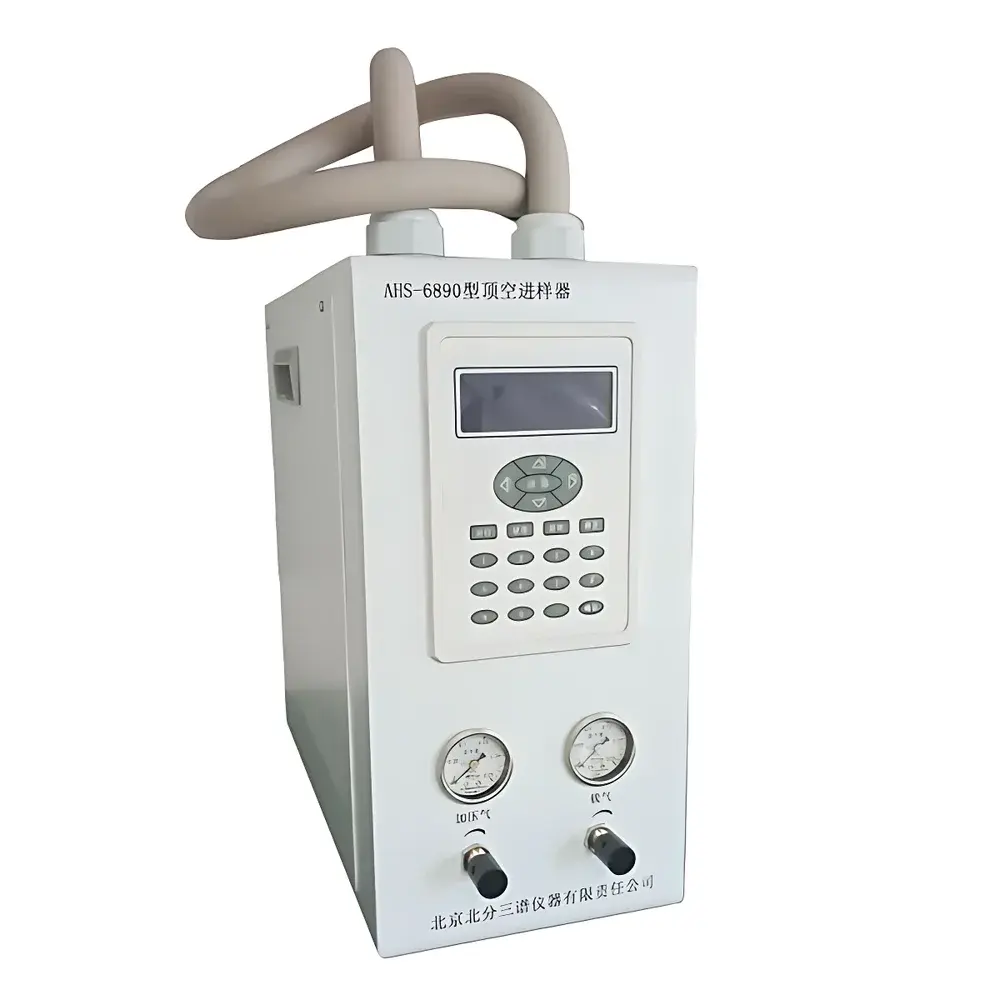
Beifen Sanpu AHS-6890 High-Pressure Automatic Headspace Sampler
| Brand | Beifen Sanpu |
|---|---|
| Origin | Beijing, China |
| Manufacturer Type | Manufacturer |
| Product Category | Domestic |
| Model | AHS-6890 |
| Instrument Type | Static Headspace Sampler |
| Automation Level | Semi-Automatic |
| Vial Heating Range | Ambient to 160 °C |
| Valve Temperature Control Range | Ambient to 160 °C |
| Temperature Control Accuracy | < ±0.5 °C |
| Sample Loop Volume | 1 mL |
| Vial Capacity | 9 positions |
| Vial Size | 10 mL standard (20 mL default per ASTM/ISO practice |
Overview
The Beifen Sanpu AHS-6890 High-Pressure Automatic Headspace Sampler is a statically operated, semi-automated sample introduction system engineered for precise, reproducible, and contamination-minimized analysis of volatile and semi-volatile organic compounds (VOCs and SVOCs) in complex solid and liquid matrices. It operates on the principle of equilibrium headspace sampling—where analytes partition between the sample phase and the gas phase above it at controlled temperature and pressure—followed by high-pressure transfer of the equilibrated vapor directly into a gas chromatograph (GC) without mechanical valves or fixed-volume loops. This design eliminates carrier gas dilution, avoids valve-related carryover and dead volume, and ensures quantitative transfer of low-concentration volatiles with minimal thermal degradation. The AHS-6890 is purpose-built for laboratories requiring GLP-compliant, routine VOC analysis across environmental, pharmaceutical, food safety, forensic, and polymer quality control applications—particularly where regulatory traceability, method robustness, and long-term instrument stability are critical.
Key Features
- High-pressure static headspace architecture: Enables direct pressurized vapor transfer without six-port valves or fixed-loop injection, minimizing adsorption losses and improving recovery of polar and reactive analytes.
- Triple-zone independent temperature control: Separately regulated heating for sample vials (ambient–160 °C), valve manifold (ambient–160 °C), and transfer lines (ambient–160 °C), all with accuracy better than ±0.5 °C and uniformity < ±0.5 °C gradient across the vial block.
- 9-position rotary carousel with standardized 10 mL (and optionally 20 mL or 50 mL) crimp-top vial compatibility—fully aligned with ASTM D6866, ISO 17935, and USP <467> requirements for residual solvent testing.
- Integrated microprocessor control with backlit Chinese/English LCD interface, programmable 8-step time sequences, and support for up to nine user-defined methods—including auto-start triggers via external TTL signals or GC ready status.
- Dual-mode operation: Supports both conventional pressurized headspace injection and programmable vacuum-assisted sampling (pump-suction mode), configurable via front-panel menu or remote command.
- Self-cleaning functionality: Automated post-injection purge of sample loop and transfer lines using adjustable reverse-flush flow (0–20 mL/min), significantly reducing cross-contamination between samples.
- Modular GC integration: Designed for seamless interfacing with any commercial GC system—no hardware modification required. Compatible with split/splitless inlets, PTV injectors, and cryo-focused systems.
- Diagnostic self-test capability: Real-time monitoring of heater status, pressure integrity, and firmware health, with error codes displayed on-screen for rapid troubleshooting.
Sample Compatibility & Compliance
The AHS-6890 accommodates aqueous, viscous, particulate-laden, and thermally labile samples—including pharmaceutical tablets, soil slurries, polymer pellets, beverage extracts, and medical device sterilant residues. Its metal isothermal vial block ensures uniform thermal distribution, eliminating hot/cold spots common in oil-bath alternatives. All wetted surfaces are inert (electropolished stainless steel and fused silica-lined pathways), supporting compliance with ICH Q2(R2), USP <467>, EPA Method 502.2/8260D, and ISO 11843-2 for detection limit validation. The integrated vial seal integrity tester verifies crimp closure performance prior to equilibration—critical for achieving RSD < 1% repeatability under ISO 5725-2 guidelines.
Software & Data Management
While the AHS-6890 operates as a standalone hardware module, it provides TTL-level synchronization interfaces for bidirectional communication with third-party GC data systems (e.g., Agilent OpenLab, Thermo Chromeleon, Shimadzu GCsolution). Time-programmed events—including vial pressurization, equilibration delay, injection trigger, and post-run flush—are logged with timestamps and stored in non-volatile memory. Audit trail functionality supports 21 CFR Part 11 readiness when paired with compliant chromatography data systems (CDS), enabling full traceability of method parameters, operator ID, and run history for GMP/GLP audits.
Applications
- Pharmaceutical QC: Residual solvents (ICH Class 1–3) in APIs and finished dosage forms per USP <467>.
- Environmental monitoring: Halogenated hydrocarbons (e.g., chloroform, carbon tetrachloride) in drinking water (EPA 524.4) and leachates.
- Food safety: Ethylene oxide residuals in spices, acetaldehyde in PET packaging, hexane in edible oils.
- Forensic toxicology: Quantitative ethanol, acetone, and isopropanol in blood and urine specimens.
- Polymer manufacturing: Monomer volatiles (styrene, vinyl chloride) and catalyst residues in resins and coatings.
- Medical device testing: Ethylene oxide and chloroform residuals post-sterilization per ISO 10993-7.
FAQ
Is the AHS-6890 compatible with all major GC brands?
Yes—it interfaces natively with Agilent, Thermo Fisher, Shimadzu, PerkinElmer, and Bruker GC systems via standard TTL triggering and analog pressure feedback signals.
What vial sizes does it support out-of-the-box?
Standard configuration uses 10 mL crimp-top vials; 20 mL vials are supported without modification and align with ASTM D7622 and ISO 17935 protocols. Custom fixtures for 5 mL and 50 mL formats are available upon request.
Does it meet regulatory requirements for pharmaceutical residual solvent analysis?
Yes—the instrument’s temperature stability (< ±0.5 °C), pressure-controlled injection, and sealed vial handling support full compliance with USP <467>, ICH Q2(R2), and EU Ph. Eur. 2.4.24 when validated within the user’s laboratory environment.
Can it perform multiple injections from the same vial?
Yes—programmable multi-shot capability allows up to five repeat injections per vial, facilitating method development, linearity assessment, and precision verification per ISO 5725-3.
What maintenance is required for long-term reliability?
Routine maintenance includes quarterly verification of vial seal integrity, annual calibration of temperature sensors against NIST-traceable references, and replacement of O-rings and septa per manufacturer schedule—no internal optical or electronic recalibration is needed.
Related Products




