
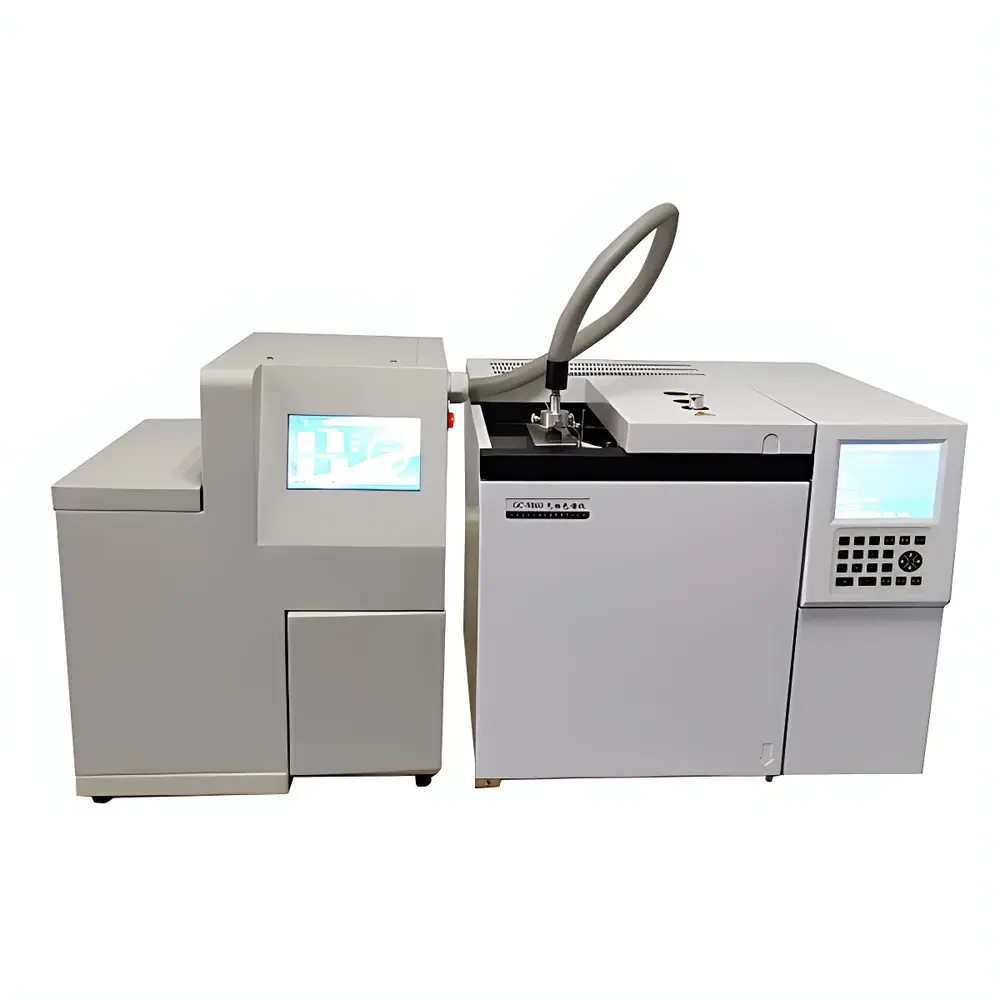
Beifen Sanpu AHzS-20A Plus Fully Automated Static Headspace Sampler
| Brand | Beifen Sanpu |
|---|---|
| Origin | Beijing, China |
| Manufacturer Type | Manufacturer |
| Product Origin | Domestic (China) |
| Model | AHzS-20A Plus |
| Instrument Type | Static Headspace Sampler |
| Automation Level | Fully Automatic |
| Vial Heating Range | Ambient to 200 °C (1 °C increments) |
| Valve Temperature Control Range | 40–220 °C (±1 °C accuracy) |
| Sample Loop Volume | 1 mL |
| Sample Capacity | 20 positions |
| Vial Compatibility | 10 mL or 20 mL headspace vials |
Overview
The Beifen Sanpu AHzS-20A Plus is a fully automated static headspace sampler engineered for precise, reproducible quantification of residual ethylene oxide (EO) in sterilized medical devices—particularly face masks, surgical gowns, catheters, and other single-use healthcare products. It operates on the principle of static headspace gas-phase equilibrium: solid or liquid samples are sealed in heated vials, allowing volatile EO to partition into the headspace above the matrix. A precisely metered volume of this equilibrated vapor is then transferred via thermostatically controlled injection valve and loop into a gas chromatograph (GC) for separation and detection—typically using flame ionization detection (FID) or mass spectrometry (MS). This methodology is explicitly mandated by ISO 10993-7:2008 and GB/T 16886.7–2015 for biological evaluation of medical devices, ensuring regulatory alignment with global quality assurance frameworks including ISO 13485 and FDA QSR (21 CFR Part 820). The system’s design prioritizes analytical robustness, thermal stability, and minimal carryover—critical for trace-level EO analysis where detection limits must routinely reach sub-μg/g levels.
Key Features
- Fully automated 20-position sample carousel with programmable sequence control and real-time status monitoring via intuitive touchscreen interface
- Independent dual-zone temperature control: vial oven (ambient to 200 °C, ±0.5 °C uniformity) and injection valve/loop assembly (40–220 °C, ±1 °C precision), minimizing condensation and adsorption losses
- 1 mL fixed-volume sampling loop with inert, low-dead-volume pathway—optimized for high recovery (>95%) of EO across concentration ranges from 0.1 to 50 μg/g
- Seal integrity verification and pressure-balanced vial pressurization ensure quantitative transfer without leakage or dilution artifacts
- Integrated leak-test routine and automatic purge cycles between injections reduce cross-contamination risk and extend GC column lifetime
- RS-232 and Ethernet connectivity for seamless integration with third-party GC systems (e.g., Shimadzu GC-2010, Agilent 7890B, Thermo ISQ) and LIMS platforms
Sample Compatibility & Compliance
The AHzS-20A Plus accommodates standard 10 mL and 20 mL crimp-top headspace vials, supporting both aqueous extraction (per GB/T 16886.7–2015 Section 6.3.2) and direct solid-phase equilibration protocols. Sample types include nonwoven fabric swatches, polymer tubing segments, sponge matrices, and lyophilized biomaterials. All wetted surfaces are passivated stainless steel or fused silica—resistant to EO-induced corrosion and compliant with USP extractables testing requirements. The instrument meets essential safety and performance criteria outlined in IEC 61010-1 (Electrical Safety for Laboratory Equipment) and supports GLP/GMP audit readiness through configurable electronic logs, user access controls, and full audit trail generation—including method parameters, run timestamps, operator IDs, and calibration history.
Software & Data Management
Control software provides method-driven workflow management: users define vial heating time/temperature, equilibration duration, pressurization pressure, loop fill/purge cycles, and GC trigger logic—all stored as encrypted, version-controlled methods. Raw data files (.csv, .txt) and metadata (including environmental chamber logs and hardware diagnostics) are exportable in formats compatible with 21 CFR Part 11–compliant review systems. Optional add-ons include electronic signature modules, automated report generation (PDF/Excel), and integration with Chromatography Data Systems (CDS) such as OpenLab CDS or Chromeleon. Audit trails record all parameter modifications, login/logout events, and result reprocessing actions—ensuring full traceability for regulatory submissions to NMPA, FDA, or EU Notified Bodies.
Applications
Primary application focus includes EO residue testing in Class I–III medical devices undergoing ethylene oxide sterilization per ISO 11135. Validated use cases span surgical drapes, syringe components, IV sets, dental impression materials, and pharmaceutical packaging films. Beyond EO, the platform supports residual solvent analysis in APIs (ICH Q3C), monomer quantification in polymer implants (e.g., methyl methacrylate in bone cements), and volatile impurity profiling in inhalation products. Its thermal stability and inert flow path also enable reliable analysis of other low-boiling, reactive analytes—including formaldehyde, chloroform, and dichloromethane—in compliance with pharmacopoeial monographs (USP , Ph. Eur. 2.4.24).
FAQ
What regulatory standards does the AHzS-20A Plus support for EO testing?
It is fully aligned with GB/T 16886.7–2015, ISO 10993-7:2008, and ASTM F1980–22 for accelerated aging and residual EO quantification in medical devices.
Can the system be integrated with existing GC instruments from other vendors?
Yes—standard TTL and RS-232 triggers enable plug-and-play compatibility with major GC platforms; custom GC method synchronization scripts are available upon request.
Is validation documentation provided for IQ/OQ/PQ protocols?
Beifen Sanpu supplies comprehensive vendor qualification packages—including factory acceptance test (FAT) reports, installation checklists, operational qualification templates, and preventive maintenance schedules.
How is carryover minimized during high-throughput EO analysis?
The system employs sequential high-purity nitrogen purges (≥99.999%), heated transfer lines (up to 220 °C), and automatic loop bake-out routines—validated to achieve <0.05% carryover at 50 μg/g EO spike levels.
Does the instrument support unattended overnight operation?
Yes—full 20-vial batch processing with auto-shutdown, ambient temperature monitoring, and emergency venting safeguards enables extended unattended runs under ISO/IEC 17025 laboratory conditions.





