
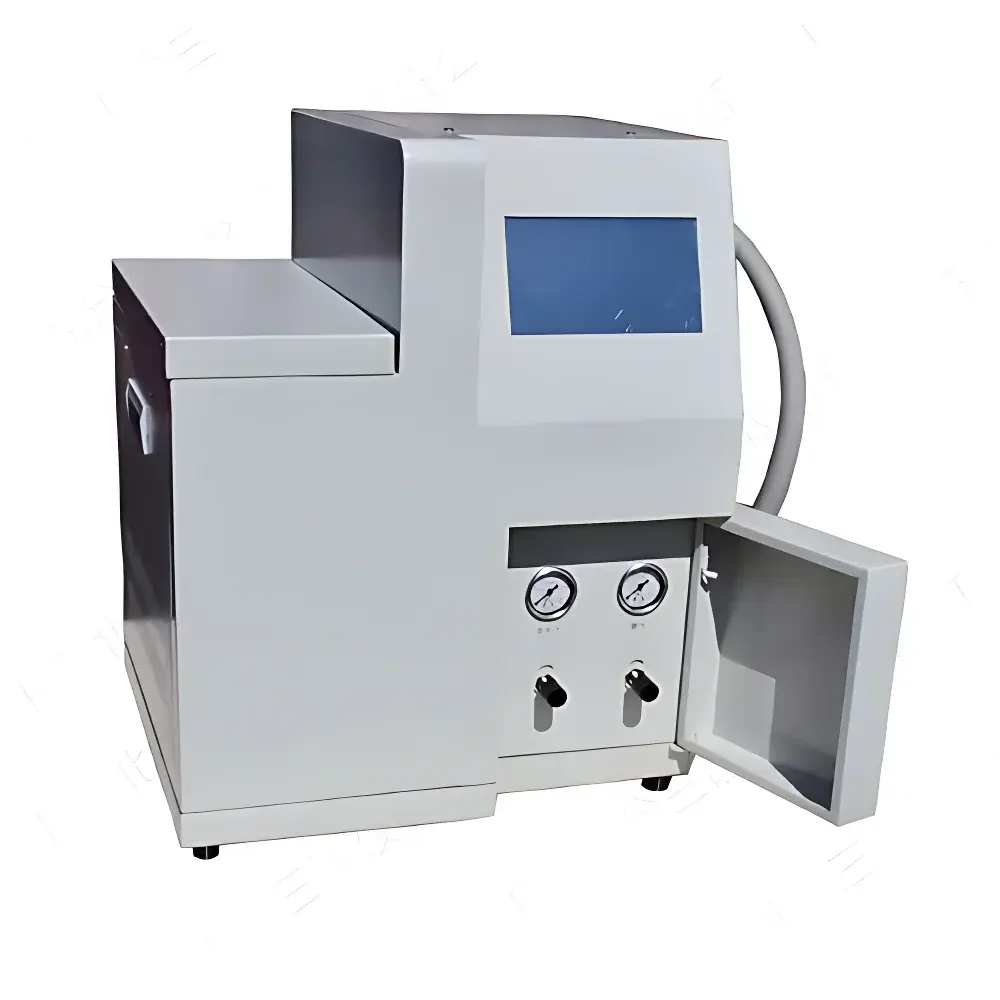
Beifen Sanpu ASH-20A Plus Automated Headspace Sampler Coupled with GC9860-5C Gas Chromatograph for Volatile Organic Compounds (VOCs) Analysis in Drinking Water and Industrial Wastewater
| Brand | Beifen Sanpu |
|---|---|
| Origin | Beijing, China |
| Manufacturer Type | Direct Manufacturer |
| Instrument Type | Laboratory Gas Chromatograph |
| Model | ASH-20A Plus + GC9860-5C |
| Temperature Control Range | 100–350 °C |
| Oven Ramp Rate | 0.1–40 °C/min |
| Cool-down Time | ~6 min (from 350 °C to 100 °C) |
| Carrier Gas Flow Range | 0–1200 mL/min |
| Carrier Gas Pressure Range | 0–970 kPa |
| Injector Maximum Temperature | 100–350 °C |
| Injector Pressure Setting Range | 0–970 kPa |
| Total Injector Flow Setting Range | 0–1000 mL/min |
| Detection Method | Headspace-GC/FID |
| Compliance Standards | GB 5749–2006, GB 3838–2002, GB 8537–2008 |
Overview
The Beifen Sanpu ASH-20A Plus automated headspace sampler integrated with the GC9860-5C gas chromatograph constitutes a validated analytical platform engineered for the quantitative determination of volatile organic compounds (VOCs) in drinking water and industrial wastewater matrices. This system implements the headspace-gas chromatography-flame ionization detection (HS-GC-FID) principle: VOCs partition from aqueous or semi-solid samples into the equilibrated vapor phase above the sample matrix under controlled temperature and time conditions; the headspace vapor is then transferred directly to the GC column without solvent extraction or derivatization. The method leverages the thermodynamic volatility of target analytes—such as benzene, toluene, ethylbenzene, xylenes (BTEX), chlorinated methanes, and trihalomethanes—to achieve selective, interference-minimized separation and detection. Designed for regulatory compliance and routine laboratory throughput, the system delivers high reproducibility (RSD < 3% for replicate injections), robust baseline stability, and trace-level sensitivity (detection limits ≤ 0.1 µg/L for key VOCs under optimized conditions).
Key Features
- Automated headspace sampling with precise temperature-controlled equilibration (30–150 °C), pressurized vial agitation, and programmable loop fill/transfer cycles—eliminating manual injection variability.
- GC9860-5C dual-channel, networked gas chromatograph featuring eight-stage programmable oven temperature ramping, EPC (Electronic Pressure Control) for carrier gas, and real-time pressure/flow monitoring across all gas lines.
- FID detector with auto-ignition, flame-out recovery, and linear dynamic range of 10⁷, calibrated per ASTM D3699 and ISO 10301 for hydrocarbon quantification.
- NETChrom® workstation supporting up to 253 simultaneous GC units, audit-trail-enabled data acquisition, and full 21 CFR Part 11-compliant user access control, electronic signatures, and data integrity logging.
- Modular architecture enabling seamless integration of optional detectors (TCD, ECD, NPD) and third-party autosamplers; supports Modbus/TCP protocol for DCS and LIMS connectivity.
- Industrial-grade 5.7″ color TFT display with bilingual (English/Chinese) UI, Ethernet interface (10/100M), and remote diagnostics via secure LAN or internet connection.
Sample Compatibility & Compliance
The system is validated for direct analysis of untreated or filtered aqueous samples—including tap water, groundwater, surface water, municipal wastewater effluent, and industrial discharge streams (e.g., petrochemical, pharmaceutical, and textile processing wastewaters). Sample introduction uses standard 20 mL crimp-top headspace vials sealed with PTFE/silicone septa. Matrix tolerance has been verified for total dissolved solids (TDS) up to 15,000 mg/L and salinity up to 3.5% w/v without significant carryover or column degradation. Method performance meets requirements of China’s mandatory standards GB 5749–2006 (Drinking Water Hygiene Standard), GB 3838–2002 (Environmental Quality Standard for Surface Water), and GB 8537–2008 (Natural Mineral Water). It also aligns with EPA Method 524.4 and ISO 15681-2 for VOC screening in environmental waters, supporting GLP-compliant reporting and regulatory submission.
Software & Data Management
NETChrom® workstation provides comprehensive instrument control, sequence management, peak integration (with retention time locking and spectral deconvolution support), calibration curve generation (linear, quadratic, or multi-point weighted), and customizable report templates. All raw data files (.ncd) are stored with embedded metadata (operator ID, method name, audit trail timestamp, instrument configuration snapshot). The software enforces role-based permissions, automatic backup to network drives, and encrypted database archiving. Full 21 CFR Part 11 compliance includes electronic signature capture, change history tracking, and tamper-evident audit logs—certified for use in regulated environments requiring FDA, CNAS, or CMA accreditation.
Applications
This configuration is routinely deployed in municipal water quality laboratories, environmental monitoring stations, third-party testing facilities, and industrial EHS departments for: routine compliance monitoring of VOCs per national drinking water standards; source water vulnerability assessment; wastewater treatment plant influent/effluent profiling; leak detection in distribution systems; forensic identification of contamination events; and method validation studies supporting ISO/IEC 17025 accreditation. Its automation capacity enables unattended overnight analysis of 40+ samples, significantly improving lab efficiency versus manual purge-and-trap or liquid–liquid extraction workflows.
FAQ
What VOCs can be reliably quantified using this system?
Target analytes include C2–C12 aliphatic and aromatic hydrocarbons, chlorinated solvents (e.g., chloroform, carbon tetrachloride), and oxygenates (e.g., MTBE, acetone), covering all compounds listed in GB 5749–2006 Annex B.
Is method validation documentation provided?
Yes—system qualification reports (IQ/OQ/PQ), method validation summaries (precision, accuracy, LOD/LOQ, linearity), and SOP templates aligned with CNAS-CL01:2018 are supplied with installation.
Can the system be upgraded to support mass spectrometric detection?
The GC9860-5C chassis supports direct coupling to single-quadrupole MS detectors (e.g., GC-MSD); retrofit requires only mechanical interface alignment and firmware update—no hardware replacement.
What maintenance intervals are recommended for routine operation?
FID jet cleaning every 200 injections; column trimming every 500 runs; headspace vial seal inspection prior to each batch; EPC transducer calibration annually or after pressure sensor replacement.
Does the system comply with international data integrity requirements?
Yes—NETChrom® implements ALCOA+ principles (Attributable, Legible, Contemporaneous, Original, Accurate, Complete, Consistent, Enduring, Available) and meets EU Annex 11 and WHO TRS 996 data governance expectations.






