
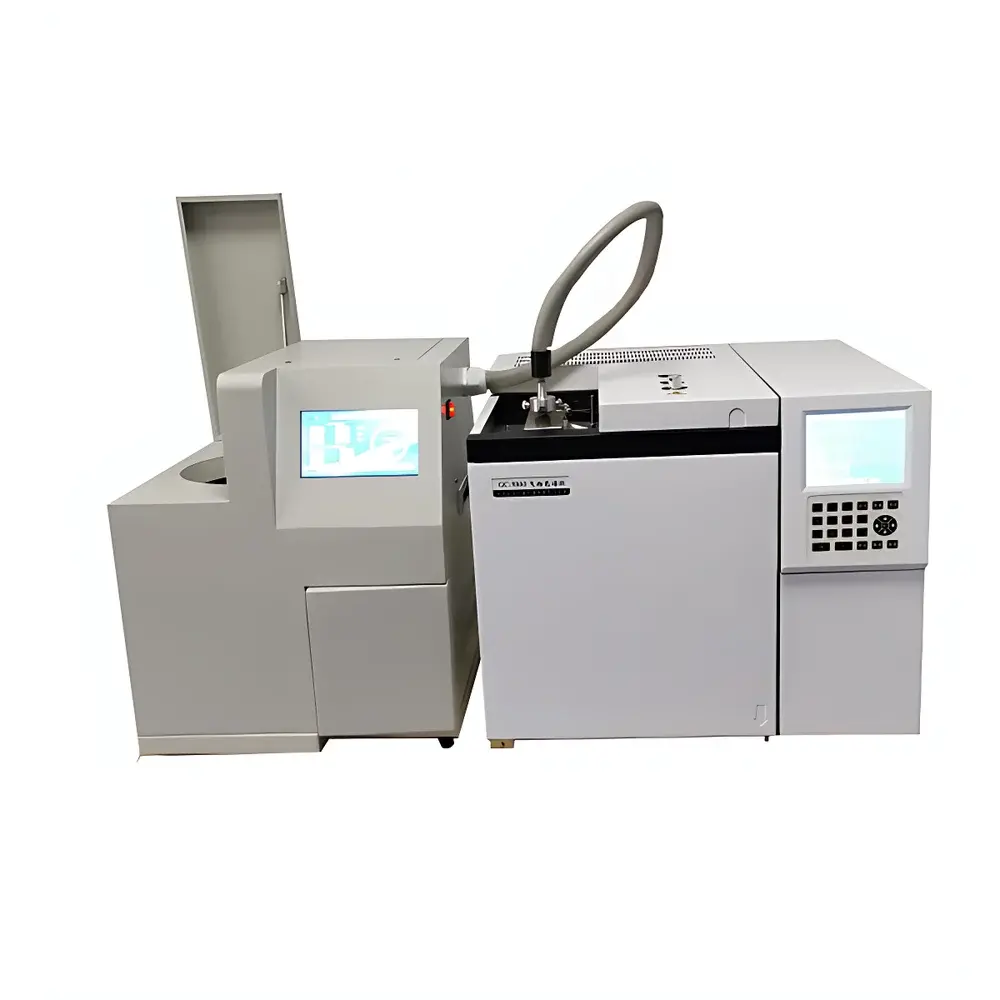
Beifen Sanpu AsHS-20A Plus Fully Automated Static Headspace Sampler for Ethylene Oxide Residue Analysis in Medical Devices
| Brand | Beifen Sanpu |
|---|---|
| Origin | Beijing, China |
| Manufacturer Type | Direct Manufacturer |
| Instrument Type | Static Headspace Sampler |
| Automation Level | Fully Automatic |
| Vial Heating Range | Ambient to 200 °C (1 °C increment) |
| Valve Temperature Control Range | 40–220 °C (±1 °C accuracy) |
| Sample Loop Volume | 1 mL |
| Vial Capacity | 20 positions |
| Vial Size Compatibility | 10 mL or 20 mL |
Overview
The Beifen Sanpu AsHS-20A Plus is a fully automated static headspace sampler engineered specifically for the quantitative determination of residual ethylene oxide (EO) in sterilized medical devices—such as surgical masks, gowns, catheters, and syringes—per regulatory requirements under ISO 10993-7 and GB/T 16886.7–2015. EO is a highly effective, low-temperature gaseous sterilant widely adopted in Class II and III medical device manufacturing due to its superior penetration into porous materials and broad-spectrum microbicidal activity. However, EO is classified as a Group 1 human carcinogen (IARC) and exhibits acute neurotoxicity and mutagenicity; therefore, strict post-sterilization residue control is mandated globally. The AsHS-20A Plus operates on the principle of static headspace equilibration: sealed sample vials containing aqueous-extracted device material are heated to a precisely controlled temperature, allowing volatile EO to partition into the vapor phase above the liquid. A fixed-volume gas loop then transfers the equilibrium headspace vapor directly to the GC inlet, enabling reproducible, matrix-independent quantification without solvent interference or column contamination.
Key Features
- 20-position rotary carousel with programmable vial identification and priority queuing for high-throughput labs conducting routine EO release testing.
- Independent dual-zone thermal control: vial oven (ambient–200 °C, ±0.5 °C stability) and transfer valve/heating block (40–220 °C, ±1 °C accuracy), minimizing condensation and carryover during pressurized loop injection.
- 1 mL fixed-volume sampling loop with inert, electropolished stainless-steel construction and integrated pressure regulation for consistent injection volume across analytical runs.
- Automated sequence execution including vial pressurization, incubation timing, loop fill/flush cycles, and GC trigger synchronization—fully compliant with 21 CFR Part 11 audit trail requirements when paired with validated chromatography data systems.
- Integrated leak detection and pressure monitoring at each vial station to ensure method robustness and prevent false negatives caused by seal failure or vial deformation.
Sample Compatibility & Compliance
The AsHS-20A Plus accommodates standard 10 mL and 20 mL crimp-top headspace vials with PTFE/silicone septa, supporting both aqueous extraction (per GB/T 14233.1–2008) and direct solid-phase equilibration protocols. It is validated for use with EO concentrations ranging from 0.1 µg/g to 50 µg/g in polypropylene, nonwoven fabric, PVC, and silicone elastomer matrices. Method performance meets ISO 10993-7 precision criteria (RSD ≤ 10% for replicate injections) and supports GLP-compliant validation per ICH Q2(R2) guidelines. All hardware interfaces comply with ASTM D6866–23 and USP material compatibility standards for EO analysis instrumentation.
Software & Data Management
Controlled via Beifen Sanpu’s HS-Link™ software (Windows 10/11 compatible), the system provides full method parameterization—including incubation time, oven ramp profiles, loop purge cycles, and GC start delay—with password-protected user roles and electronic signature support. Raw acquisition files (.raw) are timestamped and embedded with instrument metadata (vial ID, temperature logs, pressure traces) for traceability. When integrated with third-party CDS platforms (e.g., Agilent OpenLab, Thermo Chromeleon), the sampler exports ASTM E1319-compliant .csv reports containing peak area, retention time, and calculated EO concentration (mg/kg), automatically populated into LIMS via ODBC connectivity.
Applications
- Quantitative EO residue testing of single-use medical devices prior to market release (ISO 10993-7, GB/T 16886.7).
- Stability studies assessing EO desorption kinetics during shelf-life evaluation under accelerated aging conditions (40 °C/75% RH).
- Process validation of EO sterilization cycles—including parametric release justification—by correlating residual levels with cycle parameters (gas concentration, temperature, humidity, exposure time).
- Comparative analysis of EO scavenging efficacy across packaging materials (Tyvek®, PET/AL/PE laminates) and storage conditions.
- Regulatory submission support for FDA 510(k), CE Marking, and NMPA registration dossiers requiring validated analytical methodology.
FAQ
What is the minimum detectable EO concentration achievable with this system?
Detection limits depend on GC detector sensitivity and column efficiency, but typical method-level LODs range from 0.05 to 0.2 µg/g when coupled with an FID and SE-54 capillary column (30 m × 0.32 mm × 0.5 µm). Confirmation by GC–MS is recommended for trace-level confirmation in complex matrices.
Can the AsHS-20A Plus be used for other volatile residual solvents besides EO?
Yes—the system supports method development for residual acetone, ethanol, isopropanol, chloroform, and formaldehyde per ISO 10993-17 and USP , provided appropriate calibration standards and column selection are implemented.
Is validation documentation provided with the instrument?
Beifen Sanpu supplies IQ/OQ documentation templates, a factory-verified performance qualification report (including temperature uniformity mapping and loop volume accuracy test data), and a comprehensive user manual aligned with ISO/IEC 17025 requirements.
How does the system handle vial pressure during heating?
Each vial station features real-time pressure monitoring and automatic pressure equalization via a regulated vent path before loop injection—preventing over-pressurization, septum blowout, or inaccurate vapor-phase sampling.
Does the sampler support unattended overnight operation?
Yes—equipped with auto-shutdown, error logging, and email/SNMP alerting upon completion or fault condition, enabling 24-hour batch processing for high-volume QC laboratories.






