
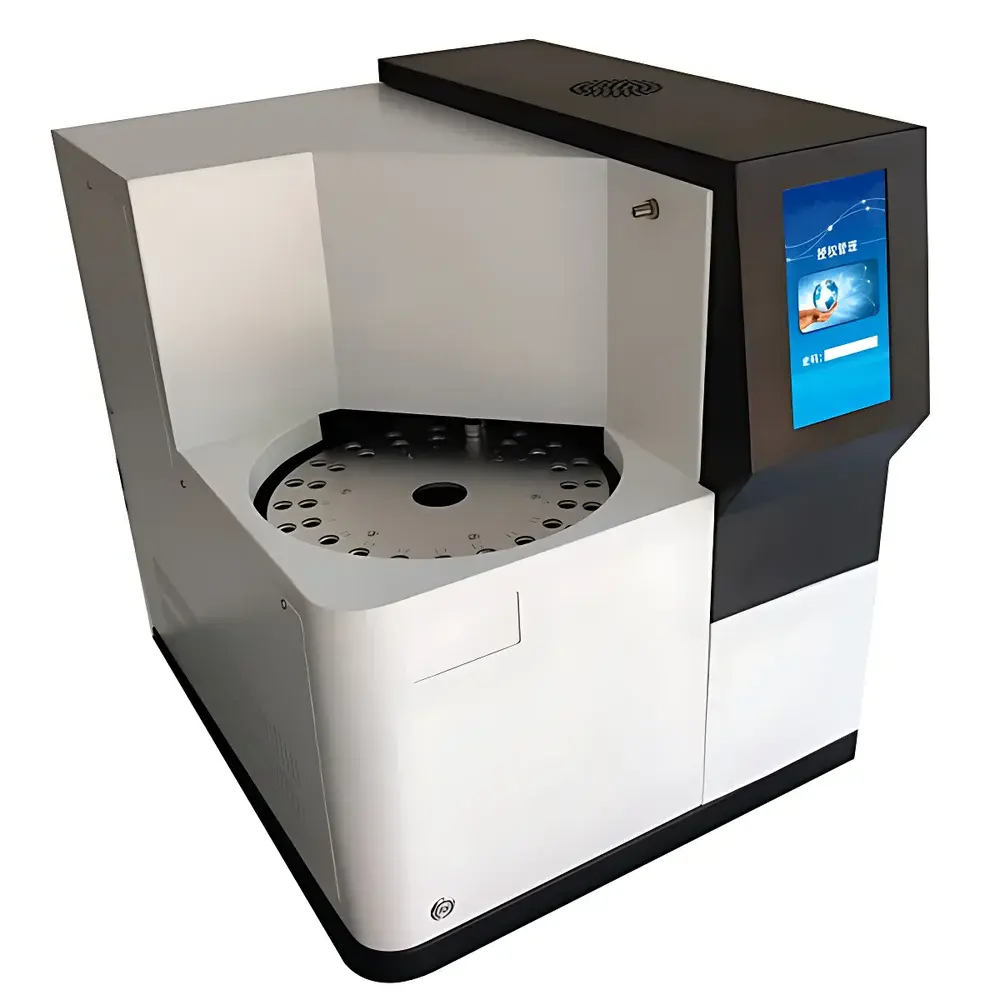
Beifen Sanpu AT1DS-20B Dual-Channel Automated Secondary Thermal Desorber
| Brand | Beifen Sanpu |
|---|---|
| Origin | Beijing, China |
| Manufacturer Type | Original Equipment Manufacturer (OEM) |
| Model | AT1DS-20B |
| Instrument Type | Secondary Thermal Desorber |
| Desorption Temperature Range | Ambient to 450 °C |
| Cold Trap Temperature Range | −35 °C to Ambient |
| Desorption Recovery Rate | >90% |
| Sample Capacity | 40 positions (dual 20-position carousel) |
| Temperature Control Accuracy | < ±0.5 °C |
| RSD | ≤2.5% (for 0.05 μg benzene in methanol) |
| Cold Trap Cooling Method | Semiconductor-based electronic cooling |
| Sample Tube Format | 1/4″ OD × 3.5″ (ASTM D6196-compliant) |
| Valve Actuation | Motor-driven 6-port switching valve |
| Dimensions (L×W×H) | 350 mm × 450 mm × 550 mm |
| Weight | ~40 kg |
Overview
The Beifen Sanpu AT1DS-20B is a dual-channel, fully automated secondary thermal desorber engineered for high-throughput, trace-level volatile organic compound (VOC) analysis in environmental, occupational health, and indoor air quality laboratories. It operates on the principle of two-stage thermal desorption: first, VOCs are thermally released from sorbent tubes under controlled inert gas flow; second, analytes are cryogenically focused in a low-temperature trap (−35 °C), then rapidly desorbed as a narrow band into the gas chromatograph (GC) or GC–MS inlet. This two-step process significantly enhances sensitivity, peak shape symmetry, and quantitative reproducibility—particularly critical for compliance with regulatory methods such as EPA TO-17, ISO 16017-1, and HJ 644–2013. The instrument integrates seamlessly with all major GC and GC–MS platforms via standardized pneumatic and electronic interfaces, supporting both standalone operation and synchronized method triggering.
Key Features
- Fully automated dual 20-position sample carousel (40 total), enabling unattended overnight batch processing without manual intervention
- Independent, precision temperature control across four zones: primary desorption oven (ambient–450 °C), secondary desorption zone (ambient–450 °C), valve manifold (ambient–300 °C), and transfer line (ambient–300 °C), each adjustable in 1 °C increments
- Integrated semiconductor-based cold trap with programmable cooling range from −35 °C to ambient, eliminating liquid nitrogen dependency while ensuring sharp, symmetrical chromatographic peaks
- Motor-driven 6-port valve with position feedback and automatic calibration routines for repeatable, leak-tight switching
- Dedicated inert gas pathways with passivated stainless-steel tubing and automated back-flush functionality to prevent carryover between samples
- Onboard 7-inch capacitive touchscreen interface with USB PC connectivity; supports method editing, real-time status animation, run-time logging, and user role management (admin/operator)
- Programmable multi-step sequence: dry purge → adsorption simulation → primary desorption → cold trap focusing → rapid secondary desorption → GC injection → post-injection valve/backflush cleaning
- Built-in simulated sampling module for direct generation of calibration curves using standard gases or permeation tubes—no external dynamic dilution system required
- 20+ preconfigured method templates; full support for Chinese/English language switching and audit-trail-enabled event logging per GLP requirements
Sample Compatibility & Compliance
The AT1DS-20B accepts standard 1/4″ OD × 3.5″ (89 mm) sorbent tubes compliant with ASTM D6196 and ISO 16017-1 specifications—including Tenax TA, Carbopack B/C, Carboxen, and multi-bed configurations. Its validated performance meets or exceeds key regulatory benchmarks: recovery >90% for C2–C12 VOCs (e.g., benzene, toluene, ethylbenzene, xylenes, styrene); RSD ≤2.5% at 0.05 μg level (benzene in methanol matrix); and linear dynamic range spanning three orders of magnitude. The system conforms to data integrity expectations under FDA 21 CFR Part 11 when operated with validated software protocols, and its operational parameters align directly with Chinese national standards HJ 644–2013, HJ 583–2010, HJ 734–2014, GB/T 18883–2020, and GB 50325–2020.
Software & Data Management
Control and method development occur via a dedicated Windows-based application communicating over USB 2.0. All thermal, timing, and pneumatic parameters—including desorption ramp rates (>3000 °C/min), hold times (0–60 min), purge flows (0–100 mL/min), and simulated sampling flows (0–160 mL/min)—are programmable with millisecond resolution. The software enforces version-controlled method storage, user authentication tiers, electronic signatures, and immutable audit trails covering parameter changes, run initiation, error events, and calibration logs. Export formats include CSV and XML for LIMS integration. No cloud dependency or subscription licensing is required—full local data ownership and offline operation are supported.
Applications
- Environmental monitoring: ambient air, stack emissions, and soil vapor analysis per HJ 644–2013, HJ 734–2014, and ISO 16017-1
- Indoor air quality assessment: formaldehyde-free VOC profiling in residential/commercial buildings per GB/T 18883–2020 and GB 50325–2020
- Automotive cabin air testing: aldehydes, ketones, and aromatic hydrocarbons per HJ/T 400–2007
- Industrial hygiene: workplace exposure evaluation of regulated VOCs under GB 12/524–2020
- Materials emission testing: carpets, adhesives, paints, and composite panels per ISO 16000-6 and ASTM D5116
- Reference material certification: preparation of certified gaseous standards via dynamic spiking and thermal calibration
FAQ
Does the AT1DS-20B require liquid nitrogen for cold trapping?
No. It employs solid-state Peltier cooling to achieve −35 °C, eliminating consumables, safety hazards, and logistical constraints associated with cryogens.
Can it be integrated with Agilent, Thermo Fisher, or Shimadzu GC systems?
Yes. Standardized 6-port valve timing signals and analog/digital trigger I/O ports ensure plug-and-play synchronization with all major GC manufacturers’ autosampler and oven control interfaces.
Is method validation documentation available?
Comprehensive IQ/OQ documentation packages—including temperature uniformity mapping, recovery studies, carryover testing, and RSD verification reports—are provided upon request for GxP-regulated environments.
What maintenance is required for long-term reliability?
Routine tasks include quarterly valve seal inspection, annual calibration of thermocouples and flow sensors, and periodic replacement of O-rings and frits—fully detailed in the bilingual service manual.
How is data integrity ensured during unattended runs?
All method parameters, run timestamps, operator IDs, and system error codes are written to non-volatile memory in real time; audit logs cannot be edited or deleted without administrator privileges and leave tamper-evident digital footprints.





