
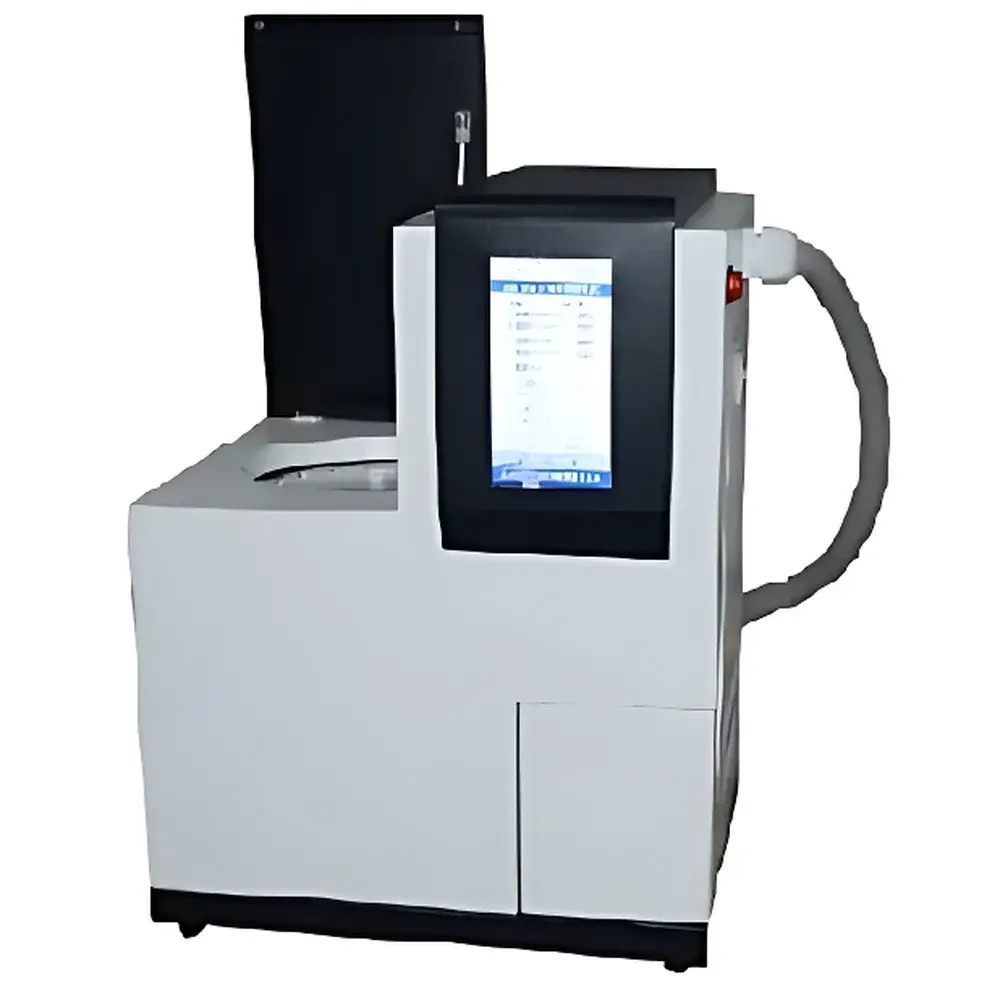
Beifen Sanpu AT2DS-20A Automated Two-Stage Thermal Desorber for HJ 734–2014 Fixed Source VOC Emission Monitoring
| Brand | Beifen Sanpu |
|---|---|
| Origin | Beijing, China |
| Manufacturer Type | OEM Manufacturer |
| Instrument Type | Two-stage Thermal Desorber |
| Primary Desorption Temp Range | Ambient to 400 °C |
| Secondary Desorption Temp Range | 100–400 °C |
| Cold Trap Temp Range | Down to –35 °C |
| Desorption Recovery Rate | >90% |
| Sample Capacity | 20 tubes |
| Tube Format | 1/4″ OD × 3.5″ (ASTM D6196-compliant) |
Overview
The Beifen Sanpu AT2DS-20A is an automated two-stage thermal desorber engineered for compliant, high-fidelity analysis of volatile organic compounds (VOCs) in fixed-source emission streams per China’s HJ 734–2014: Determination of Volatile Organic Compounds in Exhaust Gas from Stationary Sources — Solid Phase Adsorption/Thermal Desorption–Gas Chromatography. It implements a dual-zone thermal desorption protocol—first-stage desorption from the adsorbent tube (e.g., Tenax TA), followed by cryofocusing in a thermoelectrically cooled trap (–35 °C), and second-stage flash desorption directly into the GC inlet. This architecture minimizes analyte degradation, maximizes transfer efficiency, and delivers narrow, symmetrical peaks essential for accurate quantification of C2–C12 hydrocarbons, aromatics, oxygenates, and halogenated VOCs at sub-ppbv levels. Designed for integration with any GC or GC–MS platform—including those requiring strict regulatory alignment—the AT2DS-20A supports method traceability, audit-ready operation, and seamless synchronization with chromatographic data systems.
Key Features
- Full automation for unattended processing of 20 adsorption tubes per batch, reducing manual intervention and operator variability.
- Independent four-zone temperature control: primary desorption oven, secondary desorption zone, sample transfer line, and six-port valve—all programmable in 1 °C increments (range: ambient to 450 °C).
- Integrated Peltier-based cold trap with precise –35 °C minimum setpoint and ±0.5 °C stability, enabling efficient analyte focusing and sharp elution profiles.
- Motor-driven six-port valve with inert flow path and automatic back-flush capability to eliminate carryover between samples.
- Programmable sequence logic supporting desorption, purge, refocus, flash desorption, GC trigger, and post-run tube reactivation—all via time-based method scripting.
- Dedicated tube activation mode with configurable heating ramp and dwell parameters to ensure consistent adsorbent conditioning prior to sampling.
- Onboard calibration simulation function: introduces known vapor standards directly into the desorption path for linear range verification and working curve generation.
- Low-voltage (24 V DC) heating for transfer lines enhances safety and electromagnetic compatibility in shared lab environments.
- Modular interface options—including universal GC inlet adapters and optional fused silica transfer tubing—for compatibility with Agilent, Thermo Fisher, Shimadzu, and PerkinElmer instruments.
Sample Compatibility & Compliance
The AT2DS-20A accommodates standard 1/4″ OD × 3.5″ stainless steel or quartz adsorption tubes packed with Tenax TA, Carbopack B/C, or multi-bed sorbents (e.g., Carbograph 1TD + Carbopack X). It meets instrumental performance criteria outlined in HJ 734–2014, HJ 644–2013, HJ 583–2010, and GB/T 18883–2002. Its design supports GLP-aligned workflows: all temperature zones log real-time values with timestamped audit trails; method files are password-protected and version-controlled; and system suitability tests (e.g., recovery >90%, RSD ≤2.5% for 0.05 µg benzene in methanol) are documented per run. While not pre-certified to ISO/IEC 17025 or US EPA TO-17, its operational parameters align with the technical requirements of those frameworks when implemented within validated laboratory procedures.
Software & Data Management
Control is executed via an embedded industrial-grade touchscreen interface running deterministic real-time firmware—not Windows-based software—ensuring deterministic timing and immunity to OS-level interruptions. Method templates store full thermal profiles, valve timing, GC synchronization signals, and activation protocols. All system events—including temperature deviations, valve actuation timestamps, and error codes—are logged to non-volatile memory with UTC stamping. Exportable CSV logs contain raw temperature readings, cycle completion status, and user-defined annotations. For laboratories operating under 21 CFR Part 11, the instrument can be integrated into third-party LIMS or chromatography data systems (CDS) that provide electronic signatures, role-based access control, and immutable audit trails—though native Part 11 compliance requires external CDS validation.
Applications
- Regulatory monitoring of VOC emissions from industrial stacks, incinerators, and chemical process vents per HJ 734–2014.
- Indoor air quality assessment in commercial buildings and residential spaces (GB 50325–2020, GB/T 18883–2002).
- VOC profiling in automotive cabin air (HJ/T 400–2007) and packaging headspace.
- Method development and validation for EPA TO-17, ASTM D6196, and ISO 16017-1 compliant analyses.
- Quantitative analysis of benzene, toluene, ethylbenzene, xylenes (BTEX), aldehydes, and chlorinated solvents in ambient and source-test samples.
FAQ
Does the AT2DS-20A support single-stage desorption mode?
Yes—via firmware configuration, it can operate as a primary-only thermal desorber for applications requiring direct tube-to-GC transfer without cryofocusing.
What tube formats are supported beyond the standard 1/4″ × 3.5″?
With optional adapter kits, it accommodates 3.5″ × 1/8″ and 6″ × 1/4″ tubes; custom-length support requires mechanical recalibration.
Is remote monitoring or network connectivity available?
The unit features RS-232 and Ethernet ports for external command triggering and status polling; however, it does not host a web server or cloud interface.
How is carryover mitigated during high-concentration sample analysis?
Automated back-flush of the transfer line and valve using inert gas (0–100 mL/min, adjustable) occurs after each injection, verified by blank tube analysis per QC protocols.
Can the cold trap temperature be lowered below –35 °C?
No—the Peltier module is rated to –35 °C minimum; lower temperatures require liquid nitrogen cooling, which is not supported by this model’s hardware architecture.




