
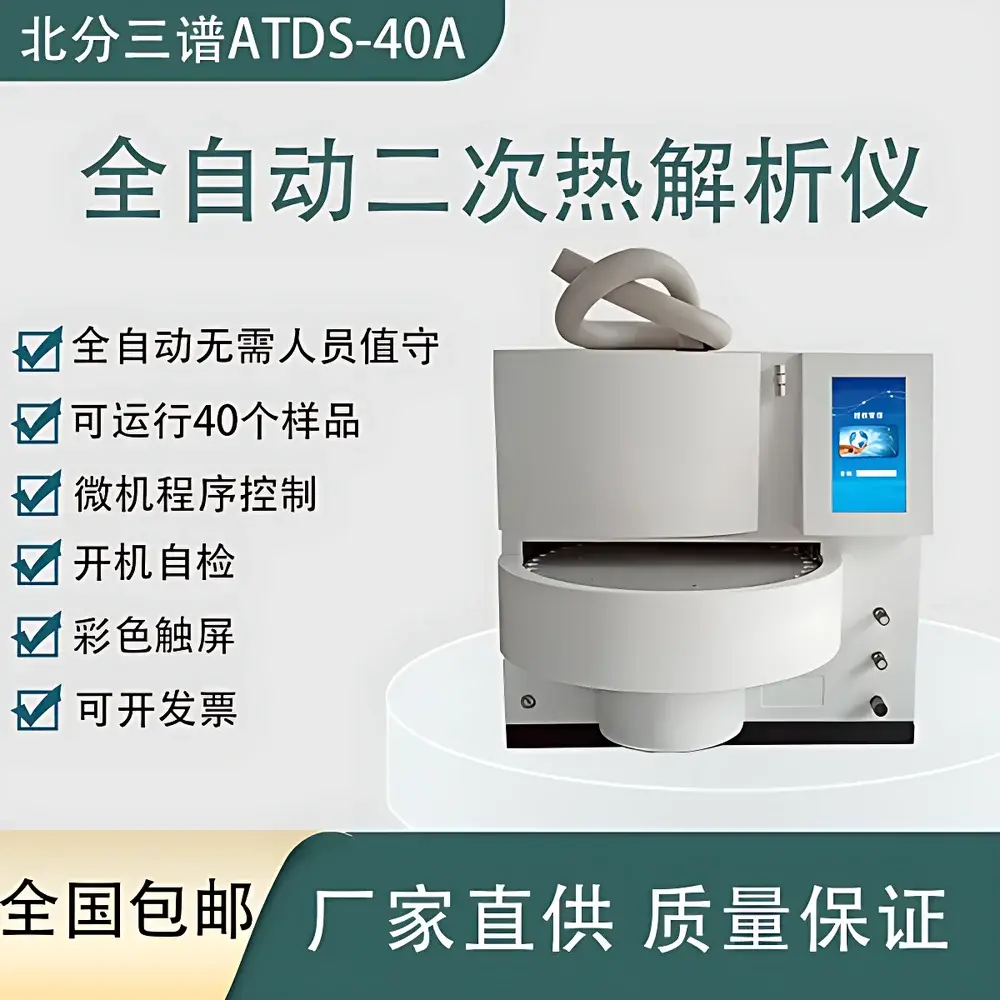
Beifen Sanpu AT2DS-40A Fully Automated Two-Stage Thermal Desorber
| Brand | Beifen Sanpu |
|---|---|
| Origin | Beijing, China |
| Manufacturer Type | Original Equipment Manufacturer (OEM) |
| Product Category | Domestic |
| Model | AT2DS-40A |
| Instrument Type | Two-Stage Thermal Desorber / Thermal Desorber |
| Automation Level | Fully Automated |
| Primary Desorption Temperature Range | Ambient to 450 °C (1 °C increment) |
| Valve Injection Zone Temperature Range | Ambient to 300 °C (1 °C increment) |
| Transfer Line Temperature Range | Ambient to 450 °C (1 °C increment) |
| Cryo-Focusing Trap Temperature Range | −35 °C to Ambient (1 °C increment) |
| Temperature Control Accuracy | < ±0.5 °C |
| Desorption Recovery Rate | >99% (compound-dependent) |
| Sample Capacity | 40 positions |
| Cooling Method | Solid-state electronic refrigeration |
| Maximum Heating Ramp Rate | >3000 °C/min (secondary desorption zone) |
| Carryover Prevention | Automated back-flush of valve and transfer line |
| Sample Tube Format | 1/4″ OD × 3.5″ length (ASTM D6196-compliant) |
| Relative Standard Deviation (RSD) | ≤2.5% (benzene at 0.05 μg in methanol) |
| Enrichment Time | 0–60 min |
| Injection Time | 0–60 min |
| Back-Flush Flow | 0–100 mL/min (adjustable) |
| Simulated Sampling Flow | 0–160 mL/min (adjustable) |
| Dimensions (L×W×H) | 350 × 450 × 550 mm |
| Weight | ~45 kg |
Overview
The Beifen Sanpu AT2DS-40A Fully Automated Two-Stage Thermal Desorber is an engineered solution for trace-level volatile organic compound (VOC) and semi-volatile organic compound (SVOC) analysis in environmental, industrial hygiene, and materials testing laboratories. It implements a two-stage thermal desorption process—comprising primary desorption from the sorbent tube, cryogenic focusing in a thermoelectrically cooled trap, and rapid secondary desorption directly into the gas chromatograph (GC) or GC–MS inlet. This architecture ensures high analyte recovery, narrow bandwidth injection, minimal carryover, and compatibility with regulatory methods requiring precise thermal control and reproducible quantitation. Designed for seamless integration with any commercial GC or GC–MS system—regardless of manufacturer—the AT2DS-40A supports both EPA, ISO, and Chinese national standard workflows, including HJ 644–2013, HJ 583–2010, GB/T 18883–2020, and GB 50325–2020.
Key Features
- Fully automated batch processing of up to 40 standardized 1/4″ OD × 3.5″ sorbent tubes without manual intervention
- Independent, precision temperature control across four critical zones: primary desorption furnace (ambient–450 °C), six-port motorized injection valve (ambient–300 °C), heated transfer line (ambient–450 °C), and secondary desorption/cryo-focusing trap (−35 °C to ambient)
- Electronic Peltier cooling system enabling stable, maintenance-free cryofocusing with sub-ambient resolution and no liquid nitrogen dependency
- Programmable multi-step sequence: primary desorption → carrier gas purge → cryo-trap focusing → rapid secondary desorption (>3000 °C/min ramp) → GC injection → automated back-flush of valve and transfer line
- Integrated sample tube activation protocol with programmable heating profiles and inert gas purging to restore tube performance between runs
- Real-time status visualization via 7-inch capacitive touchscreen interface; method storage, run logging, and event-triggered diagnostics (e.g., temperature deviation, valve positioning error)
- Configurable GC synchronization: hardware TTL trigger output or software-based initiation via external GC control signal
- Dual-path compatibility: optional low-temperature or ambient-temperature secondary desorption configurations for enhanced recovery of highly labile compounds
- Chemically inert sample pathway options—including fused quartz transfer lines—to minimize adsorption losses for polar or reactive analytes (e.g., aldehydes, organic acids)
- Modular mechanical design supporting field-upgradable components and simplified service access per ISO/IEC 17025 preventive maintenance requirements
Sample Compatibility & Compliance
The AT2DS-40A accepts industry-standard stainless steel or glass sorbent tubes conforming to ASTM D6196 and ISO 16017-1 specifications. Its thermal architecture accommodates common multi-bed sorbents (e.g., Tenax TA, Carbopack B/C, Carboxen 1000) and supports both single- and dual-tube configurations. The instrument complies with data integrity expectations outlined in FDA 21 CFR Part 11 when operated with validated LIMS or chromatography data systems (CDS), offering full audit trail capability for method parameters, run logs, calibration events, and user actions. It meets performance criteria specified in HJ 644–2013 (environmental air VOCs), HJ 734–2014 (stationary source emissions), and GB 50325–2020 (indoor air quality), delivering RSD ≤2.5% for benzene at 0.05 μg loading and quantitative recovery >99% for C6–C12 hydrocarbons under optimized conditions.
Software & Data Management
Control firmware supports method-driven operation with editable temperature ramps, flow profiles, timing sequences, and GC handshake protocols. All method parameters—including desorption dwell times, trap hold durations, and back-flush volumes—are stored in encrypted binary format with timestamped version history. Exportable CSV reports include sample ID, start/stop time, temperature deviations, valve actuation logs, and diagnostic flags. When interfaced with third-party CDS platforms (e.g., Thermo Chromeleon, Agilent OpenLab, Shimadzu LabSolutions), the AT2DS-40A transmits run completion signals and accepts remote start commands via RS-232 or Ethernet TCP/IP. Audit trails adhere to ALCOA+ principles (Attributable, Legible, Contemporaneous, Original, Accurate, Complete, Consistent, Enduring, Available) and are exportable for GLP/GMP internal audits or regulatory inspections.
Applications
- Environmental monitoring: ambient air, indoor air, and workplace air VOC profiling per HJ 644–2013, ISO 16017-2, and EN 14662
- Building material emissions testing: formaldehyde, benzene, toluene, and xylenes from carpets, adhesives, and composite wood products (GB/T 18883–2020, ASTM D5116)
- Automotive cabin air quality assessment per HJ/T 400–2007 and ISO 12219-1
- Industrial emission source characterization (e.g., paint booths, printing facilities) under HJ 734–2014 and GB 12/524–2020
- Pharmaceutical packaging leachables screening using thermal desorption–GC–MS
- Forensic toxicology and arson investigation involving ignitable liquid residue (ILR) identification
- Quality control of activated carbon filters and air purification media via breakthrough testing
FAQ
Does the AT2DS-40A support method validation per ISO/IEC 17025?
Yes—its deterministic thermal control, calibrated temperature sensors (NIST-traceable), and full operational logging enable comprehensive system suitability testing, intermediate precision assessment, and uncertainty budgeting required for accredited testing laboratories.
Can it be used with cryogen-free GC–MS systems?
Yes—the solid-state cooling trap eliminates liquid nitrogen dependency, making it fully compatible with benchtop and portable GC–MS platforms requiring zero-cryogen operation.
Is remote monitoring supported over LAN or VPN?
The embedded web server enables secure HTTP(S) access for real-time status viewing and limited parameter adjustment; full remote control requires integration via OPC UA or vendor-specific API extensions.
What maintenance intervals are recommended for routine operation?
Valve lubrication every 6 months, trap cleaning every 200 runs, and annual verification of temperature calibration against reference thermocouples per ISO/IEC 17025 Clause 6.4.
How is carryover mitigated between high-concentration and trace-level samples?
Automated back-flush of the six-port valve and transfer line—using inert gas at user-defined flow rates (0–100 mL/min)—is executed after each injection, validated to reduce carryover to <0.1% for benzo[a]pyrene and chlorobenzene standards.
Related Products




