
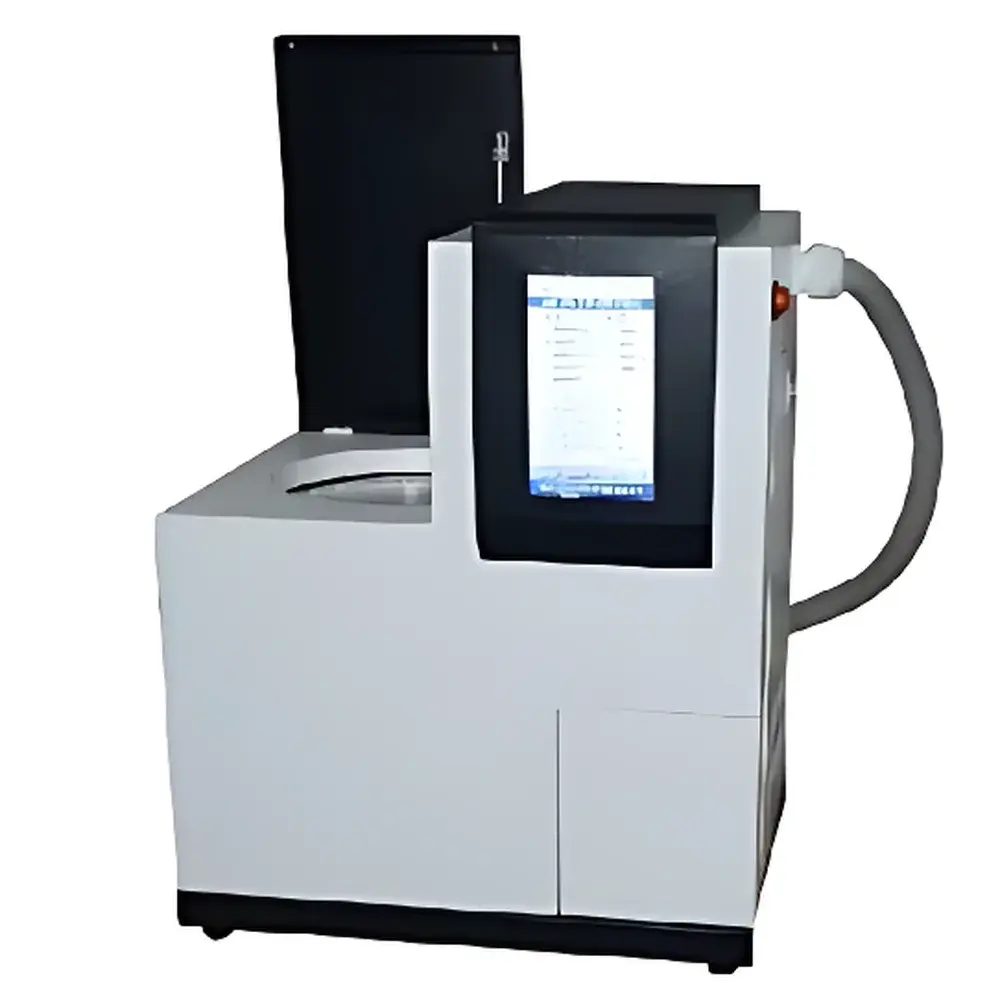
Beifen Sanpu ATD9S-20A Fully Automated Two-Stage Thermal Desorber with Cryogenic Trap
| Brand | Beifen Sanpu |
|---|---|
| Origin | Beijing, China |
| Manufacturer Type | Direct Manufacturer |
| Instrument Type | Two-Stage Thermal Desorber |
| Sample Capacity | 20 positions |
| Primary Desorption Temp Range | Ambient to 450 °C |
| Secondary Desorption (Cold Trap) Temp Range | −35 °C to ambient |
| Desorption Recovery Rate | >99% |
| Temperature Control Precision | < ±0.5 °C |
| RSD | ≤2.5% (benzene at 0.05 μg) |
| Repeatability | High reproducibility across 20-sample unattended sequences |
| Compliance | Designed for ASTM D6196, ISO 16017-1, US EPA TO-17, HJ 644–2013, HJ 583–2010, HJ 734–2014, GB/T 18883–2002, GB 50325–2010 |
Overview
The Beifen Sanpu ATD9S-20A is a fully automated two-stage thermal desorber engineered for high-fidelity, quantitative analysis of volatile and semi-volatile organic compounds (VOCs and SVOCs) in environmental, industrial hygiene, and indoor air monitoring applications. It operates on the principle of cryogenically focused, thermally driven analyte transfer: first-stage desorption releases compounds from sorbent tubes under controlled heating; analytes are then refocused in a cryogenically cooled trap (−35 °C minimum); second-stage rapid thermal desorption injects a narrow, solvent-free analyte band directly into the GC or GC-MS inlet. This two-stage architecture eliminates solvent use, enhances sensitivity by 5–10× over single-stage systems, and delivers chromatographic peak widths compatible with high-resolution capillary columns. The instrument is designed for full integration with any commercial gas chromatograph—regardless of manufacturer—including Agilent, Thermo Fisher, Shimadzu, and PerkinElmer—via standardized electrical synchronization and pressure-tight pneumatic interfaces.
Key Features
- Fully automated 20-position sample carousel with motor-driven six-port valve and self-calibrating tray positioning—enabling unattended overnight operation without manual intervention.
- Independent, precision temperature control across four critical zones: primary desorption oven (ambient to 450 °C), secondary desorption/focusing trap (−35 °C to ambient, via solid-state Peltier cooling), transfer line (ambient to 300 °C), and valve manifold (ambient to 300 °C)—all adjustable in 1 °C increments.
- Programmable multi-step sequence: primary desorption → carrier gas purge → cold trap focusing → rapid secondary desorption (≥3000 °C/min ramp) → GC injection → trap and transfer line bake-out → automated back-flush (0–100 mL/min, continuously adjustable).
- Integrated sample tube activation module: programmable heating and purging of used or new sorbent tubes prior to sampling—eliminating carryover and ensuring baseline integrity.
- Onboard calibration simulation mode: built-in flow-controlled gas standard delivery (0–160 mL/min) for direct generation of calibration curves without external hardware.
- Low-voltage (24 V DC) heating architecture for transfer lines—enhancing operational safety and electromagnetic compatibility in regulated laboratory environments.
- Touchscreen HMI with real-time graphical workflow visualization, method storage, and audit-ready event logging (including temperature setpoints, timing, valve actuation, and error flags).
Sample Compatibility & Compliance
The ATD9S-20A accepts standard 1/4″ OD × 3.5″ (89 mm) stainless steel or quartz-lined sorbent tubes compliant with ASTM D6196, ISO 16017-1, and US EPA Method TO-17. Optional quartz-lined transfer tubing minimizes adsorption of polar or reactive analytes (e.g., aldehydes, organic acids). The system meets performance validation requirements outlined in Chinese national standards HJ 644–2013, HJ 583–2010, HJ 734–2014, GB/T 18883–2002, and GB 50325–2010—specifically addressing benzene, toluene, ethylbenzene, xylenes (BTEX), C2–C12 aliphatics, and oxygenated VOCs. Its 99% average desorption recovery satisfy GLP-compliant trace-level quantitation protocols. All thermal and pneumatic events are timestamped and logged for FDA 21 CFR Part 11–aligned data integrity workflows when paired with validated chromatography data systems.
Software & Data Management
The embedded firmware supports method-based operation via intuitive touchscreen navigation—no external PC required for routine analysis. Each method stores complete thermal profiles, flow parameters, timing sequences, and GC synchronization triggers. Event logs—including startup diagnostics, temperature deviations, valve actuation history, and fault codes—are exportable as CSV files for QA/QC review. For laboratories operating under regulated quality systems, optional Ethernet connectivity enables remote monitoring, centralized method deployment, and integration with LIMS via Modbus TCP or custom API endpoints. All user actions (login, method edit, run initiation, parameter change) are recorded with operator ID and timestamp—supporting audit trail requirements per ISO/IEC 17025 and GMP Annex 11.
Applications
- Environmental air monitoring: ambient, workplace, and stack emissions testing per HJ 734–2014 (fixed sources) and HJ 644–2013 (ambient air).
- Indoor air quality assessment: formaldehyde, BTEX, and terpenes in residential/commercial buildings per GB/T 18883–2002 and HJ/T 400–2007 (in-vehicle air).
- Building material emission testing: VOC screening of carpets, adhesives, paints, and composite wood per GB 50325–2010.
- Consumer product safety: off-gassing analysis of electronics enclosures, toys, and packaging materials.
- Method development and reference material certification: high-precision recovery studies and interlaboratory comparison trials requiring sub-3% RSD performance.
FAQ
What distinguishes two-stage thermal desorption from single-stage systems?
Two-stage desorption incorporates a cryogenic trap to refocus analytes after primary desorption—yielding sharper peaks, lower detection limits, and superior resolution for co-eluting compounds. Single-stage systems inject broad, unrefocused bands directly into the GC, limiting sensitivity and quantitative accuracy.
Is the ATD9S-20A compatible with my existing GC or GC-MS?
Yes—it features universal pneumatic and electrical interfaces, including dedicated adapter kits for Agilent, Thermo Fisher, Shimadzu, and PerkinElmer instruments. Synchronization is achieved via TTL trigger signals or contact closure, supporting both hardware- and software-initiated runs.
Can I perform tube conditioning (baking) on this instrument?
Yes—the integrated tube activation function allows independent heating and purging of sorbent tubes at up to 400 °C with programmable flow and duration, eliminating need for separate aging ovens.
Does the system support regulatory compliance for laboratory accreditation?
It provides full audit trail logging, method versioning, electronic signatures (when paired with compliant CDS), and adherence to temperature uniformity and recovery specifications cited in ISO 16017-1, EPA TO-17, and HJ 644–2013—enabling successful ISO/IEC 17025 assessments.
What maintenance is required for long-term reliability?
Routine tasks include quarterly trap cleaning, annual calibration verification using NIST-traceable standards, and periodic inspection of O-rings and valve seals. The solid-state cooling module requires no refrigerant servicing, and all heaters are field-replaceable without disassembly.







