
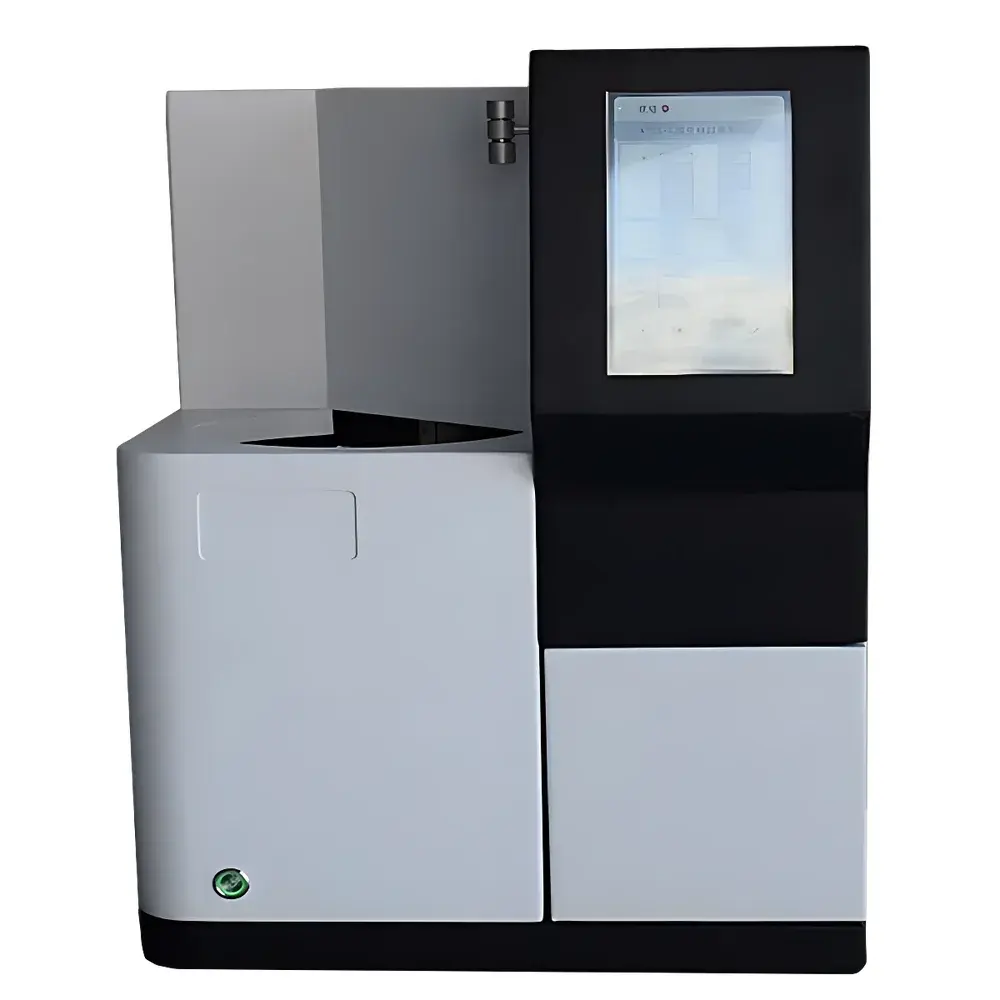
Beifen Sanpu ATDS-12A Fully Automated 12-Position Thermal Desorber
| [Brand | Beifen Sanpu |
|---|---|
| Origin | Beijing, China |
| Manufacturer Type | Direct Manufacturer |
| Instrument Type | Dual-Stage Thermal Desorber |
| Automation Level | Fully Automated |
| Sample Capacity | 12 positions |
| Primary Desorption Temp Range | Ambient to 450 °C (1 °C increments) |
| Secondary Desorption Temp Range | Ambient to 450 °C (1 °C increments) |
| Valve & Transfer Line Temp Range | Ambient to 260 °C (1 °C increments) |
| Cryo-Focusing Zone Temp Range | −35 °C to ambient (semiconductor cooling) |
| Temperature Accuracy | < ±0.5 °C |
| Desorption Recovery | >99% (compound-dependent) |
| Carryover Control | Automated back-flush of valve and transfer line |
| Reproducibility (RSD) | ≤2.5% (benzene at 0.05 μg in methanol) |
| Sample Tube Format | 1/4″ OD × 3.5″ (ASTM D6196-compliant) |
| GC Interface | Motor-driven 6-port switching valve with universal GC port adapters] |
Overview
The Beifen Sanpu ATDS-12A is a fully automated, dual-stage thermal desorber engineered for high-throughput, trace-level analysis of volatile and semi-volatile organic compounds (VOCs and SVOCs) in environmental, industrial hygiene, and indoor air quality applications. It operates on the principle of cryogenic focusing followed by rapid thermal desorption—first releasing analytes from sorbent tubes under controlled heating, then refocusing them onto a cryogenically cooled trap (−35 °C), and finally injecting a narrow, solvent-free analyte band into the gas chromatograph (GC) or GC–MS system. This two-stage architecture delivers superior peak shape, enhanced sensitivity, and minimized breakthrough for compounds boiling up to 350 °C. Designed to meet stringent regulatory requirements—including HJ 644–2013, HJ 583–2010, HJ 734–2014, and GB/T 18883–2022—the ATDS-12A supports compliant workflows for laboratories performing accredited VOC monitoring under ISO/IEC 17025, EPA TO-17, and EU EN 16755 frameworks.
Key Features
- Fully automated 12-position sample carousel enabling unattended overnight operation without manual intervention;
- Independent, precision temperature control across four critical zones: primary desorption oven (ambient–450 °C), secondary desorption/focusing zone (ambient–450 °C), GC interface valve (ambient–260 °C), and transfer line (ambient–260 °C);
- Integrated semiconductor-based cryo-cooling system maintaining stable −35 °C cold trap temperature with < ±0.5 °C accuracy;
- Motor-driven 6-port switching valve with programmable timing for precise desorption, purge, re-desorption, injection, and post-run back-flush cycles;
- Onboard tube activation protocol with configurable heating profiles and inert gas flow control to regenerate sorbent tubes post-analysis;
- Real-time status monitoring via 7-inch capacitive touchscreen; method storage, run logging, and system diagnostics accessible through embedded microprocessor;
- Universal GC interface compatibility—pre-configured mechanical and pneumatic adapters for Agilent, Thermo Fisher, Shimadzu, PerkinElmer, and other major GC platforms;
- Optional quartz-lined transfer lines available for active compound analysis (e.g., aldehydes, sulfur species, acidic/basic VOCs);
- Programmable sample introduction parameters including desorption time (0–60 min), focusing time, injection duration (0–60 min), and back-flush flow (0–500 mL/min).
Sample Compatibility & Compliance
The ATDS-12A accepts standard 1/4″ OD × 3.5″ stainless steel or glass sorbent tubes conforming to ASTM D6196 and EPA TO-17 specifications. It supports multi-bed sorbents (e.g., Tenax TA, Carbopack B/C, Carboxen 1000) and accommodates both single- and dual-tube configurations. All thermal zones are calibrated traceably to NIST-traceable references, and temperature stability is validated per IEC 61000-4-30. The instrument meets electromagnetic compatibility (EMC) requirements per CISPR 11 Group 1, Class A. Its operational software supports audit trail generation, user access levels, and electronic signatures—enabling alignment with FDA 21 CFR Part 11 and GLP/GMP data integrity expectations when integrated with compliant LIMS or chromatography data systems (CDS).
Software & Data Management
Control and method development are performed via an embedded Windows IoT-based interface with intuitive drag-and-drop sequence builder. Methods include full thermal profile definition, valve timing logic, GC trigger synchronization (TTL or Ethernet), and optional external initiation via RS-232 or TCP/IP. Raw event logs—including temperature setpoints, actual readings, valve actuation timestamps, and error codes—are stored locally with date/time stamping and exportable as CSV or PDF. For enterprise integration, optional OPC UA server support enables bidirectional communication with laboratory information management systems (LIMS) and centralized instrument monitoring dashboards. All configuration changes are logged with user ID, timestamp, and pre-/post-value deltas—ensuring full traceability for internal QA audits and regulatory inspections.
Applications
- Environmental air monitoring: VOC profiling in ambient, workplace, and stack emissions per HJ 644–2013, HJ 734–2014, and EU EN 16755;
- Indoor air quality assessment: Benzene, toluene, ethylbenzene, xylenes (BTEX), formaldehyde precursors, and terpenes per GB/T 18883–2022 and GB 50325–2020;
- Automotive cabin testing: Aldehydes, plasticizers, and off-gassing compounds per HJ/T 400–2007;
- Building material emission screening: Carpet, adhesives, paints, and composite panels per ISO 16000-6 and ASTM D5116;
- Pharmaceutical residual solvent analysis: Class 2 and 3 solvents in packaging headspace per ICH Q3C guidelines;
- Forensic and flavor/aroma profiling where reproducible thermal release kinetics and low carryover are critical.
FAQ
What sorbent tube formats does the ATDS-12A support?
It accepts standard 1/4″ OD × 3.5″ (6.35 mm × 89 mm) sorbent tubes compliant with ASTM D6196 and EPA TO-17. Custom-length tubes may be accommodated with optional tube holders.
Can the instrument perform single-stage desorption?
Yes—software allows disabling the cryo-focusing step to operate in single-stage mode for less volatile or higher-concentration samples.
Is method validation documentation provided?
Yes: Factory calibration certificates, temperature uniformity reports, recovery validation data (benzene, toluene, chloroform), and RSD verification protocols are supplied with each unit.
How is carryover mitigated between runs?
Automated high-flow inert gas back-flush of the six-port valve and transfer line occurs after each injection, with flow rate programmable from 0–500 mL/min.
Does the system support remote monitoring and control?
Via optional Ethernet module: real-time status viewing, method upload/download, and alarm notifications可通过 secure web interface or SNMP-compatible network management tools.





