
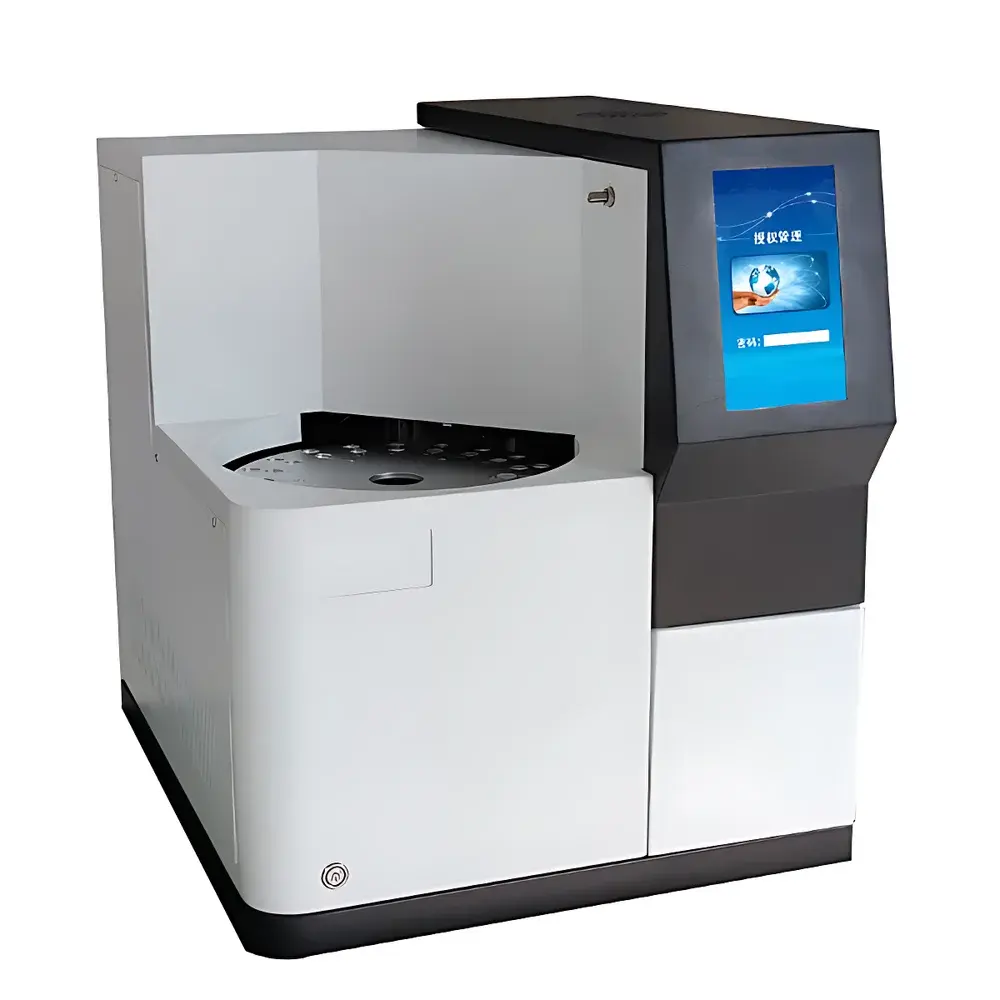
Beifen Sanpu ATDS-20A Cryogenic Cold Trap Fully Automated Two-Stage Thermal Desorber
| Brand | Beifen Sanpu |
|---|---|
| Origin | Beijing, China |
| Manufacturer Type | Direct Manufacturer |
| Product Origin | Domestic (China) |
| Model | ATDS-20A |
| Price | USD 21,800 (FOB Beijing) |
Overview
The Beifen Sanpu ATDS-20A Cryogenic Cold Trap Fully Automated Two-Stage Thermal Desorber is a precision-engineered sample introduction system designed for trace-level volatile organic compound (VOC) and semi-volatile organic compound (SVOC) analysis in environmental, industrial hygiene, and materials testing laboratories. It implements a two-stage thermal desorption process coupled with cryogenic focusing—where analytes are first thermally desorbed from sorbent tubes, cryo-trapped in a low-temperature cold trap (–35 °C to ambient), and then rapidly re-desorbed as a narrow, solvent-free band into the gas chromatograph (GC) or GC–MS inlet. This architecture delivers superior peak shape, enhanced sensitivity (sub-ng level detection), and high reproducibility—critical for compliance with regulatory methods including EPA TO-17, ISO 16017-1, and Chinese standard HJ 644–2013. The instrument is fully compatible with all major GC and GC–MS platforms via standardized pneumatic and electrical interfaces, supporting both split and splitless injection modes.
Key Features
- Fully automated 20-position sample carousel with unattended operation and integrated self-diagnostic routines—including automatic sample tray calibration and fault logging.
- Independent four-zone temperature control: primary desorption oven (room temp to 450 °C), valve manifold (room temp to 300 °C), transfer line (room temp to 300 °C, 24 V low-voltage heating), and secondary desorption/cold trap zone (room temp to 450 °C; cryogenic range –35 °C to ambient).
- Electronic Peltier-based cooling system enabling precise, maintenance-free cold trapping without liquid nitrogen or mechanical compressors.
- Rapid thermal ramping (>3000 °C/min) during secondary desorption ensures sharp, symmetrical chromatographic peaks and minimizes analyte degradation.
- Motor-driven six-port switching valve with position feedback for high-cycle reliability and leak-tight operation.
- Integrated back-flush functionality for transfer line and injection valve—programmable flow (0–100 mL/min)—to eliminate carryover between samples.
- Onboard calibration and simulation module: programmable sampling flow (0–160 mL/min) and tube activation protocol for routine sorbent tube conditioning.
- Touchscreen HMI with real-time status animation, method storage, and time-segmented programming for desorption, purge, refocusing, injection, and post-run cleaning sequences.
Sample Compatibility & Compliance
The ATDS-20A accepts standard 1/4″ OD × 3.5″ (8.9 × 89 mm) stainless steel or quartz sorbent tubes per ASTM D6196 and EPA TO-17 specifications. Optional fused silica transfer lines are available for active compound analysis (e.g., aldehydes, organic acids). The system supports both single-stage and two-stage configurations—users may configure the unit for ambient-temperature secondary desorption or cryogenic trapping depending on application requirements. It meets data integrity requirements for regulated environments: audit trail logging, user access levels, and electronic signature support align with FDA 21 CFR Part 11 principles when operated with compliant LIMS or GC data systems. Method validation documentation supports compliance with HJ 644–2013, HJ 583–2010, HJ 734–2014, GB/T 18883–2002, and GB 50325–2010.
Software & Data Management
Control is managed via embedded microprocessor firmware with a 7-inch capacitive touchscreen interface. All method parameters—including temperature ramps, timing events, valve actuation, and flow profiles—are stored in non-volatile memory with timestamped version history. The system provides TTL and RS232 outputs for synchronized triggering of external GCs and data systems (e.g., Agilent OpenLab, Thermo Chromeleon, Shimadzu LabSolutions). Optional Ethernet connectivity enables remote monitoring and integration into centralized laboratory informatics infrastructure. Raw event logs—including error codes, temperature deviations (>±0.5 °C), and valve cycle counts—are exportable as CSV for QA/QC review and GLP/GMP documentation.
Applications
The ATDS-20A is routinely deployed in accredited environmental testing labs for: indoor air quality assessment (benzene, toluene, xylenes, formaldehyde); ambient and stack emission monitoring (C2–C12 hydrocarbons, chlorinated VOCs); building material emissions testing (carpet, adhesives, insulation); and consumer product safety screening (toys, electronics, packaging). Its high recovery (>99% for BTEX compounds) and low RSD (≤2.5% at 0.05 μg benzene) make it suitable for reference method validation and proficiency testing programs. The cryogenic trapping capability significantly improves detection limits for light volatiles (e.g., vinyl chloride, acetaldehyde) and enhances resolution of co-eluting isomers in complex matrices.
FAQ
What sorbent tube formats does the ATDS-20A support?
It accepts standard 1/4″ OD × 3.5″ US-style stainless steel or quartz-packed thermal desorption tubes. Custom adapters are available for alternative dimensions upon request.
Can the system be integrated with third-party GC software?
Yes—via hardware trigger signals (TTL) and serial command protocols. Full bidirectional communication is supported with major GC data systems using optional driver modules.
Is liquid nitrogen required for cold trapping?
No—the ATDS-20A uses solid-state Peltier cooling, eliminating consumables, handling hazards, and temperature instability associated with cryogens.
How is carryover minimized between analyses?
Through programmable back-flush of the transfer line and six-port valve using inert carrier gas, combined with high-temperature bake-out cycles (up to 450 °C) and active cooling between runs.
Does the instrument comply with ISO/IEC 17025 requirements for accredited testing?
When operated under documented SOPs—including daily performance checks, calibration verification using certified standards, and full audit trail retention—the ATDS-20A satisfies technical competence criteria for thermal desorption instrumentation in ISO/IEC 17025:2017 Clause 6.4.
Related Products




