
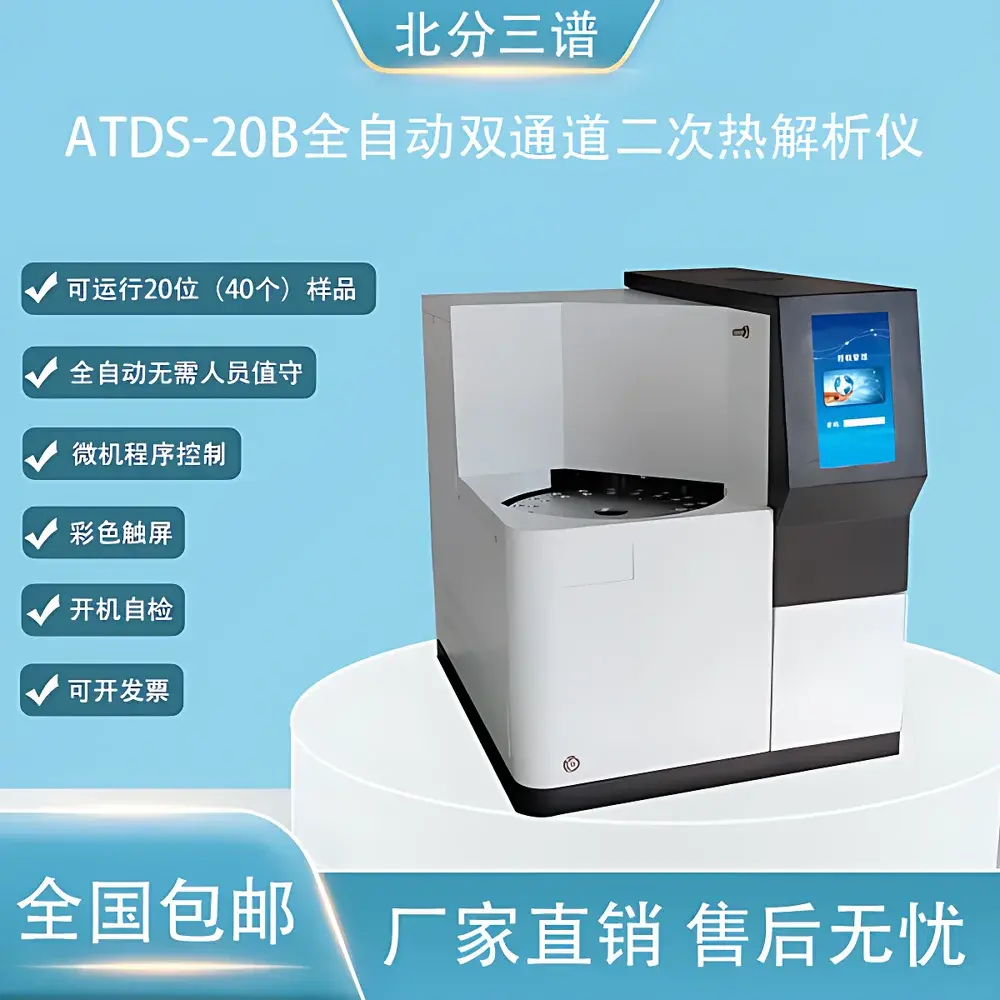
Beifen Sanpu ATDS-20B Automated Dual-Channel Two-Stage Thermal Desorber for GC/GC-MS
| [Brand | Beifen Sanpu |
|---|---|
| Origin | Beijing, China |
| Manufacturer Type | Direct Manufacturer |
| Instrument Type | Laboratory Thermal Desorption System |
| Model | ATDS-20B |
| Sample Capacity | Dual 20-position (40 total) |
| Sample Tube Specification | 1/4″ × 3.5″ (ASTM D6196-compliant) |
| Injection Mode | Motor-driven 6-port valve |
| Primary Desorption Temp Range | Ambient to 450 °C |
| Secondary Desorption (Cold Trap) Temp Range | –35 °C to ambient (Peltier-cooled) |
| Transfer Line Temp Range | Ambient to 300 °C |
| Valve & Interface Temp Range | Ambient to 300 °C |
| Temperature Control Accuracy | < ±0.5 °C |
| Heating Rate (2nd Stage) | >3000 °C/min |
| Simulated Sampling Flow | 0–160 mL/min (adjustable) |
| Purge/Backflush Flow | 0–100 mL/min (adjustable) |
| Desorption Recovery | >99% (compound-dependent) |
| RSD | ≤2.5% (benzene at 0.05 μg in methanol) |
| Enrichment Time | 0–60 min |
| Injection Time | 0–60 min |
| Dimensions | 350 × 450 × 550 mm |
| Weight | ~40 kg] |
Overview
The Beifen Sanpu ATDS-20B is an automated dual-channel two-stage thermal desorption system engineered for high-throughput, reproducible pre-concentration and introduction of volatile and semi-volatile organic compounds (VOCs/SVOCs) into gas chromatography (GC) or gas chromatography–mass spectrometry (GC-MS) platforms. It operates on the principle of thermally driven analyte release from sorbent tubes—first via low-temperature desorption and trapping onto a cryogenically focused cold trap (–35 °C), followed by rapid flash-heating (>3000 °C/min) to transfer a narrow, solvent-free analyte band into the GC column. This two-stage architecture minimizes band broadening, enhances sensitivity, and ensures compatibility with regulatory methods requiring trace-level detection in complex environmental matrices.
Key Features
- Dual 20-position autosampler (40 total samples) enabling unattended batch analysis without manual intervention
- Independent four-zone temperature control: primary desorption oven, secondary cold trap, transfer line, and six-port valve—each programmable in 1 °C increments from ambient to 450 °C (oven) or –35 °C (trap)
- Peltier-based electronic cooling for stable, maintenance-free cold trapping—no liquid nitrogen or mechanical compressor required
- Motor-driven 6-port valve with precise timing control for reproducible switching between sampling, desorption, injection, and backflush cycles
- Passivated stainless-steel flow path and automatic backflush capability (0–100 mL/min) to eliminate carryover between samples
- Integrated simulated sampling function with adjustable flow (0–160 mL/min) for direct calibration curve generation without external gas cylinders or mass flow controllers
- USB interface and embedded 7-inch capacitive touchscreen for local method setup; full remote control and data logging via PC software
- 20+ user-editable method templates with password-protected user management, audit-trail-enabled operation logs, and bilingual (English/Chinese) UI support
- Universal GC interface design—compatible with Agilent, Thermo Fisher, Shimadzu, PerkinElmer, and domestic GC systems via standardized ferrule-based connections
Sample Compatibility & Compliance
The ATDS-20B accepts standard 1/4″ × 3.5″ (OD × length) sorbent tubes conforming to ASTM D6196 and ISO 16017-1 specifications. It supports multi-bed sorbents (e.g., Tenax TA, Carbopack B/C, Carboxen 1000) for broad volatility coverage (C2–C18). The system meets performance criteria outlined in multiple Chinese national and environmental standards, including HJ 644–2013 (ambient air VOCs), HJ 583–2010 (benzene series), HJ 734–2014 (stationary source emissions), GB/T 18883–2022 (indoor air quality), and GB 50325–2020 (civil building contamination control). Its 99% recovery rate satisfy GLP-aligned validation requirements for routine environmental QC/QA laboratories.
Software & Data Management
Instrument control and sequence management are executed through a dedicated Windows-based application supporting method cloning, real-time status monitoring, and event-triggered GC start synchronization. All method parameters—including desorption times, temperature ramps, flow profiles, and valve actuation sequences—are stored with timestamps and operator IDs. The software enforces role-based access control, maintains immutable operation logs per 21 CFR Part 11 principles (user authentication, electronic signatures, change history), and exports peak-area tables in CSV and AIA formats compatible with major chromatography data systems (CDS) such as OpenLab CDS, Chromeleon, and LabSolutions.
Applications
The ATDS-20B serves as a core sample introduction module in environmental, occupational health, and materials testing laboratories. Typical use cases include: quantification of benzene, toluene, ethylbenzene, xylenes (BTEX), aldehydes, and halogenated VOCs in indoor air, vehicle cabin air, and ambient air per HJ/T 400–2007; compliance testing of formaldehyde and TVOC in building materials under GB 50325–2020; emission profiling of industrial stacks per HJ 734–2014; and screening of residual solvents in pharmaceutical packaging per ICH Q3C guidelines. Its dual-channel architecture also enables parallel processing—e.g., one channel performing desorption while the other conditions a fresh tube—reducing cycle time by up to 40%.
FAQ
Is the ATDS-20B compatible with non-Chinese GC manufacturers?
Yes—it features mechanically and pneumatically standardized interfaces for seamless integration with Agilent 7890/8890, Thermo ISQ EC, Shimadzu GC-2030, and PerkinElmer Clarus series.
Does the system support method validation per ISO/IEC 17025 requirements?
Yes—its temperature accuracy (99%), and electronic audit trail functionality align with ISO/IEC 17025 clause 7.7 on method validation and verification.
Can the cold trap temperature be set below –35 °C?
No—the Peltier cooling module is rated for –35 °C minimum; lower temperatures require optional LN2-assisted traps not included in the base configuration.
What maintenance is required for long-term reliability?
Routine tasks include quarterly valve seal inspection, annual sorbent tube holder cleaning, and biannual verification of temperature calibration using NIST-traceable reference thermometers.
Is remote diagnostics supported?
Yes—via secure VPN-enabled remote desktop access (with user consent), allowing technical support engineers to review system logs, verify firmware version, and validate method configurations without onsite visits.






