
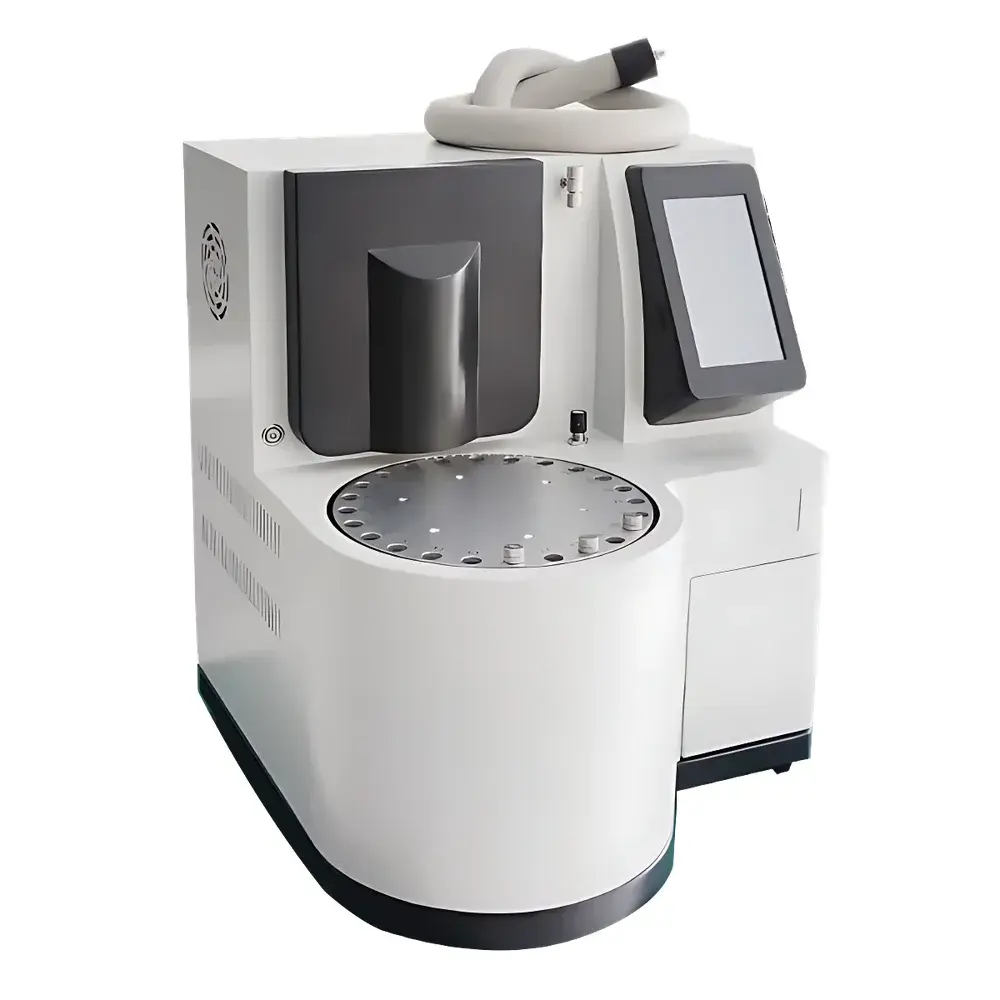
Beifen Sanpu ATDS-24B Dual-Channel Fully Automated Two-Stage Thermal Desorber
| Brand | Beifen Sanpu |
|---|---|
| Origin | Beijing, China |
| Manufacturer Type | Original Equipment Manufacturer (OEM) |
| Instrument Type | Two-stage thermal desorber / Thermal desorption unit |
| Automation Level | Fully automated |
| Primary Desorption Temperature Range | Ambient to 450 °C (1 °C increments) |
| Valve Injection Zone Temperature Range | Ambient to 300 °C (1 °C increments) |
| Transfer Line Temperature Range | Ambient to 300 °C (1 °C increments) |
| Cryo-Focusing Trap Temperature Range | −35 °C to ambient (1 °C increments) |
| Temperature Control Accuracy | < ±0.5 °C |
| Analyte Recovery Rate | > 99% (compound-dependent) |
| Sample Capacity | Dual 24-position trays (48 total samples) |
| Dimensions | 350 × 450 × 550 mm (W × D × H) |
| Weight | ~40 kg |
Overview
The Beifen Sanpu ATDS-24B is a dual-channel, fully automated two-stage thermal desorption system engineered for high-throughput, trace-level volatile organic compound (VOC) and semi-volatile organic compound (SVOC) analysis in environmental, occupational health, and indoor air quality laboratories. It operates on the principle of thermally driven analyte release from sorbent tubes—first via primary desorption into a cryogenically focused trap, followed by rapid secondary desorption directly into the GC or GC-MS inlet. This two-stage architecture ensures sharp, narrow peak formation, minimizes breakthrough, and maximizes sensitivity and reproducibility—critical for compliance with stringent regulatory methods including EPA TO-17, ISO 16017-1, and Chinese national standards such as HJ 644–2013 and GB/T 18883–2022. The system integrates precise temperature zoning across four independently controlled zones (primary desorption oven, valve manifold, transfer line, and secondary desorption/cryo-trap), enabling method robustness across diverse analyte volatilities and matrix complexities.
Key Features
- Fully automated dual 24-position sample handling (48 total samples), supporting unattended overnight operation without manual intervention
- Independent four-zone temperature control: primary desorption (ambient–450 °C), valve zone (ambient–300 °C), transfer line (ambient–300 °C), and secondary desorption/cryo-trap (−35 °C to ambient), all with 1 °C resolution and < ±0.5 °C accuracy
- Ultra-rapid secondary heating rate exceeding 3000 °C/min—optimized for sharp band focusing and minimal thermal degradation
- Semiconductor-based electronic cooling for the cryo-trap, eliminating liquid nitrogen dependency and enhancing operational safety and repeatability
- Motor-driven 6-port switching valve with integrated back-flush capability to prevent carryover between samples
- Dual inert gas flow control: programmable desorption purge (0–100 mL/min) and simulated sampling flow (0–160 mL/min)
- Passivated stainless-steel tubing throughout the entire sample path to minimize adsorption and surface reactivity
- USB interface for PC-based method programming; 7-inch capacitive touchscreen with bilingual (English/Chinese) UI, user management, and audit-trail-enabled event logging
- Predefined support for 20+ editable thermal desorption methods—including dry-purge, adsorption, primary desorption, cryo-focusing, secondary desorption, and post-run trap cleaning sequences
- Universal GC interface compatibility: configurable hardware adapters for Agilent, Thermo Fisher, Shimadzu, PerkinElmer, and other major GC/GC-MS platforms
Sample Compatibility & Compliance
The ATDS-24B accepts standard 1/4″ OD × 3.5″ (US EPA/TO-17 compliant) sorbent tubes (e.g., Tenax TA, Carbopack B/C, Carboxen 1000) and supports multi-bed configurations for broad volatility range coverage (C2–C16). Its design conforms to key international and domestic regulatory frameworks: it meets performance criteria specified in HJ 644–2013 (ambient air VOCs), HJ 583–2010 (benzene homologues), HJ 734–2014 (stationary source emissions), GB/T 18883–2022 (indoor air quality), and GB 50325–2020 (civil construction). System validation includes documented RSD ≤ 2.5% (n = 6) for 0.05 μg benzene in methanol matrix, recovery > 99% for target compounds under optimized conditions, and full traceability of calibration, maintenance, and run logs per GLP/GMP-aligned data integrity requirements.
Software & Data Management
Control and method development are performed via Windows-based software communicating over USB 2.0. The software supports full method parameterization—including time-segmented temperature ramps, flow profiles, valve actuation timing, and GC synchronization triggers (TTL or Ethernet-based start signals). All method files, run logs, and instrument status histories are timestamped and stored locally with optional network backup. User access levels (admin/operator/guest) enforce role-based permissions; password-protected logins and immutable audit trails satisfy FDA 21 CFR Part 11 readiness requirements when deployed in regulated environments. Export formats include CSV, PDF reports, and native chromatography data system (CDS)-compatible .txt outputs for seamless integration with OpenLab, Chromeleon, or MassHunter workflows.
Applications
- Environmental monitoring: ambient air, stack emissions, soil headspace, and landfill gas VOC profiling per HJ 734–2014 and EPA Method TO-17
- Indoor air quality assessment: formaldehyde, benzene, toluene, ethylbenzene, xylenes (BTEX), and C3–C12 aliphatics per GB/T 18883–2022 and HJ/T 400–2007
- Building material emission testing: carpets, adhesives, paints, and composite wood products per GB 50325–2020
- Workplace exposure evaluation: industrial hygiene sampling of solvents, monomers, and process intermediates
- Consumer product safety: off-gassing analysis of electronics enclosures, automotive interiors, and children’s toys
- Method development and reference standard preparation via integrated simulated sampling and calibration curve generation
FAQ
What sorbent tube formats does the ATDS-24B support?
It accepts standard 1/4″ OD × 3.5″ US EPA-compliant tubes, including single- and multi-bed configurations (e.g., Tenax TA + Carbopack B + Carboxen 1000). Custom tube holders are available upon request.
Does the system require liquid nitrogen for cryo-focusing?
No. It employs solid-state Peltier cooling for the cold trap, delivering stable −35 °C operation without consumables or cryogenic hazards.
Can the ATDS-24B be integrated with third-party GC-MS systems?
Yes. It provides TTL trigger output and configurable hardware interfaces for Agilent, Thermo Fisher, Shimadzu, and PerkinElmer instruments, with detailed wiring schematics and timing diagrams supplied.
Is audit trail functionality enabled by default?
Yes. All user actions, method changes, system errors, and run events are automatically logged with timestamps and operator IDs. Logs are write-protected and exportable for regulatory review.
What is the typical maintenance interval for the valve and trap assembly?
Under normal use (≤ 2000 cycles/year), the motorized valve and trap require inspection every 6 months; routine cleaning of the transfer line and valve ports is recommended after every 200 samples.
Related Products





