
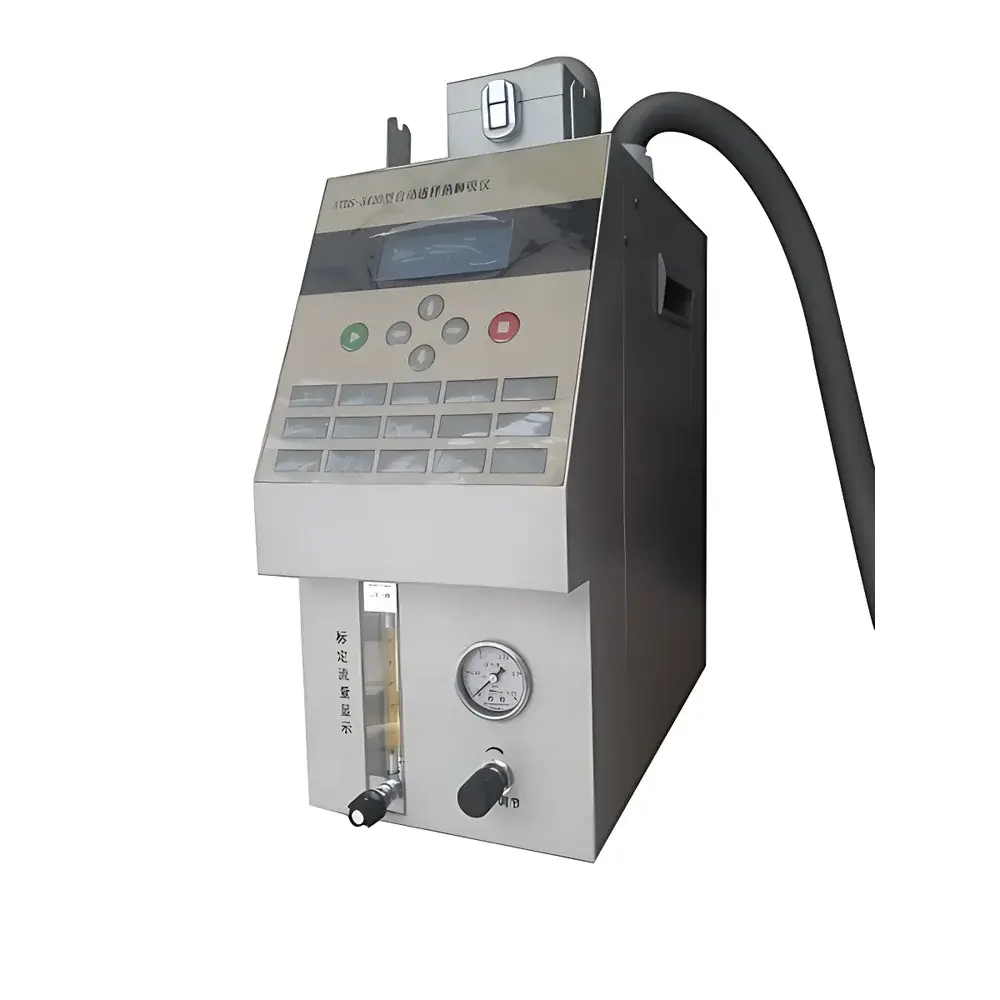
Beifen Sanpu ATDS-3420 Automated Thermal Desorber for Flavor and Fragrance Analysis
| Brand | Beifen Sanpu |
|---|---|
| Origin | Beijing, China |
| Manufacturer Type | Direct Manufacturer |
| Instrument Type | Dual-Stage Thermal Desorber |
| Primary Desorption Temperature Range | Ambient to 400 °C |
| Secondary Desorption Temperature Range | 100–400 °C |
| Cold Trap Temperature Range | Down to –35 °C |
| Desorption Recovery Rate | >90% |
| Sample Capacity | 20 adsorption tubes |
| Dimensions | 360 × 170 × 390 mm |
| Weight | ~10 kg |
| Temperature Control Accuracy | < ±0.5 °C |
Overview
The Beifen Sanpu ATDS-3420 is a fully automated, dual-stage thermal desorption system engineered for trace-level volatile organic compound (VOC) analysis in complex matrices—particularly flavor and fragrance compounds, environmental air, indoor air, occupational hygiene samples, and forensic or pharmaceutical headspace specimens. It operates on the principle of thermally driven desorption from sorbent-packed tubes (e.g., Tenax TA, Carbopack B/C, or multi-bed configurations), followed by cryofocusing in a low-temperature trap (down to –35 °C), rapid flash-heating, and quantitative transfer into a gas chromatograph (GC) or GC–MS system. Unlike single-stage desorbers, the ATDS-3420 implements two sequential thermal zones: primary desorption at ambient–400 °C for gentle analyte release from the tube, and secondary desorption at 100–400 °C with precise cold-trap refocusing to eliminate water vapor interference and enhance sensitivity. This architecture enables sub-ppb detection limits for benzene, toluene, ethylbenzene, xylenes (BTEX), aldehydes, terpenes, esters, and other semi-volatile flavor volatiles across diverse regulatory and research workflows.
Key Features
- Dual-zone temperature control: independently programmable primary furnace (ambient–400 °C), secondary desorption zone (100–400 °C), and heated transfer line (ambient–160 °C), all with < ±0.5 °C stability and 1 °C resolution
- Integrated cryogenic cold trap capable of reaching –35 °C, enabling effective water and CO2 removal while retaining polar and labile aroma compounds
- 20-position auto-sampler carousel with programmable tube indexing, compatible with standard 6 mm OD stainless steel or quartz sorbent tubes
- Eight-step, three-event time-programmable logic supporting unattended operation—including automated tube conditioning, desorption, trap focusing, GC trigger, and post-analysis backflush (0–20 mL/min, continuously adjustable)
- Native GC synchronization via TTL or contact closure; supports external event triggering and bidirectional communication with major GC data systems (e.g., Agilent OpenLab, Thermo Chromeleon, Shimadzu GCsolution)
- Modular carrier gas management: built-in pressure-regulated split-flow system eliminates need for GC hardware modification; compatible with He, N2, or H2 carrier gases
- Optional high-inertness 0.53 mm i.d. fused silica transfer line for enhanced recovery of reactive or adsorptive analytes (e.g., sulfur compounds, short-chain aldehydes)
- Front-panel LCD with Chinese/English toggle, real-time parameter display (method name, elapsed time, temperature setpoints, date/time stamp), and silent-mode keypad operation
Sample Compatibility & Compliance
The ATDS-3420 accommodates a broad spectrum of regulated and research-driven sampling protocols. It is validated for compliance with multiple national and method-specific standards, including HJ 644–2013 (ambient air VOCs by TD-GC–MS), HJ 583–2010 (BTEX in ambient air), HJ 734–2014 (stack emission VOCs), GB 50325–2020 (indoor air TVOC and benzene), and GB/T 18883–2002 (indoor air quality). Its design supports GLP-aligned workflows: audit trails are maintained via method timestamping and parameter logging; user-accessible method storage (up to 9 preconfigured methods) ensures reproducibility across shifts and operators. For flavor and fragrance labs, the system demonstrates high recovery (>90%) for monoterpenes (limonene, α-pinene), lactones (γ-decalactone), phenylpropanoids (vanillin, eugenol), and sulfur-containing thiols—critical for authenticity testing, shelf-life studies, and raw material QC per ISO 8587 and ASTM E2154 guidelines.
Software & Data Management
While the ATDS-3420 operates as a standalone hardware module with embedded microcontroller-based timing and thermal control, it integrates natively into laboratory information management systems (LIMS) through standardized GC trigger interfaces and ASCII-based status reporting. All method parameters—including desorption ramp rates, hold times, trap freeze/flash profiles, and backflush durations—are stored in non-volatile memory with checksum validation. The instrument logs operational history (start/stop timestamps, temperature deviations, fault codes) for internal review. For full 21 CFR Part 11 compliance, integration with validated third-party chromatography data systems (CDS) is recommended; such configurations support electronic signatures, role-based access control, and immutable audit trails required in pharmaceutical and contract testing environments.
Applications
- Quantitative profiling of volatile aroma compounds in essential oils, perfumes, food extracts, and tobacco products
- Indoor air quality (IAQ) assessment per GB 50325–2020 and ISO 16000 series standards
- OCCUPATIONAL exposure monitoring for solvents (e.g., acetone, MEK, styrene) in manufacturing and coating facilities
- Forensic toxicology: detection of volatile drugs of abuse (e.g., chloroform, toluene) and accelerants in arson investigations
- Pharmaceutical residual solvent analysis (ICH Q3C) and headspace screening of drug product packaging leachables
- Environmental emissions testing from polymer processing, adhesive curing, and composite manufacturing lines
- Rapid field-deployable screening of unknown airborne hazards using pre-packed tubes and portable GC platforms
FAQ
Is the ATDS-3420 compatible with GC–MS systems?
Yes—it delivers sharp, focused analyte bands suitable for both quadrupole and high-resolution GC–MS detection, with minimal peak broadening or carryover when operated within specified thermal and flow parameters.
Can the system perform tube aging or conditioning in situ?
Yes—built-in tube bake-out functionality allows automated thermal conditioning of sorbent tubes under inert gas purge prior to sample loading, reducing background contamination.
What is the maximum allowable moisture content in sampled air without cold trap overload?
When sampling ambient air at ≤60% RH and ≤25 °C, the –35 °C cold trap reliably retains target VOCs while rejecting bulk water; for high-humidity environments, optional Nafion dryers or chilled impingers are recommended upstream.
Does the ATDS-3420 support EPA TO-17 methodology?
It meets all instrumental requirements of TO-17 (including temperature precision, trap performance, and desorption efficiency), though final method validation must be performed by the end user per their QA/QC protocol.
How is calibration verified across the 20-tube carousel?
Each position undergoes independent thermal mapping during factory qualification; users may perform routine verification using certified standard permeation tubes or dynamic spiking with known VOC mixtures across all positions.
Related Products






