
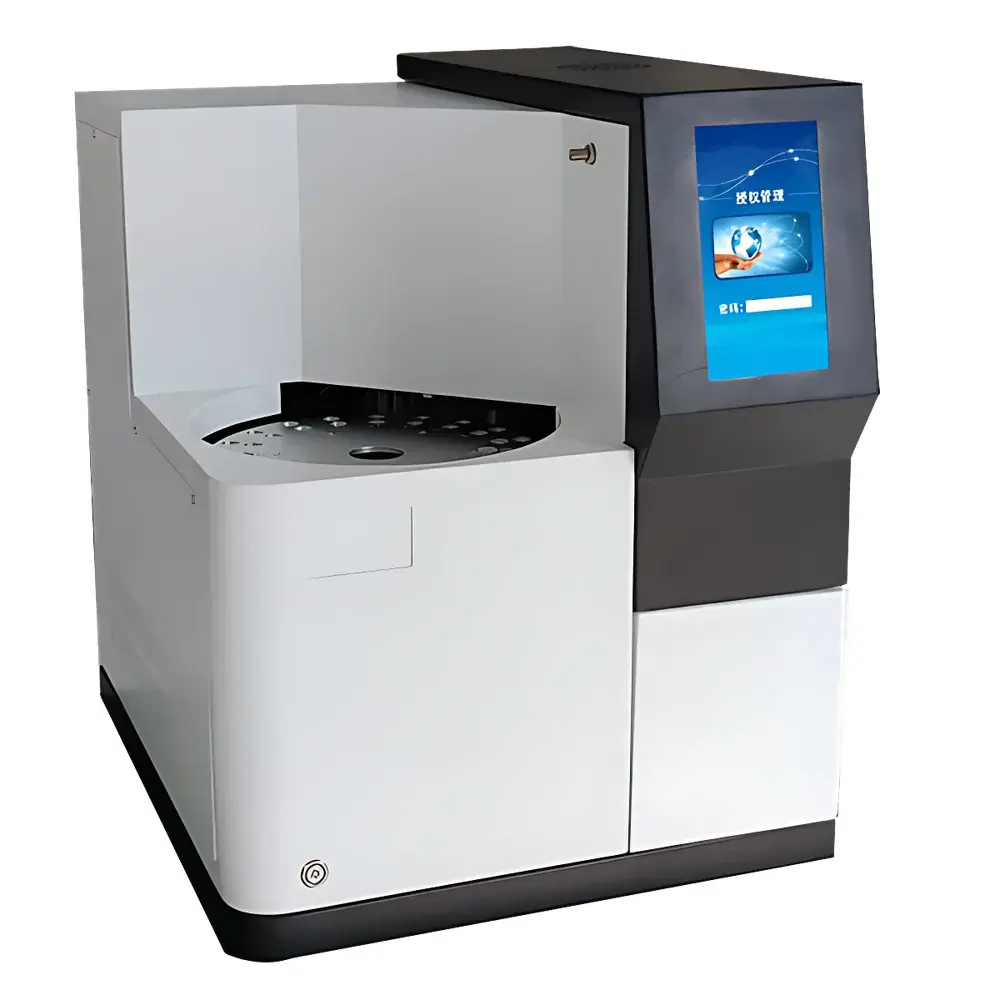
Beifen Sanpu ATDS Series Dual-Channel Fully Automated Thermal Desorber
| Brand | Beifen Sanpu |
|---|---|
| Origin | Hebei, China |
| Manufacturer Type | Direct Manufacturer |
| Instrument Type | Secondary Thermal Desorber |
| Automation Level | Fully Automated |
| Desorption Zone Temperature Range | 150–380 °C |
| Valve Oven Temperature Range | Ambient to 260 °C (1 °C increments) |
| Transfer Line Temperature Range | Ambient to 260 °C (1 °C increments |
| Cold Trap Temperature Range | –35 °C to ambient (1 °C increments |
| Temperature Control Accuracy | < ±0.5 °C |
| Sample Capacity | Dual 12-, 20-, or 24-position trays |
Overview
The Beifen Sanpu ATDS Series Dual-Channel Fully Automated Thermal Desorber is a precision-engineered secondary thermal desorption system designed for quantitative and qualitative analysis of volatile and semi-volatile organic compounds (VOCs and SVOCs) in air, indoor environments, building materials, food packaging, and industrial emissions. Operating on the principle of two-stage thermal desorption—first-stage desorption from sorbent tubes followed by cryo-focusing and rapid flash desorption into the GC inlet—the ATDS Series ensures high analyte recovery, minimal band broadening, and exceptional reproducibility. Its dual-channel architecture enables parallel processing of two independent sample sets, significantly increasing laboratory throughput without compromising method integrity. The system complies with core regulatory frameworks governing environmental and occupational hygiene testing, including EPA TO-17, ISO 16017-1, and multiple Chinese national standards (e.g., HJ 644–2013, HJ 583–2010, GB/T 18883–2020), making it suitable for accredited laboratories conducting GLP-compliant or regulatory submission-ready analyses.
Key Features
- Fully automated dual-channel operation supporting simultaneous processing of two independent sample batches—up to 24 samples per channel (ATDS-24B), with programmable staggered start capability.
- Four independently controlled temperature zones: primary desorption furnace, valve oven, transfer line, and secondary cold trap—each adjustable in 1 °C increments with stability better than ±0.5 °C.
- Semiconductor-based electronic cooling for the cold trap (–35 °C to ambient), enabling precise cryofocusing and narrow peak formation without liquid nitrogen or mechanical compressors.
- Integrated sample tube activation mode with programmable flow (0–500 mL/min) and time (0–999 min), eliminating manual off-line conditioning steps.
- Automated back-flush functionality for both the transfer line and injection valve, minimizing carryover between samples and extending system uptime.
- Modular design supports optional configurations: ambient-temperature or cryogenic secondary desorption modules, quartz-lined transfer lines for reactive analytes (e.g., aldehydes, sulfur compounds), and GC-synchronized triggering via TTL or Ethernet.
- Intuitive 7-inch capacitive touchscreen interface with embedded microcontroller; all methods stored locally with timestamped audit logs compliant with basic data integrity requirements.
Sample Compatibility & Compliance
The ATDS Series accepts standard 1/4″ OD × 3.5″ (US) or 6 mm OD × 89 mm (CN) sorbent tubes—including Tenax TA, Carbopack B/C, Carboxen, and multi-bed configurations. It supports both single- and multi-bed tube formats and accommodates custom-packed tubes up to 100 mg total sorbent mass. All thermal zones meet ASTM D6196-22 specifications for temperature uniformity and ramp fidelity. The instrument’s performance validation adheres to HJ 644–2013 criteria: RSD ≤ 2.5% (n = 6) for 0.05 µg benzene spiked onto methanol-wetted tubes. System suitability testing includes breakthrough volume verification, desorption efficiency assessment (>95% for C6–C12 aliphatics), and blank integrity checks per ISO 16017-1 Annex B. Full traceability of calibration events, maintenance logs, and method versions is maintained internally for internal QA review.
Software & Data Management
The ATDS operates autonomously via its embedded control firmware—no external PC required for routine runs. Method files include complete thermal profiles, flow parameters, timing sequences (desorption, purge, trap focusing, flash, bake-out), and GC trigger logic. All run records are timestamped and stored in non-volatile memory with automatic overwrite protection for the latest 1,000 analyses. Export options include CSV-formatted run summaries and PDF reports containing temperature profiles, pressure traces (where integrated sensors are installed), and QC flag annotations. While not natively 21 CFR Part 11 compliant, the system supports integration with third-party LIMS or chromatography data systems (CDS) via RS-232, Ethernet, or dry-contact I/O, enabling centralized audit trail management, electronic signatures, and role-based access control when deployed within validated IT infrastructure.
Applications
The ATDS Series is routinely deployed in environmental monitoring labs for compliance testing under HJ 583–2010 (benzene/toluene/ethylbenzene/xylene in ambient air), HJ 734–2014 (VOCs from stationary sources), and GB 50325–2020 (indoor formaldehyde and TVOC screening). It is equally suited for product safety evaluation—e.g., VOC emission testing of automotive interiors (HJ/T 400–2007), children’s toys, and construction adhesives—and for occupational hygiene assessments in manufacturing facilities governed by DB12/524–2020. Research applications include method development for polar compound analysis (e.g., C2–C5 carbonyls using derivatization-compatible traps), kinetic studies of sorbent–analyte interactions, and interlaboratory comparison exercises requiring strict thermal protocol adherence.
FAQ
What sorbent tube formats are supported?
Standard 1/4″ OD × 3.5″ (ASTM D6196) and 6 mm OD × 89 mm (GB/T 18883) tubes; compatible with single- and multi-bed configurations up to 100 mg total sorbent mass.
Does the system support EPA TO-17 compliance?
Yes—temperature accuracy, ramp rates, and cold trap performance meet TO-17 Section 6.3 specifications; full validation documentation available upon request.
Can the ATDS be integrated with Agilent, Thermo, or Shimadzu GC systems?
Yes—dedicated hardware interfaces and TTL/Ethernet trigger protocols are provided for seamless synchronization with all major GC and GC-MS platforms.
Is liquid nitrogen required for cold trapping?
No—solid-state Peltier cooling achieves –35 °C without consumables, reducing operational cost and improving lab safety.
What maintenance is required for long-term reliability?
Quarterly verification of temperature calibration (NIST-traceable thermometer), annual valve seal inspection, and routine cleaning of the trap frit and transfer line connectors using solvent-rinsed lint-free swabs.





