
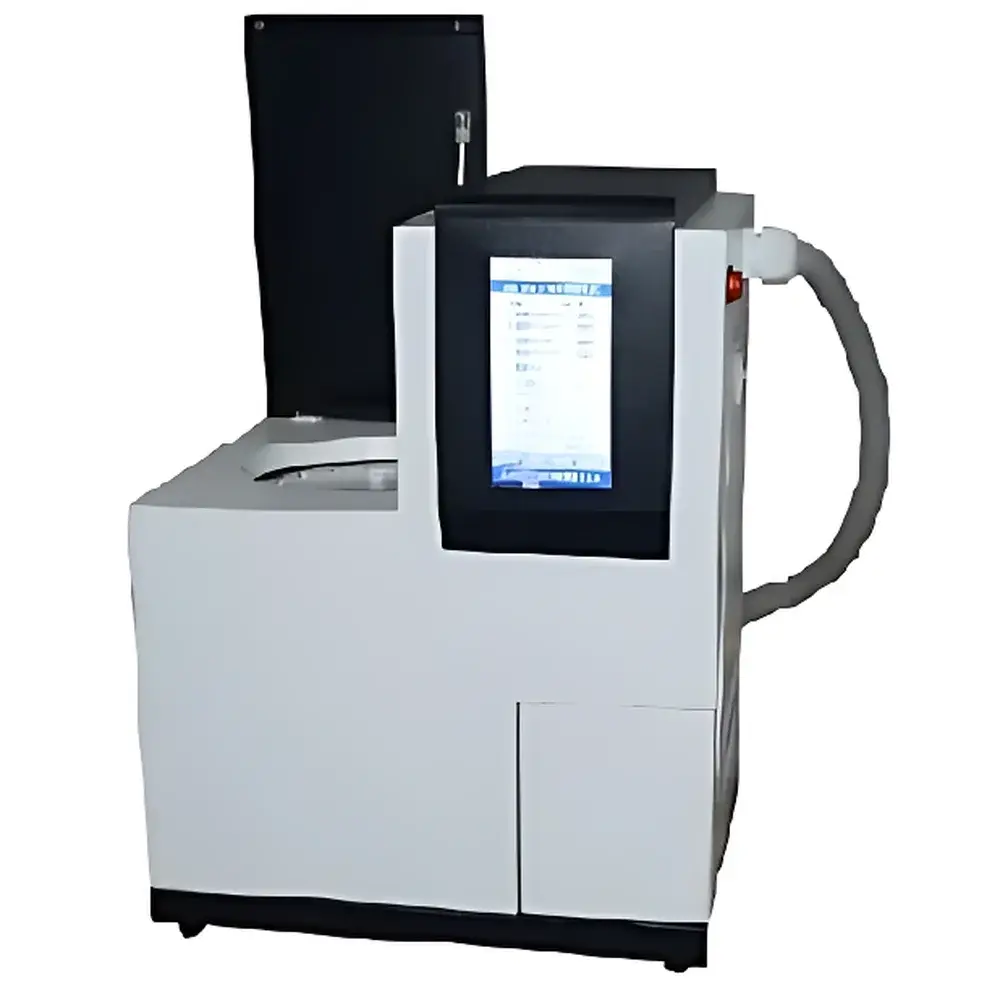
Beifen Sanpu ATSD-20A Dual-Stage Thermal Desorber with Cryogenic Trap
| Brand | Beifen Sanpu |
|---|---|
| Origin | Beijing, China |
| Manufacturer Type | Direct Manufacturer |
| Instrument Type | Dual-Stage Thermal Desorber / Thermal Desorption Unit |
| Model | ATSD-20A |
| Sample Capacity | 20 positions |
| Primary Desorption Temperature Range | Ambient to 400 °C |
| Secondary Desorption Temperature Range | 100–400 °C |
| Cold Trap Temperature Range | Down to −35 °C |
| Desorption Recovery Rate | >90% |
| Compliance | Designed for ASTM D6196, ISO 16017-1, USP <621>, and EPA TO-17 workflows |
Overview
The Beifen Sanpu ATSD-20A is a fully automated dual-stage thermal desorption system engineered for high-fidelity volatile organic compound (VOC) and semi-volatile organic compound (SVOC) analysis in environmental air, occupational hygiene, and indoor air quality monitoring applications. It operates on the principle of two sequential thermal desorption stages: primary desorption releases analytes from sorbent tubes under controlled heating and inert gas flow, followed by cryofocusing in a low-temperature trap (down to −35 °C), and secondary desorption delivers a narrow, solvent-free analyte band directly into the gas chromatograph (GC) inlet. This two-step process significantly enhances sensitivity, peak shape symmetry, and quantitative reproducibility—particularly critical for trace-level analysis of polar, reactive, or thermally labile compounds. The system integrates precise temperature zoning across four independently controlled zones (primary desorption chamber, transfer line, valve oven, and secondary desorption/focusing zone), ensuring minimal thermal degradation and optimal analyte integrity prior to GC separation.
Key Features
- Fully automated 20-position sample carousel enables unattended batch processing—ideal for high-throughput laboratories performing routine EPA TO-17, ISO 16017-1, or ASTM D6196 compliance testing.
- Self-diagnostic startup sequence with real-time fault detection, audible/visual alerts, and patented automatic sample tray positioning and calibration—reducing operator dependency and minimizing alignment-related carryover.
- Four-zone independent temperature control: primary desorption (ambient–400 °C), secondary desorption (100–400 °C), valve oven, and transfer line—each programmable with ±0.5 °C accuracy and ramp rate control.
- Cryogenic cold trap utilizing electronic Peltier cooling (−35 °C minimum) enables sharp focusing of desorbed analytes, resulting in narrow chromatographic peaks and improved resolution for co-eluting compounds.
- Integrated sample tube activation protocol: automatically heats and purges used or new sorbent tubes under controlled carrier gas flow—eliminating manual off-line conditioning and ensuring consistent tube performance.
- Time-programmable multi-step sequence including primary desorption, purge, cryo-trapping, secondary desorption, GC injection, and post-run transfer line/valve backflush—fully customizable via intuitive touchscreen interface.
- Dual-configurable secondary desorption architecture: supports both ambient-temperature and cryo-enhanced secondary desorption modules, allowing method flexibility for diverse analyte volatility profiles.
- GC synchronization capability: triggers external GC start commands via TTL or contact closure; also accepts external trigger signals for instrument coordination within integrated analytical workflows.
Sample Compatibility & Compliance
The ATSD-20A accommodates standard 1/4″ OD stainless steel or quartz sorbent tubes (e.g., Tenax TA, Carbopack B/C, Carboxen 1000) and is compatible with legacy and modern sampling media per EPA Method TO-17 specifications. Its design supports GLP-compliant operation through audit-trail-capable method storage, user-access logging, and parameter versioning. The system meets mechanical and thermal stability requirements outlined in ISO/IEC 17025 for accredited testing laboratories and aligns with data integrity expectations under FDA 21 CFR Part 11 when deployed with validated software configurations. Optional fused silica transfer lines minimize adsorption of polar analytes, while configurable inlet adapters ensure seamless integration with Agilent, Thermo Fisher, Shimadzu, and PerkinElmer GC systems.
Software & Data Management
Controlled via a 7-inch capacitive touchscreen HMI running embedded Linux, the ATSD-20A provides real-time graphical animation of thermal zones, gas flow status, and method progression. All methods—including temperature ramps, timing sequences, and GC synchronization logic—are stored locally with timestamped revision history. Exportable CSV logs capture desorption efficiency metrics, cold trap performance, and system diagnostic events. For enterprise integration, optional Ethernet/IP communication enables remote monitoring and centralized method deployment across multi-instrument networks. Software architecture supports IQ/OQ documentation packages and facilitates validation against GMP/GLP environments when paired with qualified chromatography data systems (CDS).
Applications
- Regulatory air monitoring: ambient, stack, and workplace air analysis per EPA TO-17, ISO 16017-1, and EN 16755.
- Indoor air quality (IAQ) assessment: formaldehyde, benzene, toluene, xylene (BTX), and C2–C12 aliphatic/aromatic hydrocarbons.
- Material emission testing: VOC release from building products, automotive interiors, and polymer composites (ASTM D5116, D6886).
- Forensic and flavor/aroma profiling: trace-level volatile characterization in complex matrices without solvent introduction.
- Method development labs requiring flexible thermal desorption parameters for optimizing recovery of reactive species (e.g., acrolein, hydrogen sulfide, terpenes).
FAQ
What sorbent tube formats are supported?
Standard 1/4″ OD stainless steel or quartz-packed tubes (60–120 mm length); custom tube holders available upon request.
Does the system support method validation for regulated environments?
Yes—designed to support IQ/OQ protocols; full traceability of temperature setpoints, timing events, and system diagnostics enables compliance with 21 CFR Part 11 when used with validated CDS.
Can the cold trap temperature be verified and calibrated?
The Peltier cooling module includes a calibrated PT100 sensor with NIST-traceable verification points at −10 °C, −20 °C, and −35 °C.
Is remote operation or network integration possible?
Ethernet connectivity enables remote status monitoring, method upload/download, and alarm notification via SNMP or HTTP API (optional firmware module).
How is carryover minimized between samples?
Automated backflush of the transfer line and six-port valve using high-purity helium or nitrogen occurs after each injection; combined with cryo-trap regeneration and tube purging, typical carryover is <0.1% for target VOCs.
Related Products





