
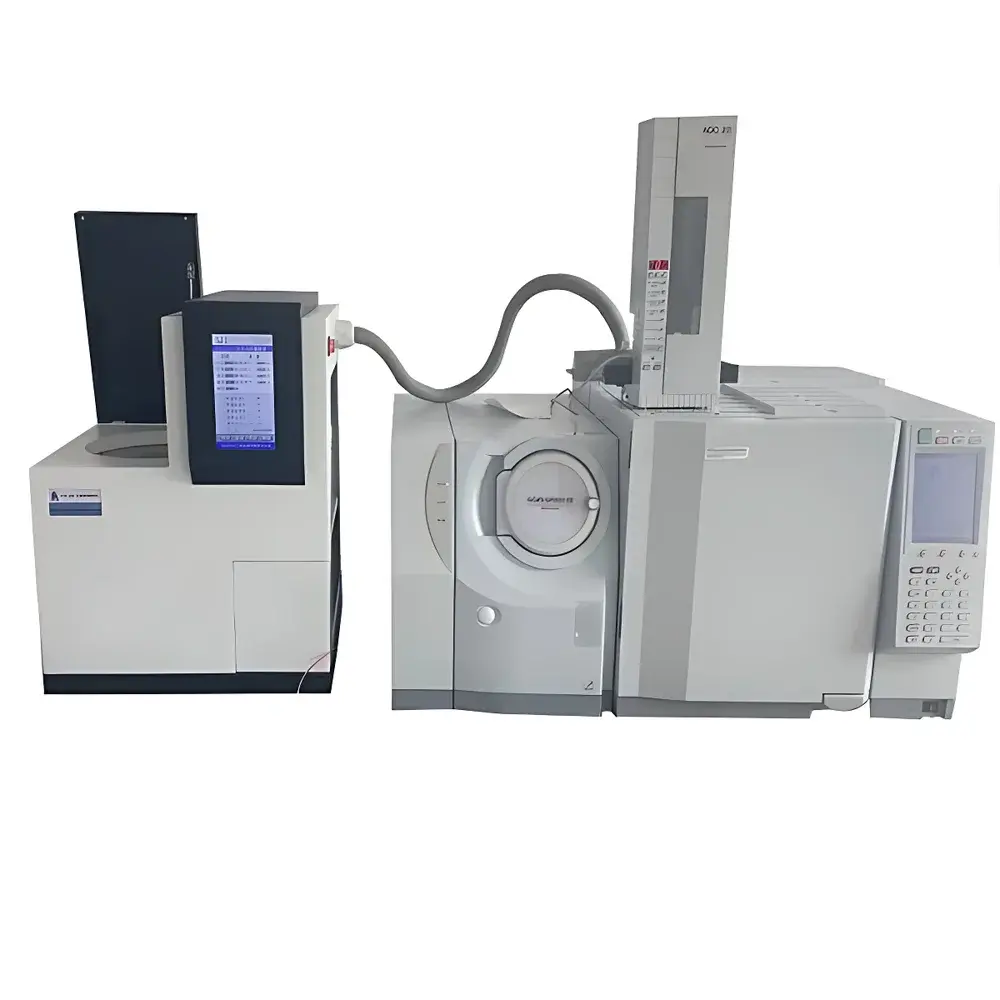
Beifen Sanpu ATTDS-20A Low-Temperature Cryo-Focused Automated Dual-Stage Thermal Desorber
| [Brand | Beifen Sanpu |
|---|---|
| Origin | Shanghai, China |
| Manufacturer Type | Original Equipment Manufacturer (OEM) |
| Instrument Type | Dual-Stage Thermal Desorber |
| Primary Desorption Temp Range | Ambient to 450 °C |
| Secondary Desorption Temp Range | 100–450 °C |
| Cryotrap Temp Range | −35 °C to Ambient |
| Desorption Recovery Rate | >99% (compound-dependent) |
| Sample Capacity | 20 positions |
| Cold Trap Cooling Method | Solid-State Electronic Refrigeration |
| Temperature Control Precision | ±0.5 °C |
| RSD | ≤2.5% (for 0.05 μg benzene in methanol) |
| Sample Tube Format | 1/4″ OD × 3.5″ (ASTM D6196-compliant) |
| Valve Actuation | Motor-Driven 6-Port Rotary Valve |
| GC Interface | Universal low-diffusion interface compatible with Agilent, Thermo, Shimadzu, and PerkinElmer GC/GC-MS systems] |
Overview
The Beifen Sanpu ATTDS-20A is a fully automated, cryogenically enhanced dual-stage thermal desorber engineered for high-fidelity preconcentration and quantitative transfer of volatile organic compounds (VOCs) from sorbent tubes into gas chromatographic systems. It operates on the principle of two-stage thermal desorption: first, analytes are thermally released from the sorbent matrix under controlled inert gas flow; second, they are refocused onto a cryogenically cooled trap (down to −35 °C) to yield narrow, solvent-free analyte bands prior to rapid flash desorption into the GC inlet. This architecture eliminates solvent dilution, minimizes breakthrough, and maximizes sensitivity—enabling detection at sub-pptv levels in ambient air, indoor air, vehicle cabin, and fixed-source emission matrices per U.S. EPA TO-17, ISO 16017-1, and Chinese national standards including HJ 644–2013, HJ 583–2010, and HJ 734–2014.
Key Features
- Fully automated 20-position sample carousel with programmable sequence execution—no manual intervention required during unattended overnight runs.
- Independent four-zone temperature control: primary desorption oven (ambient–450 °C), secondary desorption zone (ambient–450 °C), valve manifold (ambient–300 °C), and transfer line (ambient–300 °C), all with ±0.5 °C stability and 1 °C resolution.
- Integrated solid-state cryogenic trap capable of sustained operation at −35 °C, enabling sharp band focusing without liquid nitrogen or mechanical compressors.
- Motor-driven 6-port rotary valve with low-dead-volume design ensures precise timing, minimal carryover, and reproducible injection volumes.
- Automated tube conditioning module with configurable bake-out protocols (up to 450 °C) for post-analysis reactivation of Tenax®, Carbopack™, and multi-bed sorbent tubes.
- Onboard calibration functionality: built-in simulated sampling mode with adjustable flow (0–160 mL/min) and permeation-based standard generation for direct working curve construction.
- GC synchronization support via TTL, RS-232, or Ethernet—compatible with major GC data systems (OpenLab, Chromeleon, GCMSsolution, TurboMass) for full audit-trail compliance.
- Self-diagnostic startup routine with real-time fault logging, automatic tray position calibration, and error-code display on 7-inch capacitive touchscreen interface.
Sample Compatibility & Compliance
The ATTDS-20A accepts standard 1/4″ OD × 3.5″ stainless steel or quartz sorbent tubes compliant with ASTM D6196 and ISO 16017-1 dimensional specifications. It supports single- and multi-bed sorbents (e.g., Tenax TA, Carbopack B/C, Graphitized Carbon Black) and accommodates both passive and active sampling configurations. The system meets critical regulatory requirements for environmental VOC analysis, including full alignment with HJ 644–2013 (GC-MS method for ambient air VOCs), HJ 734–2014 (fixed-source emissions), and GB/T 18883–2002 (indoor air quality). All temperature and timing parameters are logged with timestamps and user ID, satisfying GLP/GMP documentation needs and supporting FDA 21 CFR Part 11–compliant electronic records when integrated with validated chromatography data systems.
Software & Data Management
The ATTDS-20A is controlled via an embedded Linux-based firmware with intuitive touch interface and hierarchical method editor. Users define complete thermal desorption sequences—including primary desorption time/temp, cold trap hold time, secondary desorption ramp rate (>3000 °C/min), and backflush parameters—with up to 99 customizable methods stored onboard. All method files and run logs (including temperature profiles, valve actuation events, and error flags) are exportable as CSV or XML. Remote monitoring and method push/pull are supported over TCP/IP, enabling centralized instrument fleet management. When paired with compliant GC software, the system generates full electronic audit trails, including operator login history, parameter change logs, and digital signatures—essential for ISO/IEC 17025-accredited laboratories.
Applications
- Regulatory monitoring of ambient and indoor air VOCs (BTEX, aldehydes, terpenes, halogenated solvents) per HJ 644–2013 and ISO 16017-1.
- Occupational exposure assessment in industrial hygiene settings using NIOSH/OSHA-specified sorbent tubes.
- Vehicle cabin air quality evaluation per HJ/T 400–2007, including formaldehyde and acetaldehyde quantification.
- Building material emission testing (e.g., carpets, adhesives, paints) aligned with GB 50325–2020 and ISO 16000 series.
- Fixed-source stack testing for aromatic and chlorinated VOCs per HJ 734–2014 and EPA Method TO-17.
- Method development and validation studies requiring high recovery (>99%), low RSD (≤2.5%), and trace-level reproducibility.
FAQ
What sorbent tube formats does the ATTDS-20A support?
It accepts standard 1/4″ OD × 3.5″ metal or quartz tubes meeting ASTM D6196 dimensions, including single- and multi-bed configurations.
Is the cryotrap cooled with liquid nitrogen or an electronic system?
The unit employs solid-state Peltier cooling—no LN₂, no moving parts, and stable −35 °C operation with <1 °C drift over 8-hour runs.
Can it be integrated with third-party GC or GC-MS systems?
Yes—via TTL trigger, RS-232, or Ethernet; includes hardware adapters for Agilent, Thermo, Shimadzu, and PerkinElmer instruments.
Does the system support 21 CFR Part 11 compliance?
When operated with validated chromatography data systems, its full audit trail (user logins, parameter changes, run logs) satisfies electronic record and signature requirements.
What is the typical recovery for polar VOCs such as formaldehyde or acetaldehyde?
Recovery exceeds 90% for most C2–C12 VOCs; formaldehyde requires derivatization (e.g., DNPH cartridges) prior to thermal desorption—this unit supports offline derivatization tube handling.







