
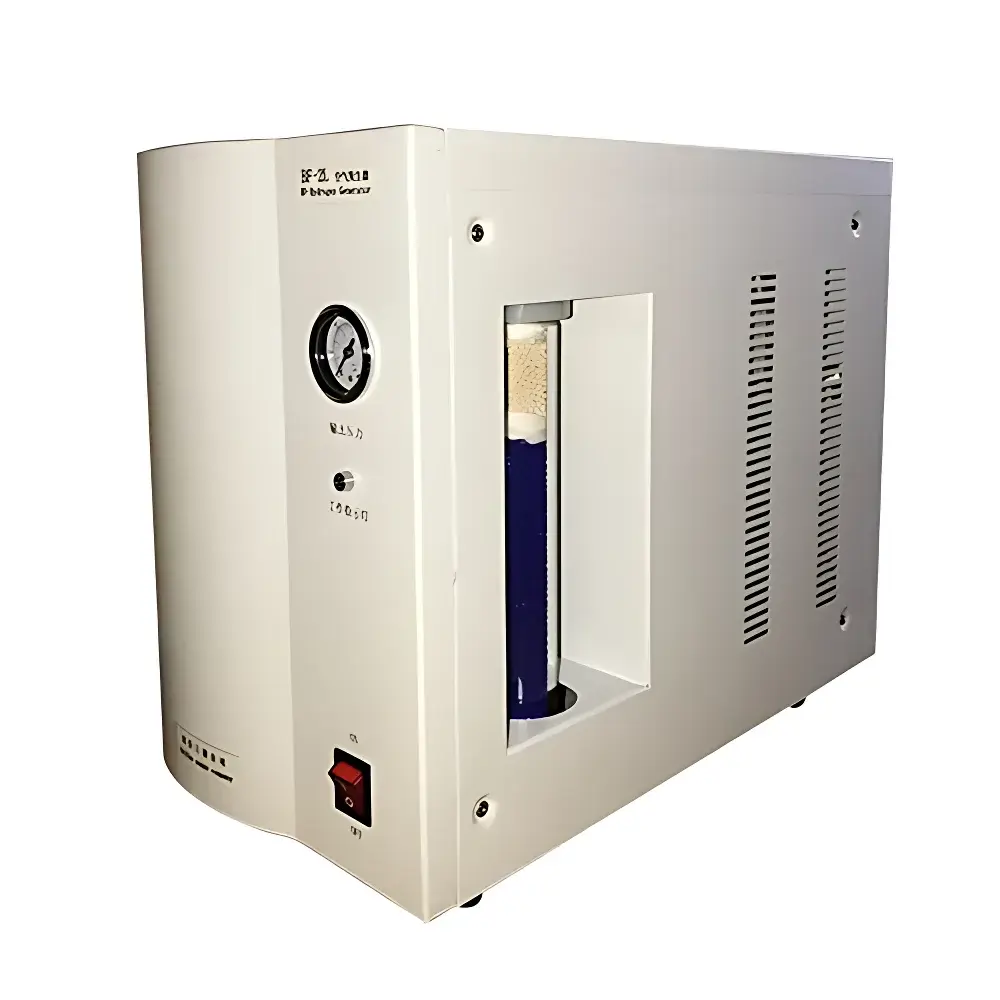
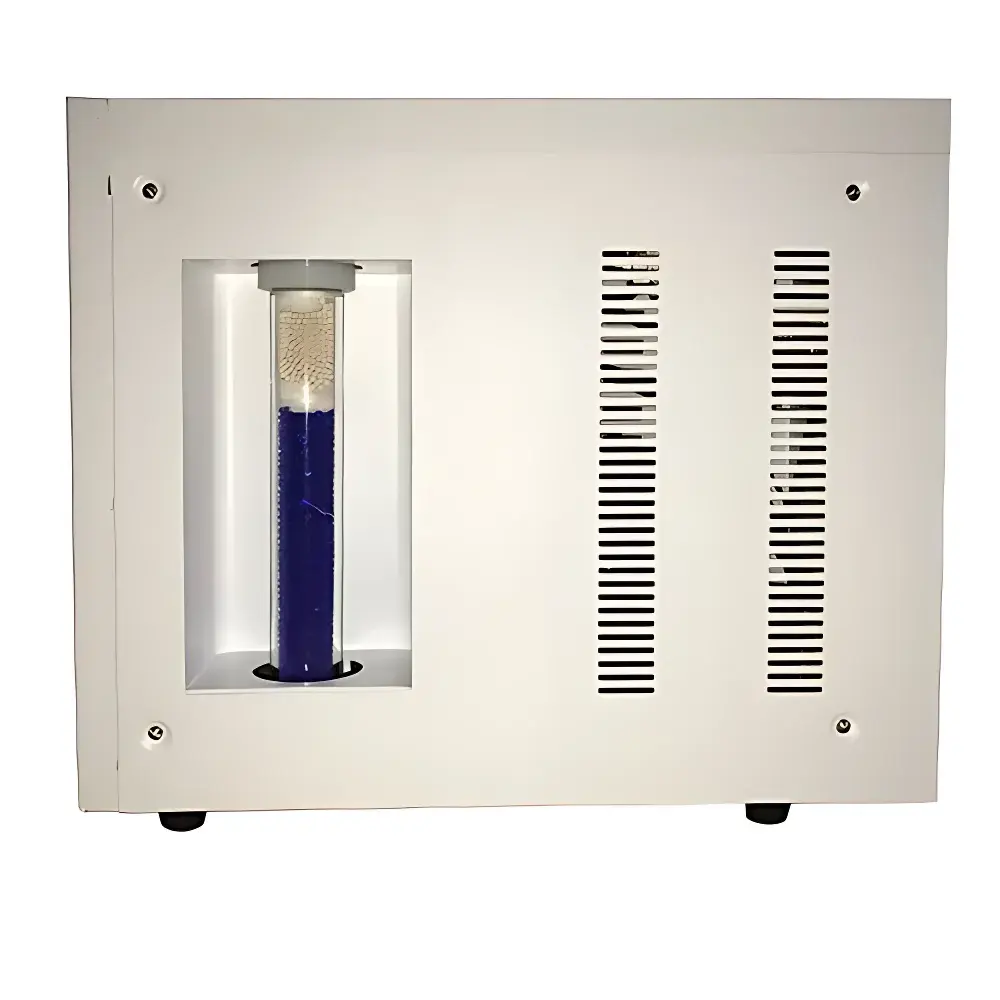
Beifen Sanpu BF-2L Air Generator
| Brand | Beifen Sanpu |
|---|---|
| Origin | Beijing, China |
| Manufacturer Type | Direct Manufacturer |
| Product Category | Domestic |
| Model | BF-2L |
| Price Range | USD 1,400 – 7,000 (est.) |
| Hydrocarbon Removal Principle | Catalytic Cracking |
| Output Flow Rate | 0–300 mL/min |
| Output Pressure | 100 psi (6.9 bar) |
| Total Hydrocarbon Content | ≤0.1 ppm (as methane equivalent) |
| Dew Point | −10 °C |
| Noise Level | ≤42 dB(A) |
| Input Voltage | AC 220 V, 50 Hz |
| Rated Power | 150 W |
| Weight | 23 kg |
| Dimensions (L×W×H) | 490 × 240 × 380 mm |
| Operating Ambient Temperature | 15–40 °C |
| Relative Humidity | <70% RH (non-condensing) |
| Air Purity Grade | Oil-free, Triple-stage Purified Air |
Overview
The Beifen Sanpu BF-2L Air Generator is an engineered solution for laboratories requiring a continuous, reliable, and ultra-pure source of compressed air for analytical instrumentation—including gas chromatography (GC), GC–MS, flame ionization detectors (FID), nitrogen–phosphorus detectors (NPD), and other air-dependent analytical systems. Unlike conventional high-pressure cylinder-based supply methods, the BF-2L employs an integrated air compression and purification architecture based on oil-free diaphragm pumping, followed by catalytic cracking for hydrocarbon removal and multi-stage desiccant and coalescing filtration. This ensures consistent delivery of instrument-grade air meeting stringent purity requirements for trace-level analysis. Designed specifically for integration into modern analytical workflows, the BF-2L delivers stable output at up to 100 psi (6.9 bar) with flow control across 0–300 mL/min—optimized for low-flow detector support and auxiliary air applications in compact laboratory environments.
Key Features
- Oil-free diaphragm compressor core eliminates risk of oil contamination—critical for sensitive detectors and long-term column integrity.
- Catalytic cracking technology reduces total hydrocarbons to ≤0.1 ppm (as CH4), satisfying ASTM D6216 and ISO 8573-1 Class 1.2.1 requirements for hydrocarbon content in instrument air.
- Triple-stage purification system: particulate filtration (0.01 µm), activated carbon adsorption, and molecular sieve desiccation—achieving a dew point of −10 °C and removing water, oil vapor, and volatile organics.
- Dual-stage pressure regulation ensures stable output pressure with minimal fluctuation (<±0.5 psi), enhancing reproducibility in pneumatic control loops.
- Integrated safety architecture includes over-pressure relief valve, automatic condensate drain port, thermal cut-off, and real-time pressure monitoring—fully compliant with IEC 61010-1 for laboratory electrical equipment safety.
- Low-noise operation (≤42 dB[A]) enables placement inside analytical labs or near workbenches without acoustic interference.
- Compact footprint (490 × 240 × 380 mm) and lightweight design (23 kg) support benchtop deployment and flexible integration with GC ovens, autosamplers, or centralized gas distribution manifolds.
Sample Compatibility & Compliance
The BF-2L is validated for use with all major GC and GC–MS platforms requiring clean, dry, hydrocarbon-free air—including Agilent, Thermo Fisher Scientific, Shimadzu, PerkinElmer, and Waters instruments. Its purified air output meets critical specifications outlined in USP General Chapter <467> for residual solvents testing, as well as ASTM D6216 (Standard Specification for Compressed Air Used in Gas Chromatography) and ISO 8573-1:2010 Class 1.2.1 (compressed air purity classes). The unit is designed for ambient lab conditions (15–40 °C, <70% RH, non-corrosive, low-dust environment) and does not require external cooling or ventilation ducting. It is not intended for medical, breathing-air, or industrial process applications.
Software & Data Management
The BF-2L operates as a standalone, microprocessor-controlled device with no embedded software interface or digital connectivity. All operational parameters—including pressure, flow status, and thermal protection states—are indicated via front-panel LED indicators and mechanical gauges. While it lacks USB/Ethernet ports or remote monitoring capability, its deterministic behavior and passive diagnostics align with GLP/GMP environments where audit-trail simplicity and hardware-level reliability are prioritized over feature-rich firmware. Maintenance logs (e.g., filter replacement dates, pressure calibration records) are maintained manually per laboratory SOPs, supporting FDA 21 CFR Part 11 compliance when paired with documented procedural controls.
Applications
- Carrier gas makeup air for FID, NPD, and ECD detectors in gas chromatography.
- Auxiliary air supply for GC–MS ion sources and vacuum system purge lines.
- Instrument air for pneumatic actuators in autosamplers, valve boxes, and pressure-controlled columns.
- Primary air source for portable or benchtop GC systems deployed in QA/QC, environmental, pharmaceutical, and petrochemical laboratories.
- Replacement for high-pressure air cylinders in regulated environments seeking reduced storage hazards, inventory overhead, and supply-chain dependency.
FAQ
What is the recommended maintenance schedule for the BF-2L?
Filter cartridges (particulate, carbon, and desiccant) should be replaced every 6–12 months depending on ambient humidity and usage frequency. The catalytic cracking module has a typical service life of ≥2 years under normal operating conditions.
Can the BF-2L be used with nitrogen generators as an air feed source?
Yes—the BF-2L’s 100 psi output is compatible with the air input requirements of most membrane- and PSA-based nitrogen generators, including those requiring 0.4–0.5 MPa (58–73 psi) inlet pressure.
Is the BF-2L certified for use in explosion-proof areas?
No. The unit is rated for general laboratory use only and does not carry ATEX, IECEx, or UL Class I Division 2 certification.
Does the BF-2L require external drainage or plumbing?
No. Condensate is collected internally and discharged manually via the rear-mounted drain valve—no permanent plumbing or floor drain connection is required.
How does the BF-2L compare to larger-capacity models such as the BF-5L?
The BF-2L is optimized for single-instrument or low-flow applications (≤300 mL/min); the BF-5L supports higher aggregate demand (up to 5 L/min) and is suited for multi-instrument labs or centralized air distribution systems.



